
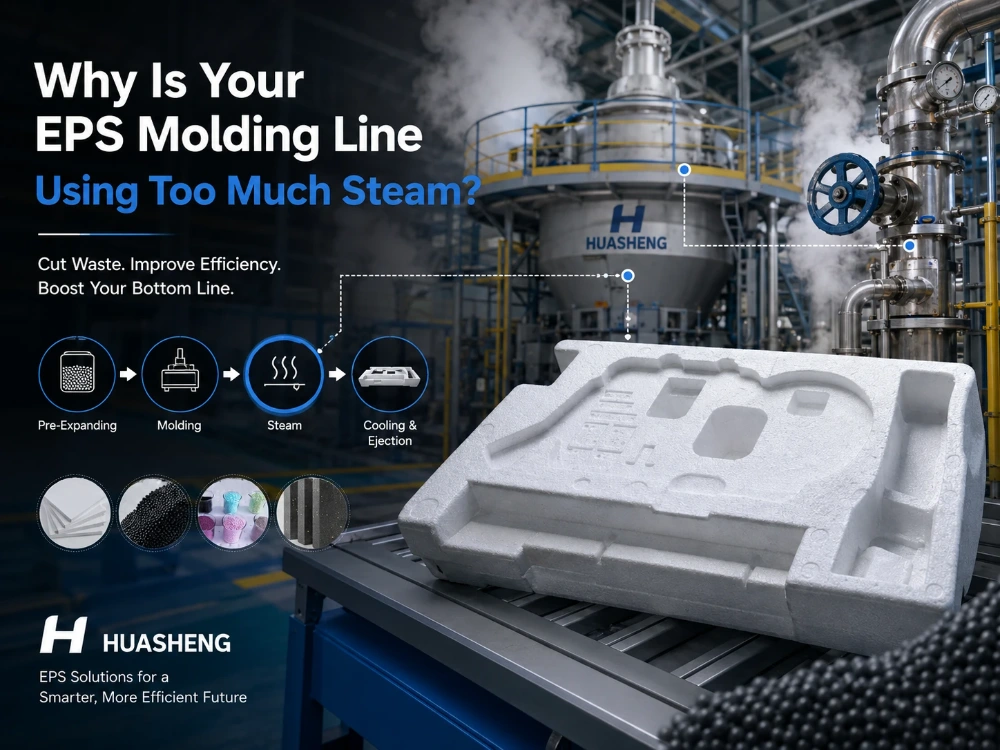
High EPS steam consumption usually comes from several small losses working together, not one obvious boiler problem. The pre-expander may be using more steam than necessary to reach density. Mold pressure may be unstable. Condensate may be slowing heat transfer. Operators may over-steam weakly filled molds to recover fusion. A material grade may also require a wider processing window than the line was designed around.
That is why EPS production energy consumption should be traced stage by stage.
Before changing the boiler, factories should separate EPS pre-expander steam consumption from EPS molding machine steam consumption and then check what each kilogram of steam is actually doing.
Where Does an EPS Line Use Steam?
Steam is mainly needed to expand raw beads and then heat them again during molding so neighboring particles fuse.
Why Does Pre-Expansion Need Steam?
In the pre-expander, heat softens the polystyrene and vaporizes the internal blowing agent. The bead grows and density falls.
EPS pre-expander steam consumption therefore depends on target density, bead formulation, incoming material temperature, machine design, batch size, pressure control, and how consistently the chamber retains heat.
If the factory targets an unnecessarily low density, it may spend more steam and create a bead that is less suitable for the final product.
The first question should always be: what finished density does the application actually need?
Why Does Molding Need Steam Again?
During molding, pre-expanded beads fill the cavity and are heated until their surfaces soften and fuse together.
EPS molding machine steam consumption depends on mold size, part thickness, bead condition, filling uniformity, steam routing, condensate removal, mold temperature, and target fusion.
A large block machine and a small packaging shape machine should not be compared using one consumption number.
Is High EPS Molding Steam Pressure the Real Problem?
Not always.
Pressure needs to be high enough to deliver suitable heat, but raising it blindly can increase waste without improving the product.
Why Does Stable Pressure Matter More Than Maximum Pressure?
EPS molding steam pressure should reach the mold consistently.
If line pressure fluctuates, operators often compensate with longer heating times. That can increase EPS steam consumption even if the nominal pressure appears acceptable.
Measure pressure at the boiler, distribution line, machine inlet, and where practical within the process.
A stable lower setting that completes fusion can be more efficient than a high nominal setting that fluctuates.
What Happens When Steam Distribution Is Uneven?
If one side of a mold receives steam easily while another side heats slowly, operators tend to extend the complete steaming step until the weakest zone fuses.
The well-heated areas then receive unnecessary energy.
Check blocked vents, steam paths, valves, mold channels, drainage, and cavity geometry before increasing time globally.
This is particularly important with large parts or molds containing thick and thin sections.
Why Does Condensate Increase Steam Use?
Steam transfers heat effectively when it condenses at the right location. But accumulated condensate in lines or molds can obstruct steam flow and reduce heating efficiency.
What Should the Factory Check?
Look at steam traps, drainage slopes, separators, valve condition, low points, insulation, and whether cold equipment is producing excessive startup condensate.
A poorly insulated distribution line can also consume steam before the energy reaches the EPS machine.
If steam use rises across every mold at the same time, the distribution system deserves attention.
If only one mold becomes inefficient, the problem is more likely local.
Can Warm-Up Loss Be Reduced?
Yes, particularly on lines with frequent stops.
Repeatedly heating a cold machine, mold, and piping system consumes energy without producing parts.
Production scheduling that groups similar jobs can sometimes reduce unnecessary reheating. Maintenance and changeover planning also matter.
EPS production energy consumption is therefore partly a production-management issue, not only a machine-setting issue.
Can Raw Material Increase EPS Steam Consumption?
Yes. Material behavior affects how much steam the operator needs to achieve density and fusion.
Why Does Bead Flow Matter?
If expanded beads do not fill the cavity evenly, some zones contain poorer bead contact.
Operators may respond by applying more steam to force fusion, even though the underlying issue is filling.
A grade with stable particle size and good expanded-bead flow can reduce this pressure to over-process the mold.
For appliance, ceramic, fish-box, produce-box, float, craft, and general packaging production, HUASHENG B Rapid Prototyping Grade combines uniform bead size, good flow, short curing, fast demolding on automatic machines, higher vacuum-cooling efficiency, good fusion, and high impact resistance.
Why Does Curing Condition Matter?
Pre-expanded beads that have not reached a suitable molding condition can behave differently inside the mold.
The operator may see poor filling or fusion and compensate with longer heating.
That extra steam does not necessarily solve the real cause.
Check pre-expanded density, curing time, silo condition, bead temperature, and lot consistency before extending the molding steam cycle.
How Can a Factory Measure EPS Molding Machine Steam Consumption?
A total monthly boiler bill is not enough.
Why Should Consumption Be Normalized?
Compare steam per accepted unit, per cubic meter of product, per kilogram of molded product, or per machine cycle where that metric makes sense.
Then separate startup, idle, pre-expansion, block molding, shape molding, and other users.
This allows the factory to see whether a “high-consumption” machine is actually processing a larger or denser product.
EPS molding machine steam consumption should always be connected to output.
What Should Be Recorded During a Trial?
For one stable product, record raw-material grade, target density, pre-expansion conditions, chamber or machine pressure, heating time, mold temperature where available, cycle time, scrap, and finished fusion.
Then make one change at a time.
Without a baseline, energy-saving adjustments can reduce steam while quietly increasing scrap or weak fusion.
Can a Different EPS Grade Reduce Energy Use?
Sometimes.
The right material can shorten processing, but grade selection must still follow final product performance.
When Is a Faster Grade Useful?
If a packaging line is limited by curing, fusion, or release time, a material designed for automatic molding may give the factory a wider path to stable output.
For building and industrial insulation, HUASHENG FSH European Standard Flame Retardant Grade combines uniform foaming, fast curing, good steam penetration, improved fusion, low processing energy consumption, and high production efficiency. Its compressive strength is more than 20% higher than other HUASHENG grades, and it is designed for B1 applications.
That combination matters because saving steam by under-processing a board is not a real efficiency gain.
Why Should Product Quality Stay in the Energy KPI?
Energy per molded unit can fall while total cost rises if rejects increase.
Track density, fusion, dimensional stability, appearance, and cycle yield alongside steam.
The useful KPI is energy per accepted product.
Factories looking across different molding and insulation requirements can compare HUASHENG EPS grades for production efficiency before changing machine parameters around an unsuitable raw material.
What Should a Steam-Reduction Trial Look Like?
Choose one stable product and one machine.
Establish the current EPS steam consumption, then inspect pre-expansion, distribution pressure, valves, condensate, mold routing, heating time, cooling, and raw-material condition.
Change one item and measure the result over enough cycles to remove operator and startup noise.
If steam drops but density, fusion, dimensions, or cycle yield move outside target, reverse the change.
The aim is not the smallest steam number. It is the lowest repeatable EPS production energy consumption that still produces an accepted part.
Conclusion
High EPS steam consumption is usually a process-chain problem.
EPS pre-expander steam consumption can rise when density targets, material condition, or chamber control are poor. EPS molding machine steam consumption can increase because of unstable EPS molding steam pressure, blocked steam paths, condensate, heat loss, uneven filling, or excessive heating used to compensate for another defect.
Factories should therefore measure steam by stage and by accepted output.
Once pressure stability, drainage, mold distribution, material behavior, curing, and product quality are connected in one baseline, energy reduction becomes much safer. The goal is not to starve the EPS line of steam. It is to stop paying for steam that does not improve the finished product.
FAQs
Q1: What causes high EPS pre-expander steam consumption?
A1: Common causes include an unnecessarily low target density, unstable steam pressure, poor chamber control, cold incoming material, heat loss, inconsistent raw beads, and inefficient batch operation. Measure density and steam together before changing settings.
Q2: Does higher EPS molding steam pressure improve fusion?
A2: Not automatically. Adequate and stable pressure is necessary, but excessive pressure or heating time can waste energy. Poor filling, blocked steam paths, condensate, or unsuitable bead condition may be the real reason fusion is weak.
Q3: What is the best way to reduce EPS production energy consumption?
A3: Measure energy by production stage, establish a stable baseline, fix distribution and condensate losses, verify material and density targets, and change one parameter at a time while tracking finished-product quality and rejection rate.
 English
  German
  Spanish
  French
  Arabic