
Returns ledger, quarter 3, upholstered range: 46 claims. Twenty-one corner crush. Fourteen scuffs on finished tops. Seven water marks. Four hardware bags loose.
The pack had not changed in three years. The route had: two extra transfer hubs, a longer rail leg, and cartons stacked four high instead of three.
Where the 46 Claims Came From
The 21 crushed corners
All 21 came off pallets where the 30 mm corner block had moved 10-15 mm out of position before it engaged. The block was placed by eye at the plant and held only by strapping. Pattern on the furniture: crushed corner, cracked lacquer, panel behind it intact.
The 1.9 m sideboard produced 9 of those 21 claims. Its corner radius is the tightest in the range, so a block sitting 12 mm off the profile takes the hit on one edge instead of across the corner.
The 14 scuffs, 7 water marks and 4 loose bags
The 14 scuffs ran along the top face of cabinets, all in the direction of travel. That range travels 900 km by road and rail to its main market. The unit rocked inside the carton against the wrap for the whole leg.
The 7 water marks sat on solid wood tops. Those cartons were loaded warm, moved through a cold leg, then re-stacked in a warehouse at 70% humidity for 11 days. Four cartons arrived with the hardware bag loose.
Floor 3 of that warehouse holds 11 days of stock at 70% humidity, and cartons sit there through two weekends.
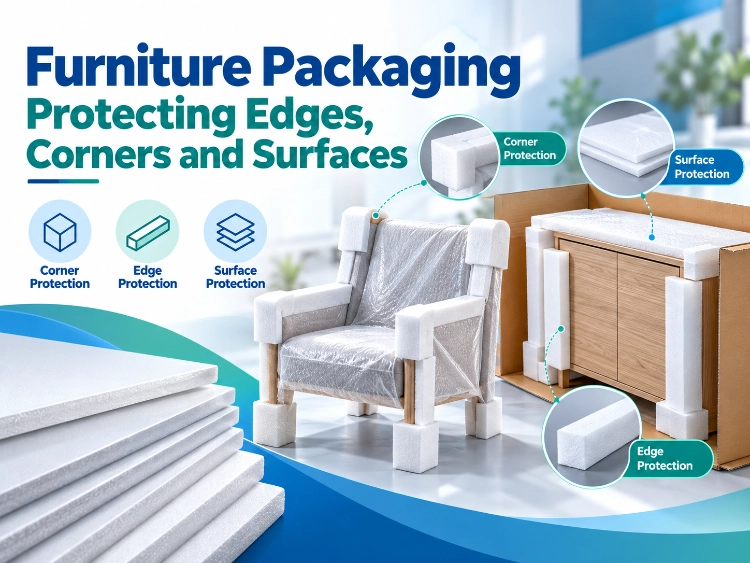
Where a range ships in volume, the EPS packaging product range carries the foam parts for corner, edge and surface protection. A unit needing its own internal set runs through the custom moulded foam service.
What Each Part Does
Blocks, wraps and where each one lands
A wrap handles light contact across a face. The 30 mm block handles the direct corner hit and keeps strapping off the lacquer. On the 21 claims the block did the right job in the wrong place: it travelled 12 mm before it took any load.
The rebuilt sideboard uses a block moulded to the profile. It sits on the drawing position and takes the load across the corner instead of on one edge. Density decides the behaviour at that corner. The soft block on the old pack deformed and stayed deformed. The denser block on the rebuilt pack held and passed the energy into the frame underneath.
Two block densities were quoted for that corner. The soft one deformed under a 40 kg side panel at the corner and stayed deformed after the drop. The denser one held its shape and passed the load into the frame, and the frame is what the panel sits on.
Fit, restraint and the carton
The 14 scuffs and the 4 loose bags came from movement inside the carton. The old pack was padded until the carton was full, which restrained nothing. Contact belongs at the frame, the base and the corners, with clearance wherever a lacquer face could touch.
Cartons stacked four high instead of three carried an extra unit of weight each. The bottom cartons deformed enough to let the internal parts shift. Carton grade belongs in the pack specification as a condition. The export packaging failure review covers the same failures on long routes.
What the Rebuilt Pack Showed
The sideboard first, then the range
The sideboard went first because it produced 9 of the 21 corner claims. Blocks moulded to the 1.9 m profile. A taped hardware bag. A moisture wrap for the solid wood tops. The first 40 cartons went out on the same route.
Pallet 12 of the first 40 cartons came back with the wrap opened at one corner and the block still square, which told the loader the wrap had been cut at a hub inspection rather than in transit.
The same hub inspection cut the wrap on two other pallets in that consignment. Both arrived with the wrap open and both came through with clean corners.
Claims on the sideboard fell from 9 to 1 over the next quarter. The one return had a block missing at loading, and the loading check caught the same fault on the following pallet. Corner condition, lacquer finish and internal part positions are what that check looks at.
The pack sheet and the arrival check
The approved pack travels as a sheet: unit and hardware, block position and density, wrap type, restraint points, carton grade, closure. New pallets get checked against it before they leave the plant.
The sheet also carries the route: 900 km, two hubs, one rail leg, and the stacking limit of three cartons in the warehouse.
The loading check on that pack is short. Block present and square at all four corners. Wrap closed on four faces. Banding in the three marked positions. Hardware bag taped inside the front rail.
The sideboard pack now runs on two moulded parts, a corner block and a rail pad, and both are ordered against the same drawing revision as the unit itself.
The loading check is four lines on a clipboard, signed by the loader at the pallet. Buyers specifying a pack for a new range can bring the unit and the hardware to HUASHENG for the moulded protection parts.
Conclusion
The 46 claims were 21 crushed corners, 14 scuffs and 7 water marks, and every one started after the carton closed. Blocks in the drawing position take the impact. Foam and interleaving control contact and abrasion. Blocking and bracing stop the furniture working on its own joints. Rebuild one SKU, put block position and restraint points on the pack sheet, and open the first cartons at arrival.
FAQs
Q1: Why does furniture arrive damaged when the carton is undamaged?
A1: Fourteen scuffs and four loose bags came out of cartons that arrived intact. That range rocks 900 km against its wrap. The hardware bag is now taped inside the front rail.
Q2: Is a foam wrap enough to protect furniture corners?
A2: The old pack had a wrap and logged 21 crushed corners. Fourteen of them came off pallets where the block had moved 10-15 mm. The rebuilt block sits on the drawing position.
Q3: How should a furniture pack be verified before a volume order?
A3: One SKU at a time. The 1.9 m sideboard went from nine claims to one over a quarter, and the single return had a block missing at loading. The other nine SKUs followed over the next two quarters. The pack sheet carries the block position and density for each part. The first 40 cartons of that quarter logged no corner claims.
 English
  German
  Spanish
  French
  Arabic