
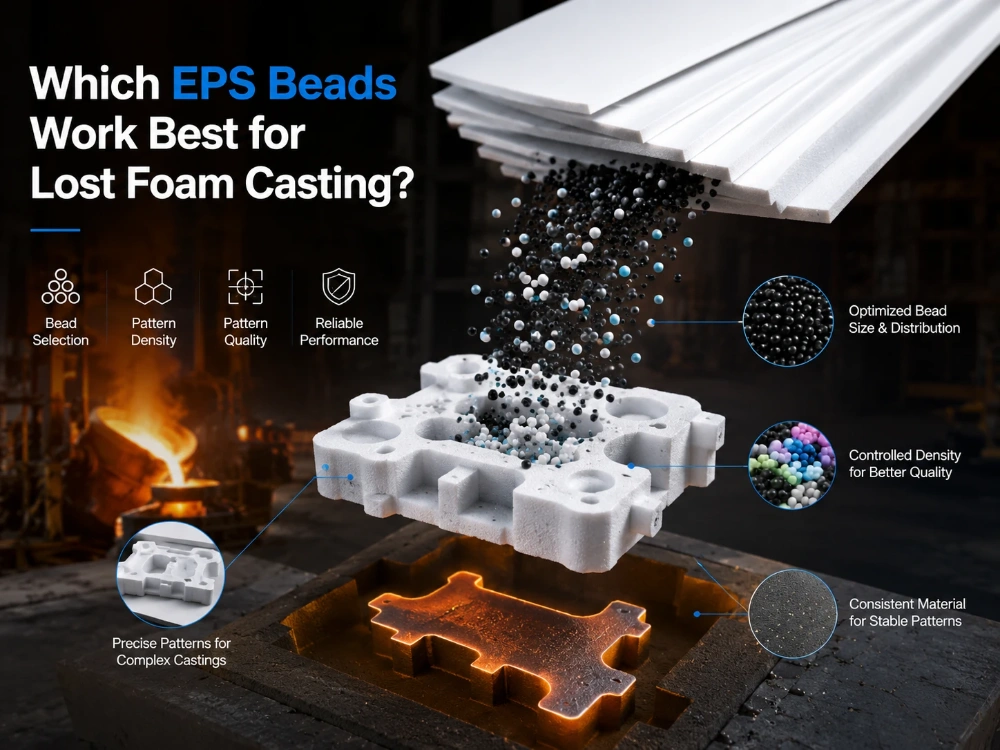
The best EPS beads for lost foam casting are not simply the beads that expand the most or cost the least. A foundry needs a grade that can produce a dimensionally stable EPS foam pattern, fill the required geometry, fuse consistently, survive handling and coating, and then disappear predictably when molten metal enters the mold.
That makes lost foam casting foam a process material rather than ordinary packaging foam. Bead size, expanded density, fusion, pattern thickness, alloy type, molding conditions, and pattern drying all affect whether the casting line gets a clean pattern or spends time chasing folds, misruns, distortion, and surface defects.
For buyers, the right specification should start from the casting rather than from a generic EPS quotation.
Why Does Bead Selection Matter So Much in Lost Foam Casting?
Lost foam casting replaces the foam pattern with molten metal. Every weakness in that pattern can therefore move downstream into the casting process.
The pattern has to be accurate enough to reproduce the required geometry, strong enough to survive handling and sand compaction, yet low enough in density to avoid creating unnecessary decomposition products during pouring.
Why Is Pattern Density a Balancing Act?
Lost foam casting pattern density affects both pattern strength and what happens when the metal front reaches the foam.
A very light pattern may be easier for molten metal to replace, but it can become more vulnerable to distortion, handling damage, or weak surface quality. A denser pattern can be stronger and easier to handle, but there is more polymer for the molten metal to decompose and displace.
That is why foundries should not copy one density from another project without checking the alloy, section thickness, casting geometry, coating, pouring temperature, and pattern strength requirement.
A useful RFQ should state the target lost foam casting pattern density rather than simply asking for “high-expansion EPS.”
What Happens If Bead Fusion Is Uneven?
An EPS foam pattern is built from individual pre-expanded beads that fuse inside the pattern mold.
When fusion is weak, bead boundaries can remain more pronounced. The pattern may shed particles, break at thin areas, or behave inconsistently during coating and handling. In aluminum lost foam work, poor bead fusion can also be associated with visible fold-type defects further downstream.
The pattern should therefore be checked after molding, not just measured for external dimensions. A cut or broken trial pattern can show whether fusion is consistent through thicker and thinner areas.
How Should EPS Bead Size Match the Casting Geometry?

EPS bead size for casting becomes more important as pattern geometry gets smaller, thinner, or more detailed.
Large open patterns can accept a wider bead range than thin ribs, narrow passages, small lettering, or detailed surfaces.
When Are Smaller Beads Useful?
Smaller beads can flow more easily into narrow sections and detailed cavities before final steam molding. That can help the pattern reproduce fine geometry with fewer unfilled areas.
However, “smaller is always better” is not a useful purchasing rule.
Very fine beads still need to expand, age, flow, and fuse correctly. They may require a different processing window from a larger grade. The foundry should therefore treat EPS bead size for casting as one element of the pattern system, not as an isolated quality score.
Why Should the Foundry Test More Than One Particle Range?
A drawing cannot fully predict how a bead will move through the real mold.
A sensible trial compares two suitable particle ranges using the same target density, molding machine, pattern geometry, and inspection method. Check thin-wall filling, surface detail, fusion, dimensional repeatability, and damage during removal.
For general EPS applications including lost foam casting, the HUASHENG E Standard Grade EPS provides several particle specifications from 1.0–1.8 mm down to 0.3–0.8 mm. The grade is compatible with automatic vacuum forming machines, electric-drive forming machines, and traditional lifting hydraulic presses, with fast foaming, short molding cycles, good fusion, dimensional stability, and high strength.
Why Does Pre-Expansion Control Affect Pattern Quality?
Raw EPS beads are not molded directly into the final low-density pattern. They first need controlled pre-expansion.
This is where the target density begins.
Why Is One Density Reading Not Enough?
If the pre-expanded batch contains uneven bead density, the pattern can develop local differences even when its average weight looks acceptable.
Operators should check whether expansion remains repeatable from batch to batch. Steam condition, bead loading, heating time, raw-material condition, and local operating environment can all shift the result.
For EPS beads for lost foam casting, the better production record connects raw-material lot, pre-expanded density, molding conditions, final pattern weight, and casting result.
That record becomes especially valuable when a defect appears weeks later.
How Long Should Expanded Beads Stabilize Before Pattern Molding?
The correct window depends on the bead grade and process.
Pre-expanded beads need time for internal pressure and air exchange to stabilize before molding. If the factory molds too early or holds the material too long under unsuitable conditions, filling and fusion can change.
Instead of adopting one universal curing time, the foundry should validate the working window for its selected grade and density.
HUASHENG’s common-grade EPS range for standard molding applications gives foundries more than one material route when a trial needs different expansion behavior, particle size, or molding response.
Does the Metal Alloy Change the Foam Requirement?
Yes. The foam is exposed to very different thermal conditions when casting aluminum compared with iron or other higher-temperature alloys.
Why Does Foam Decomposition Matter?
The molten metal must replace the EPS foam pattern while liquid and gaseous decomposition products escape through the coating and mold system.
If the pattern is unnecessarily dense, the metal front has more polymer to remove. If the pattern is too weak, it may distort before pouring.
This is one reason lost foam casting foam selection cannot be separated from the foundry’s alloy and coating process.
For ferrous casting, foundries may also need to consider whether standard EPS is the preferred pattern material or whether another expandable polymer system is more appropriate for the targeted surface and carbon-defect requirements.
A raw-material supplier should not tell every foundry that one EPS grade is universally ideal.
What Should a Foundry Put Into an EPS RFQ?
The RFQ should describe the pattern and casting rather than only the bead.
Which Technical Inputs Matter Most?
Provide the alloy family, pattern dimensions, minimum wall thickness, target pattern density, preferred raw-bead range, molding equipment, expected pattern volume, surface requirements, and any recurring defect that the foundry is trying to reduce.
If an existing grade works except in one section of the pattern, provide photos of that section and the current bead specification.
A supplier can then judge whether the issue points toward particle size, expansion, fusion, density, or a process condition.
Why Should Casting Results Be Linked Back to the Bead Lot?
A successful trial is useful only if it can be reproduced.
Retain the raw-material batch number, pattern density, sample pattern, molding conditions, coating condition, and final casting inspection. When several lots are compared, the foundry can separate material variation from mold, coating, sand, or pouring changes.
This is more reliable than replacing EPS every time a casting defect appears.
For projects that need a specific particle range or a different molding window, buyers can send lost foam pattern requirements to HUASHENG with the mold geometry, target density, machine type, and trial quantity before moving to bulk supply.
Conclusion
EPS beads for lost foam casting should be selected around the finished pattern and the casting process, not around a generic bead price.
Lost foam casting pattern density controls a difficult balance between pattern strength and foam decomposition. EPS bead size for casting affects how well detailed cavities fill. Fusion determines whether the EPS foam pattern survives handling and coating consistently. Pre-expansion and stabilization determine whether those results can be repeated from one batch to the next.
A good lost foam casting foam program therefore starts with a controlled trial and ends with a traceable specification. Once particle range, density, molding conditions, and casting results are linked together, the foundry can buy EPS against a proven process instead of restarting material selection with every order.
FAQs
Q1: What EPS bead size is best for lost foam casting?
A1: There is no single best size. The bead range should follow pattern thickness, cavity detail, target density, mold-filling behavior, and the required surface quality. Thin or detailed patterns may benefit from smaller beads, but the choice should be validated through an actual pattern trial.
Q2: Why is lost foam casting pattern density important?
A2: Pattern density affects both handling strength and the amount of polymer that molten metal must replace. A pattern that is too light may distort, while excessive density can make mold filling and decomposition more difficult.
Q3: Can standard EPS foam be used for every lost foam casting?
A3: No. Standard EPS is widely used, but alloy type, casting temperature, carbon-defect sensitivity, pattern geometry, density, and surface requirements can change the preferred material. Foundries should qualify the foam system for each major casting family.
 English
  German
  Spanish
  French
  Arabic