
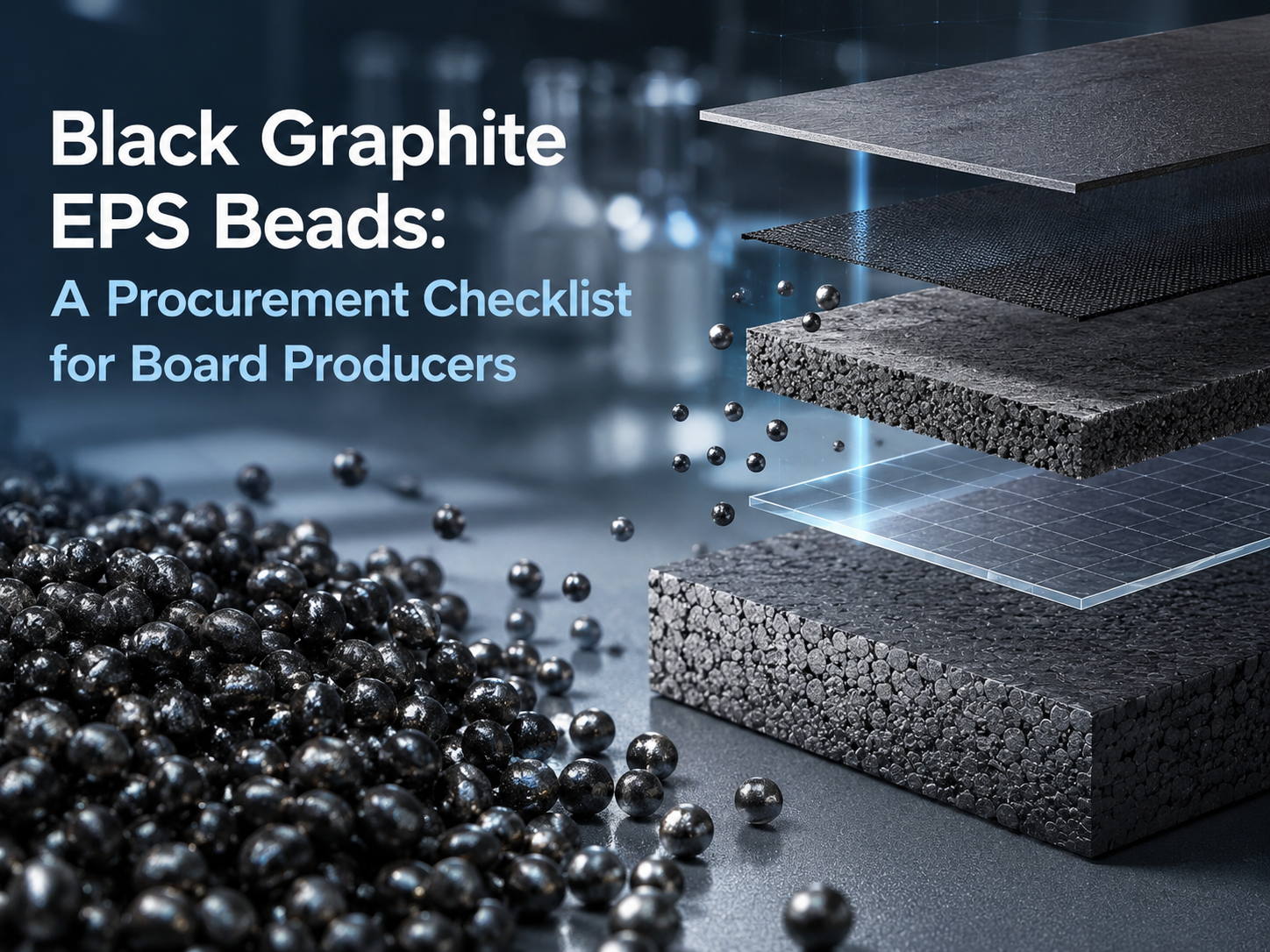
Board producers buying black graphite EPS beads need to verify more than a quotation or a general material claim. This article will set out how to check the finished-board application, target thermal and fire requirements, density and processing fit, sample results, batch consistency, and supplier documents before a bulk purchase decision.
Why Does a Board Purchase Need More Than a Price Comparison?
How Board Application Changes the Requirement for Black Graphite EPS Beads
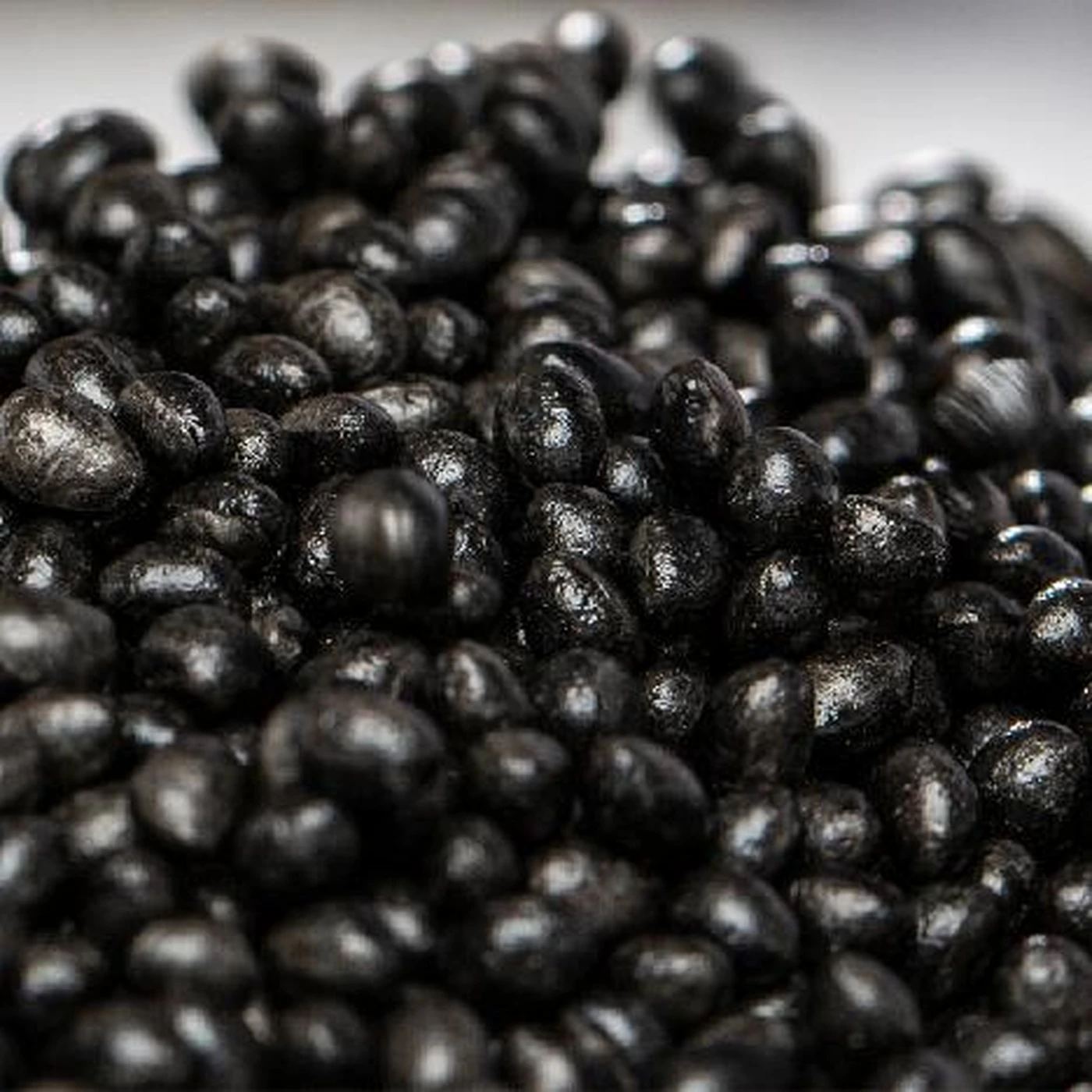
A low bead price says very little until the finished board has been defined. Exterior wall insulation, industrial insulation, passive-house boards, and other energy-saving products can all use graphite polystyrene, but they may need different density ranges, particle sizes, thermal targets, compressive performance, and molding conditions.
The RFQ should therefore begin with the board rather than a broad request for “graphite EPS.” A useful specification normally includes the final board thickness, molded density, application, required thermal performance, fire-performance route, machine type, and any mechanical requirement that may affect handling or installation.
This matters particularly with black graphite EPS beads because similar-looking materials are not necessarily interchangeable. HUASHENG supplies suspension and extrusion graphite grades for different board requirements. Its FGE graphite polystyrene for construction and industrial insulation is intended for higher-density products of 18 kg/m³ or above, while the S-33 and S-32 extrusion grades are aimed at energy-saving and higher-standard insulation applications.
For a board producer, these differences affect more than the material name. They affect what should be tested, how the pre-expansion target is set, and whether the bead grade can run inside the factory’s normal process window.
Why Target Thermal Performance Must Be Defined at Board Level
Thermal performance is one of the main reasons producers choose graphite polystyrene insulation, but it can be specified at the wrong level. A bead grade may have a thermal-conductivity value, while the customer finally buys a board with a particular thickness and thermal resistance.
This is where graphite polystyrene r value becomes important. R-value is not a fixed number that applies to every board simply because graphite is present. It depends on the thermal conductivity of the molded material and the board thickness. Density, fusion quality, and molding consistency also matter when a plant needs to reproduce the same result across production batches.
An RFQ that says only “high R-value graphite EPS” leaves too much open. A better requirement states the board thickness, target thermal result, relevant test basis, and acceptable production tolerance.
HUASHENG’s extrusion grades show the practical difference. S-33 has a listed thermal conductivity of ≤0.033 W/m·K, while S-32 is listed at ≤0.032 W/m·K. Those values help narrow the material choice, but the finished graphite polystyrene foam board still needs to be checked against its own thermal target.
What Must Be Confirmed Before Asking Suppliers for a Quote?
Which Fire-Performance Route Applies to the Finished Board?
Fire performance should not be reduced to a loose term such as “flame-retardant.” A board producer needs to know the required classification, what specimen was tested, and whether the supporting result applies to raw material, a molded sample, the finished board, or a complete insulation system.
HUASHENG S-33 is listed as reaching B1 with an oxygen index of at least 30. S-32 is also listed at B1, with an oxygen index of at least 32. FGE suspension graphite material can reach B1 as well.
Those figures are useful during supplier screening, but they should not be treated as an automatic finished-board guarantee. Molded density, board thickness, processing conditions, contamination, aging, and the chosen test method may all affect the final result.
For procurement, the better question is not simply, “Is this graphite EPS flame-retardant?” It is, “What evidence supports the fire requirement for the board being produced?” That question makes quotations easier to compare and exposes gaps that a simple B1 label may hide.
How Target Density and Board Thickness Affect Material Selection
Density affects board strength, raw-material consumption, processing behavior, and thermal performance. Board thickness then influences the overall thermal resistance. These two variables should be set before a buyer compares bead prices.
FGE suspension graphite material is intended for products at 18 kg/m³ or above. Its particle-size ranges include 1.30–1.60 mm, 1.00–1.40 mm, 0.75–1.10 mm, and 0.50–0.80 mm, with different first-expansion ranges for different specifications.
That difference matters on the production floor. If a factory tries to run a grade outside its intended density window, it may face poor fusion, unstable dimensions, more process adjustment, or higher scrap.
The same logic applies to graphite polystyrene r value. A producer trying to reach a higher thermal resistance may adjust board thickness, density, or bead grade. Those decisions should be made together instead of treating the bead quotation as a separate purchasing issue.
For graphite polystyrene insulation, the lowest quoted price per ton is rarely enough to identify the lowest finished-board cost.
What Processing Conditions Must Match the Bead Grade?
A supplier cannot judge processing fit from the application alone. The pre-expander, target pre-expansion density, aging practice, molding machine, steam conditions, cooling method, and expected cycle time all affect how a graphite grade behaves.
For HUASHENG FGE, the curing time after foaming is normally 4–8 hours. Storage should remain below 25°C, away from direct sunlight and fire. Molding pressure should be adjusted according to the surface condition and internal bonding of the finished product.
Particle size also changes the processing discussion. FGE-101 has a 1.30–1.60 mm particle range with a first-expansion ratio of 40–60, while FGE-401 has a 0.50–0.80 mm range with a first-expansion ratio of 25–35.
A buyer should therefore discuss actual density and molding conditions before selecting a grade simply because the bead size looks suitable. The same principle applies when reviewing HUASHENG graphite polystyrene grades. A better material match comes from comparing the plant’s real process window with the grade rather than assuming every graphite material runs on the same recipe.
How Should Samples and Early Production Be Checked?
What a Meaningful Trial Should Compare Before Bulk Purchase
A sample bag is useful only when the trial reflects commercial production. Expanding a few kilograms until the beads look acceptable does not show whether the material can repeatedly make the required board.
A meaningful trial should keep the important variables controlled. Use the target board dimensions and density, the intended machine, and a defined production procedure. Then record pre-expanded density, aging time, molding cycle, cooling behavior, board weight, surface condition, edge quality, internal fusion, dimensional change, and the required thermal or mechanical results.
For graphite polystyrene insulation, a lower thermal-conductivity value does not automatically mean a lower production cost. If one material needs repeated machine adjustment, produces inconsistent fusion, or makes the graphite polystyrene foam board harder to stabilize, a small raw-material saving may disappear quickly.
A practical approval route is to screen the material first, run it under normal production conditions, and then confirm a limited commercial batch. Full-volume purchasing should come after the same specification has been repeated successfully.
Which Batch-Consistency Signals Need to Be Recorded
The first trial answers whether a material can work. Batch records show whether it keeps working.
Incoming inspection should cover particle appearance, particle-size range, expansion response, pre-expanded density, aging behavior, finished-board density, dimensions, surface quality, fusion, and the performance checks that matter to the application.
Production settings deserve attention as well. Two batches may both make acceptable boards, but one may require much more adjustment to steam, pressure, cooling, or cycle time. That difference has a real production cost.
For products sold on thermal performance, stable production also helps keep graphite polystyrene r value within the range expected for the finished board. The purchasing specification should therefore include a usable batch acceptance range rather than rely on one successful sample.
How Does HUASHENG Graphite Grade Fit the Evaluation?
How HUASHENG Graphite Grade Can Be Reviewed Against Board Requirements

HUASHENG’s graphite portfolio gives board producers several technical routes rather than one generic graphite EPS material.
FGE suspension material is intended for construction and industrial thermal insulation and is suited to products at 18 kg/m³ or above. It offers several particle-size ranges with different expansion windows.
S-33 introduces natural flake graphite through an extrusion process. Its listed thermal conductivity is ≤0.033 W/m·K, its flame-retardant performance reaches B1 with an oxygen index of at least 30, and it is mainly used for external-wall insulation and energy-saving buildings. It also has high compressive strength and good dimensional stability.
For projects with tighter thermal targets, HUASHENG S-32 graphite polystyrene has a listed thermal conductivity of ≤0.032 W/m·K, B1 flame-retardant performance, an oxygen index of at least 32, high molecular weight, high compression strength, and improved dimensional stability. Its main applications include passive houses and high-standard energy-saving buildings.
That range gives a board producer a clearer comparison path: start with the application, then review thermal target, density, particle size, fire requirement, mechanical performance, and process fit.
When a Grade Discussion Needs Actual Processing Conditions Instead of a Generic Material Label
“Black graphite EPS beads for insulation boards” is still too broad for a serious grade recommendation. The supplier needs the target board density and thickness, machine type, pre-expansion practice, expected cycle, preferred particle size, thermal requirement, fire requirement, and any recurring production problem.
Those details separate material performance from processing performance. A grade may look strong in a specification but still be a poor commercial fit if the factory cannot reach the target density or fusion without moving far outside its normal process settings.
HUASHENG’s product range covers ordinary, flame-retardant, graphite, environmental-protection, carbon-black, and customized grades. Buyers dealing with non-standard density, performance, particle-size, or processing requirements can also discuss HUASHENG customized EPS solutions around the actual board and production conditions.
The practical advantage is not simply having more product options. It is having room to connect material selection, trial production, and process conditions before a bulk specification is fixed.
What Documents Should a Buyer Request Before a Supply Decision?
Which Product and Technical Documents Should Accompany the Quotation
A quotation becomes easier to judge when the technical documents arrive with it. Procurement should ask for the exact grade identification, technical data, particle-size range, expansion guidance, storage conditions, safety information, and test evidence related to the required thermal or fire performance.
The scope of each document matters. The buyer should know which material was tested, the specimen condition, the method used, the result, and whether the document applies to the grade being quoted.
For a graphite polystyrene foam board project, this prevents a common purchasing mistake: treating a raw-material result as finished-board approval. Production and quality teams still need to confirm whether the molded board reaches the required result under the plant’s actual conditions.
A supplier that provides enough information to connect the bead grade, processing window, and finished-board target is easier to qualify than one that only offers a headline thermal number and a price.
How to Align the Sample Specification, Batch Requirement, and Purchase Contract
The purchase contract should be built from the approved trial rather than the first quotation.
Once a sample passes, record the approved grade, particle-size range, production conditions, target board density, required performance, incoming checks, batch identification, and any material or process change that requires re-approval.
This puts purchasing, production, and quality on the same specification. Purchasing knows what is being ordered. Production knows what process window was approved. Quality knows what should be checked when a new batch arrives.
It also makes supplier discussions more precise. If a later batch behaves differently enough to push production outside the approved window, the issue can be compared against recorded conditions rather than vague comments such as “this batch feels different.”
Before a container order or long-term supply agreement is fixed, buyers can send HUASHENG the target board specification for a technical discussion and compare the proposed bead grade against the planned density, thermal target, fire requirement, and production setup.
Conclusion
A reliable black graphite EPS bead purchase begins with the finished board, not a generic raw-material quotation. By checking application, performance requirements, process fit, samples, and supplier documents together, board producers can build a clearer specification. Review HUASHENG Graphite Grade as part of the material discussion.
FAQs
Q1: Are Black Graphite EPS Beads Selected Only by Thermal Performance?
A1: No. Black graphite EPS beads also need to match the target board density, thickness, particle-size requirement, fire-performance route, fusion quality, dimensional stability, machine setup, and production consistency. A strong thermal number alone does not prove that a grade is suitable for commercial board production.
Q2: How Can a Board Producer Compare Two Graphite EPS Bead Suppliers?
A2: Give both suppliers the same finished-board requirement and run trials under comparable conditions. Compare bead specification, expansion behavior, process window, board density, fusion, dimensions, thermal result, fire-related evidence, and the amount of machine adjustment needed. That gives a much clearer comparison than price per ton alone.
Q3: Should a New Grade Be Approved Before Bulk Ordering?
A3: Yes. A new graphite polystyrene insulation grade should first be tested on the intended production line. The approved trial conditions and finished-board results should then become part of the bulk-order specification, so later batches can be judged against the same standard.
 English
  German
  Spanish
  French
  Arabic