
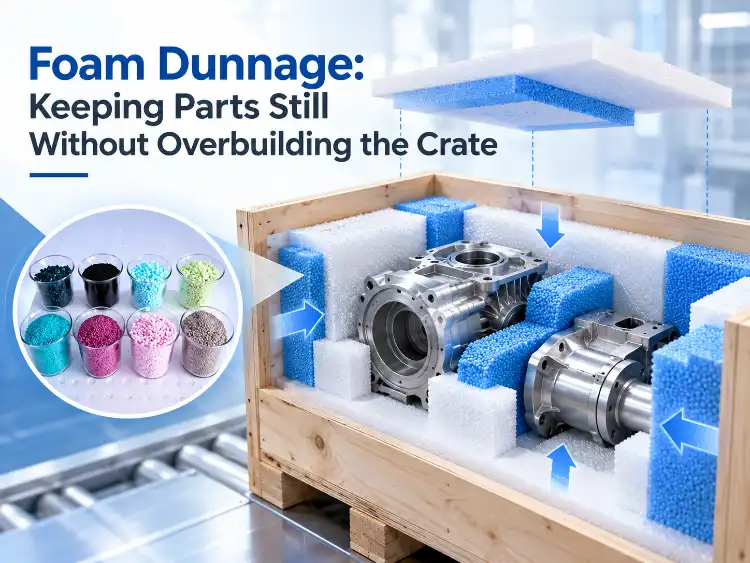
A crate arrives with the part scuffed, and the carrier gets the blame. More often the cause was settled earlier, at the drawing stage, when nobody wrote down where the part was allowed to touch anything. Foam dunnage is the material that fixes that gap, but only when it is designed around movement rather than around a habit.
Foam that stops a part from sliding and foam that absorbs a drop are doing two different jobs. Most dunnage failures come from treating them as one job, and from a crate that grew heavier every time a shipment arrived scratched.
What Dunnage Has to Do
Blocking and Bracing Are Not Cushioning
Start with the part’s movement. The material comes later. Blocking stops the part from shifting; cushioning takes the energy out of a shock. Both can live in the same foam block, and the design inputs are not the same. Blocking turns on contact area, the direction of the likely movement, and whatever holds the part in place. Cushioning turns on the energy the part will see and how much distance is available to absorb it.
Design a block as though it were a cushion and the block usually ends up thicker than the job needs, with the load path still undefined. The crate looks well filled. The part still moves when the truck turns.
Where the Load Actually Goes
Draw the load path before choosing a foam. Which surface carries the restraint? Is the floor the reference, or does the part hang from a rack? Are there features that must never be touched, such as a machined face or a connector?
Those answers change the shape of the dunnage more often than they change its material. A part restrained at its base needs a different form from one held at the top, and a part with a finished face needs clearance there instead of contact. Buyers who want to see why foam keeps turning up in this role can read why expanded polystyrene works well for protective packaging.
Choosing the Foam for the Job
Molded Foam Versus Cut Foam
With the load path settled, the material choice narrows quickly. Cut foam wins when the shape is simple, the quantity is low, or the design is still moving. Molded foam wins when the geometry repeats, when every part has to sit identically across thousands of units, or when the shape carries ribs and tapers that a knife cannot produce economically.
Edges and surfaces differ between the two routes as well. A molded form can guide a part into place with a taper; a cut form holds whatever tolerance the cutting route and the foam allow. Plenty of programs run both at once, prototyping in cut foam and moving to a mold once the shape stops changing.
Density, Contact Area and Span
A simple check catches most problems before tooling is cut. Take the part’s weight, the contact area each restraint provides, and the gap it has to cross, and ask whether the material can carry that combination in the worst direction of travel. If nobody can answer the question on paper, the sample will answer it in a truck.
Density and compressive behaviour decide how much load a given area carries before it deforms too far. Widen the contact area and the pressure at each point drops, which often buys a lighter material or a thinner section. Stretch the same foam across an unsupported gap and the section has to carry the part alone.
Which is why dunnage rarely fails because a foam is wrong in general. It fails because area, span, or load path was never stated, and the material got chosen out of habit. Cutting weight out of a container is a related decision with its own limits, so it is worth reading how extra-light EPS reduces packaging weight next to the dunnage design rather than afterwards.
Proving the Dunnage Before the First Shipment
Sample and Fit Check
Dunnage is cheap to prove early and expensive to prove late. Check the sample against the part, not against a drawing. Can the part be loaded and unloaded without forcing? A fit that needs pressure will mark a finished surface and slow the line down. Is the part restrained in every direction the journey can move it?
Then write down what was approved. A sample signed off without a note on contact points and clearances cannot be repeated, and no supplier can hold a condition nobody recorded.
Reuse, Cleaning and Replacement
A one-way crate only has to be right once. A loop has to be right on the hundredth trip, after the fixtures have been dropped, stacked and washed a hundred times. Repeated handling compresses contact points, cleaning changes surfaces, and a damaged piece tends to go back into service until someone notices.
Decide the replacement rule before the first shipment. That rule is also where custom work earns its keep: a form built for the part and the loop usually outlasts a generic block that someone re-packs by hand on every trip. Buyers exploring that route can compare custom EPS forms made to a drawing with the cut-foam options already in use.
Conclusion
Foam dunnage works when the design starts from movement rather than material: define the load path, keep blocking and cushioning separate, and settle density, contact area and span together. Cut foam and molded foam are then two ways of making the same requirement, and the sample plus the replacement rule decides whether the design survives the loop. HUASHENG documents its EPS production and customization process, including sample production, so the dunnage conversation can stay on the part and the load case.
FAQs
Q1: Is dunnage the same as cushioning?
A1: No. Dunnage keeps a part from moving inside its container; cushioning absorbs shock energy. A foam form can do both, but the design inputs differ, so a package that blocks a part well may still pass too much shock if nobody stated the cushioning requirement.
Q2: When is molded foam worth it instead of cut foam?
A2: Molded foam earns its cost when geometry repeats, when the fit has to be identical across many parts, or when the shape carries ribs and tapers that are impractical to cut. Low volumes and moving designs usually get to a working sample faster in cut foam.
Q3: What should be recorded when dunnage is approved?
A3: Record the contact points and clearances, the directions the part is restrained in, and the load path the design assumes. For returnable dunnage, add the cleaning method and the replacement rule, so the approved condition can be repeated and inspected.
 English
  German
  Spanish
  French
  Arabic