
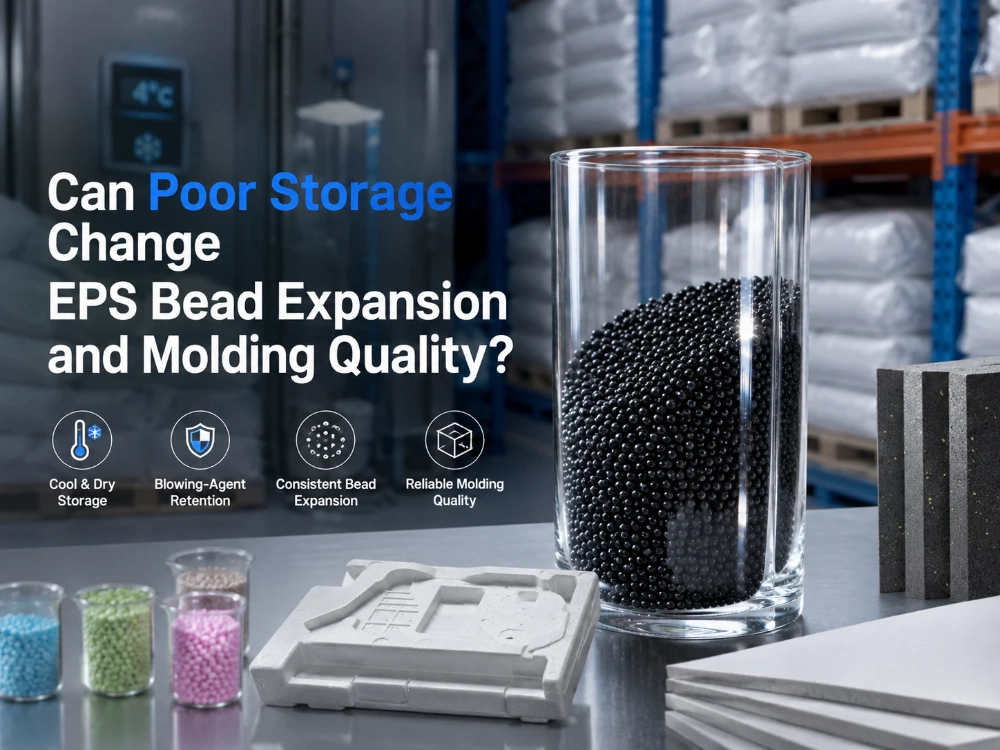
Ja. Eine unsachgemäße Lagerung des EPS-Rohmaterials kann das Verhalten von expandierbaren Pellets im Vorexpander beeinflussen. EPS enthält ein flüchtiges Treibmittel, üblicherweise auf Pentanbasis. Mit der Zeit kann ein Teil dieses Treibmittels aus den Pellets entweichen, und die Verlustrate steigt bei ungünstigeren Lagerbedingungen.
Das erste Warnsignal ist nicht immer ein sichtbar beschädigter Beutel. Ein Werk kann stattdessen feststellen, dass eine ältere Charge andere Dampfeinstellungen benötigt, die erwartete Ausdehnung nicht so leicht erreicht, eine andere Vorschwelldichte aufweist oder sich innerhalb des zuvor genehmigten Formfensters schwieriger verarbeiten lässt.
Aus diesem Grund ist die Lagerung von EPS-Perlen Teil der Prozesssteuerung und nicht nur der Lagerordnung.
Warum beeinflusst die Lagerung das EPS-Wachstum?
Expandierbares Polystyrol wird als kompakte Kügelchen mit einem physikalischen Treibmittel geliefert. Beim Erhitzen während der Vorexpansion verdampft dieses Treibmittel und trägt zur Expansion des erweichten Polystyrols bei.
Ändert sich der verfügbare Treibmittelgehalt, kann sich auch das Expansionsverhalten ändern.
Warum ist das EPS-Treibmittel wichtig?
Das EPS-Treibmittel erzeugt während der Vorexpansion einen Innendruck. Dies ist einer der Gründe, warum sich ein kleines Rohmaterialkügelchen zu einem viel größeren Zellpartikel ausdehnen kann.
Pentan ist flüchtig. Geringe Mengen können sich allmählich aus gelagerten Rohperlen ausbreiten, selbst wenn das Material nicht geöffnet oder verarbeitet wurde.
Das bedeutet nicht, dass alle älteren Säcke unbrauchbar werden. Es bedeutet lediglich, dass der Hersteller nicht davon ausgehen sollte, dass sich eine lange gelagerte Charge genauso verhält wie eine frische Charge, ohne dies zu überprüfen.
Ein einfacher Vorversuch zur Ausdehnung kann aufzeigen, ob das Material unter dem etablierten Verfahren noch die erforderliche Dichte erreicht.
Warum ist die Lagertemperatur von EPS wichtig?
Höhere Temperaturen beschleunigen die Freisetzung des Treibmittels aus expandierbaren Perlen. Daher ist die Lagertemperatur von EPS einer der wichtigsten Faktoren zur Steuerung von Lagerhallen.
Ein kühler, trockener und gut belüfteter Lagerraum ist wesentlich sicherer als ein heißer Containerhof, ein Lagerhaus auf dem Dach oder ein Raum, der direkter Sonneneinstrahlung ausgesetzt ist.
Für HUASHENG Funktionsmaterialien wie FGE Graphit-Polystyrol, Zu den Lagerungshinweisen gehören: Vermeidung von Sonnenlicht, Fernhaltung des Materials und Einhaltung einer Lagertemperatur unter 25°C.
Diese Bedingungen sind nicht kosmetischer Natur. Sie tragen dazu bei, das Material vor der Weiterverarbeitung zu konservieren.
Wie sollte die Lagerung von EPS-Perlen in der Praxis aussehen?
Ein gutes Lagersystem schützt sowohl die Materialleistung als auch die Anlagensicherheit.
Warum ist Belüftung wichtig?
Rohe EPS-Kügelchen setzen geringe Mengen an Pentandampf frei.
Pentan ist entzündlich, und seine Dämpfe sind schwerer als Luft. Daher ist besondere Vorsicht geboten in geschlossenen, niedrigen Bereichen, Gruben, schlecht belüfteten Lagerräumen oder versiegelten Transporträumen.
Die Lagerung von EPS-Kügelchen sollte unter Einhaltung von Belüftungs- und Zündquellenschutzmaßnahmen erfolgen. Statische Entladungen, Rauchen, Funken, Schweißarbeiten und nicht zugelassene elektrische Geräte dürfen in der Nähe von gelagertem expandiertem Polystyrol nicht unterschätzt werden.
Lagersicherheit und Materialeigenschaften hängen hier zusammen: Die gleiche flüchtige Komponente, die die Ausdehnung verursacht, birgt auch das Lagerrisiko.
Sollen die Taschen im Voraus geöffnet werden?
Im Allgemeinen bringt es wenig Vorteile, Rohstoffsäcke lange vor der Verwendung zu öffnen.
Sobald die Schutzverpackung geöffnet ist, sind die Perlen weniger gut vor den Einflüssen der Lagerumgebung geschützt. Wird nur ein Teil des Beutels verbraucht, sollte der Rest verschlossen und gemäß den Handhabungshinweisen des Lieferanten gekennzeichnet werden.
Bei der Lagerung von expandiertem Polystyrol gilt die praktische Regel, das Material so lange in seiner vorgesehenen Verpackung aufzubewahren, bis es im Produktionsplan benötigt wird.
Die Fabrik sollte außerdem geöffnete, ungeöffnete, frische und gereifte Chargen trennen, anstatt alles in einem Silo zu vermischen.
Kann altes EPS noch verwendet werden?

Möglich, aber es sollte eher getestet als angenommen werden.
Was sollte überprüft werden, bevor eine ältere Charge in die Produktion geht?
Beginnen Sie mit der Identifizierung. Bestätigen Sie die Güteklasse, das Produktions- oder Eingangsdatum, die Chargennummer, die Lagergeschichte und ob die Verpackung unbeschädigt ist.
Anschließend sollte eine kontrollierte Vorexpansionsstudie durchgeführt werden.
Vergleichen Sie die resultierende Dichte, Expansionsgeschwindigkeit, den Zustand der Schweißraupe und die Prozesseinstellungen mit einer bekannten, einwandfreien Charge. Falls das ältere Material ein deutlich anderes Dampffenster benötigt, dokumentieren Sie diese Abweichung, bevor Sie es in die Serienproduktion einführen.
Ein EPS-Rohstofflagersystem, das das FIFO-Prinzip anwendet, kann solche Überraschungen reduzieren, aber FIFO allein reicht nicht aus, wenn die Lagertemperatur schlecht kontrolliert wurde.
Warum kann das Mischen alter und neuer Chargen das Problem verschleiern?
Durch das Mischen von Produkten mag die kurzfristige Produktion stabiler erscheinen, aber es zerstört die Rückverfolgbarkeit.
Wenn sich die Formdichte oder die Schmelze später verändert, weiß das Produktionsteam möglicherweise nicht, ob die Ursache in einem Unterschied im Alter des Rohmaterials, in den Maschineneinstellungen oder in einer anderen Prozessvariablen liegt.
Fragwürdige Lose werden so lange separat geführt, bis ihr Verhalten verstanden ist.
Dies ist besonders nützlich für funktionelle Materialien mit höherer Dichte. HOUSE Schwarzes Polystyrol FGE Es ist für elektrische Bauteile, Verpackungen und spezielle schwarze Produkte konzipiert. Es eignet sich für Produkte mit einer Dichte von 18 kg/m³ oder mehr, die farbecht, antistatisch, alterungsbeständig und B1-konform sind. Die Lagerungshinweise sehen eine Temperatur unter 25 °C vor.
Beeinflusst die Lagerung sowohl die Formqualität als auch die Ausdehnung?
Das kann es.
Eine speicherbezogene Verschiebung beginnt bereits vor der Erweiterung, kann sich aber auf den gesamten weiteren Prozess auswirken.
Wie können Ausdehnungsschwankungen die Form erreichen?
Wenn eine Charge unter dem normalen Vorexpansionsprogramm nicht mehr die gleiche expandierte Dichte erreicht, kompensieren die Bediener dies häufig durch Änderung der Dampfzeit, des Drucks oder der Zykluseinstellungen.
Das verändert den Zustand der Kügelchen, die mit der Alterung und dem Schimmelprozess beginnen.
Das Ergebnis kann sich in einer veränderten Formdichte, veränderter Verschmelzung, Oberflächenveränderungen oder einem weniger vorhersehbaren Zyklus äußern.
Deshalb sollte bei dem Vorfall „die Spritzgießmaschine plötzlich instabil geworden ist“ manchmal eine Überprüfung des Rohmaterialalters und der Lagerung erfolgen, bevor die Maschine wiederholt nachjustiert wird.
Warum sollten Lageraufzeichnungen dem Material bis zur Produktion folgen?
Eine sinnvolle Chargendokumentation endet nicht am Lagertor.
Das Produktionsteam sollte nachvollziehen können, wann das Material eingetroffen ist, wo es gelagert wurde, wann es geöffnet wurde, in welcher Vorexpansionscharge es verwendet wurde und welche Fertigprodukte aus dieser Charge stammen.
Dadurch wird die Lagerung von expandiertem Polystyrol Teil der Qualitätsrückverfolgbarkeit und nicht zu einer separaten Lagerfunktion.
Was ist das Besondere an der Aufbewahrung von vorgequollenen Perlen?
Die Lagerung von Rohperlen und die Konditionierung von vorgequollenen Perlen sind unterschiedliche Themen.
Warum sollten sie nicht verwechselt werden?
Die Rohperlen enthalten das für die Expansion notwendige EPS-Treibmittel. Ziel der Lagerung des EPS-Rohmaterials ist es, das gelieferte Material bis zur Weiterverarbeitung zu konservieren.
Nach der Vorexpansion benötigen die Kügelchen vor dem Formen eine kontrollierte Konditionierungs- oder Aushärtungsphase. Luft dringt in die Zellen ein und der Druck der Kügelchen stabilisiert sich.
Bei HUASHENG-Graphit und kohlenstoffmodifizierten FGE-Materialien beträgt die angegebene Aushärtezeit nach dem Aufschäumen üblicherweise 4–8 Stunden. Dieser Wert bezieht sich auf den Zustand nach dem Aufschäumen, nicht auf die Haltbarkeit ungeöffneter Rohperlen.
Eine Verwechslung dieser beiden Phasen kann zu einer mangelhaften Produktionsplanung führen.
Hat jede EPS-Klasse das gleiche Speicherlimit?
NEIN.
Rezeptur, Treibmittelgehalt, Verpackung, Produktionsdatum, Klima und Materialqualität können die praktische Lagerfähigkeit beeinflussen. Käufer sollten daher die herstellerspezifischen Angaben verwenden, anstatt für jedes EPS-Produkt eine einheitliche Haltbarkeitsdauer anzusetzen.
Fabriken, die mit mehreren Funktionsklassen arbeiten, können Vergleich der HUASHENG-Ruß-EPS-Materialien und bestätigen Sie die Anforderungen an Lagerung, Dichte, Partikelgröße und Formgebung, bevor Sie die Lager- oder Produktionspraxis ändern.
Wie sollten Einkäufer Lageranforderungen in den Beschaffungsprozess einbeziehen?
Die Bestellung sollte nicht bei Güteklasse und Menge enden.
Prüfen Sie gegebenenfalls die Verpackung, die Chargenkennzeichnung, das Herstellungs- oder Freigabedatum, die Transportbedingungen, die Lagerhinweise und das Vorgehen, falls eine Sendung ungewöhnlicher Hitze ausgesetzt war.
Wenn Fracht durch eine sehr heiße Region transportiert werden soll oder in einem Hafen gelagert werden soll, fragen Sie, wie lange das Material unter diesen Bedingungen bestehen bleiben kann.
Bei langfristigen Programmen empfiehlt es sich, die EPS-Lagertemperatur in einem einfachen Lagerprotokoll festzuhalten, anstatt sich auf saisonale Annahmen zu verlassen.
Schlussfolgerung
Die Lagerung von EPS-Rohmaterial kann die Expansion und Formgebung beeinträchtigen, da die Kügelchen ein flüchtiges EPS-Treibmittel enthalten.
Höhere Temperaturen können den Treibmittelverlust beschleunigen. Beschädigte Verpackungen, lange Lagerzeiten, mangelhafte Belüftung und unkontrollierte Lagerbestände können die Lagerung von EPS-Kügelchen unberechenbarer machen. Das Problem kann sich zunächst durch eine Veränderung der Dichte oder der Dampfaushärtung anstatt durch offensichtliche Materialschäden bemerkbar machen.
Ein solides Lagerprogramm für expandierbares Polystyrol kombiniert daher Temperaturkontrolle, Belüftung, Brandschutz, versiegelte Verpackung, FIFO-Prinzip, Chargenrückverfolgbarkeit und Vorabprüfungen älterer oder fragwürdiger Chargen.
Die Einbeziehung des Lagers in den Prozessablauf hilft, zu verhindern, dass die Bediener ein Lagerproblem durch endloses Ändern der Einstellungen der Spritzgießmaschine lösen.
Häufig gestellte Fragen
Frage 1: Welche EPS-Lagertemperatur sollte eine Fabrik verwenden?
A1: Beachten Sie die lieferantenspezifischen Anforderungen. Mehrere Graphit- und Kohlenstoff-FGE-Sorten von HUASHENG erfordern eine Lagerung unter 25 °C, geschützt vor Sonnenlicht und Zündquellen. Ein kühles und stabiles Lager ist einer Lagerung bei hohen oder stark schwankenden Temperaturen vorzuziehen.
Frage 2: Kann das Treibmittel EPS während der Lagerung verschwinden?
A2: Ja. Das Treibmittel auf Pentanbasis diffundiert allmählich aus dem expandierbaren Polystyrol, wobei die Freisetzungsrate mit steigender Temperatur zunimmt. Zu hohe Verluste können das Expansionspotenzial verringern und das Verarbeitungsfenster verändern.
Frage 3: Sollten alte EPS-Kügelchen automatisch entsorgt werden?
A3: Nicht automatisch. Überprüfen Sie die Chargenhistorie und führen Sie einen kontrollierten Vorexpansionsversuch durch. Wenn das Material innerhalb eines akzeptablen Verarbeitungsfensters die erforderliche Dichte und den gewünschten Raupenzustand erreicht, kann es weiterhin verwendet werden.
 German
  English
  Spanish
  French
  Arabic