
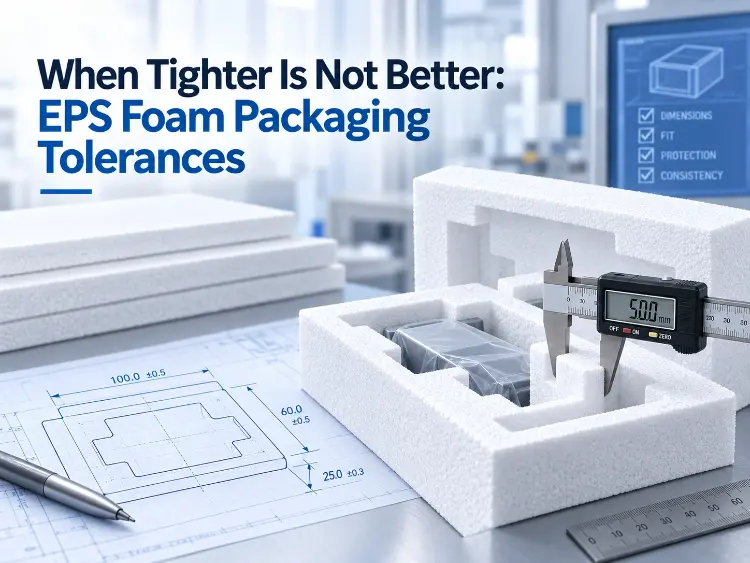
EPS foam packaging tolerances should be tightened only when the tighter limit protects a real fit, assembly, or handling requirement. A smaller number on the drawing is not automatically a better specification. When the process cannot repeat that limit, the buyer has added inspection work and rejection risk without improving the package.
The useful question is not “Can we make this dimension tighter?” It is “Which dimensions affect the product fit, and what range can the process hold consistently enough to accept in bulk?”
What a Packaging Tolerance Actually Controls

A tolerance defines an allowable dimensional variation around a nominal value. Measuring method, datum, and inspection condition must be defined for a tolerance to be verifiable. It should relate to the function of the part: whether a product fits in a cavity, whether two foam pieces assemble, whether an insert sits flush, or whether a board fits a frame or support.
Start with the functional feature rather than the whole drawing. A pocket length may need tighter control because the product must fit. A non-contact outer edge may accept a wider range. The functional features are the ones that affect fit, assembly, and retention; non-critical surfaces can use a practical band.
The datum should also be defined. Measurements from different reference points can produce different results even when the part is the same. The drawing, inspection plan, and supplier discussion should use the same datum and the same measurement condition. Measuring method, datum, and inspection condition must be defined for a tolerance to be verifiable. A tighter value is not automatically better if it is not functional and measurable.
Which Variations Drive EPS Dimensions

EPS dimensions can change with molding, cooling, moisture, and cutting conditions. Tolerance decisions should reflect the production process and intended fit. The tolerance should reflect those process sources rather than assuming that every part will match the first sample exactly. Packaging specifications should connect dimensions to the product, cavity, assembly, and inspection method. The review should separate molding variation from post-molding handling.
The production volume also matters. A tool that can hold a dimension over a short trial may drift over a long run as mold temperature, material, or operating conditions change. The tolerance band should be evaluated across a representative batch, not only a single approved sample.
Mold Shrinkage and Cooling
Mold dimensions, material shrinkage, cooling, and demolding conditions influence the molded part. The EPS density-control process is part of this picture because it affects the material structure and how the part develops in the tool.
Cooling and release can also change the measured result. A part measured immediately after demolding may not have the same dimension after it has cooled or stabilized. The inspection timing should be stated so the supplier and buyer measure the part at the same stage.
A change in the process window can change the dimensional result with it. Record the relevant molding conditions alongside the dimensions when a new part or tool is being qualified.
Cutting, Trimming, and Measurement
Cut, trimmed, or fabricated EPS forms add another source of variation. Cutting equipment, blade condition, support, speed, and handling can change the edge or thickness. A molded part and a cut part should not be judged against the same tolerance assumption without checking the process.
Measurement method matters as much as the part. Calipers, gauges, fixtures, and vision systems may contact or reference the surface differently. Define where the measurement is taken, how the part is supported, and whether the result is an average or a maximum deviation.
Use the same method for the sample and bulk inspection. A supplier measuring a different feature or using a different reference plane does not produce a comparable result, even when both numbers are expressed in millimeters.
Why Tighter Is Not Automatically Better
A tighter tolerance can increase cost because the process needs more control, slower cycles, additional fixtures, or more inspection. It can also increase rejection risk at the supplier and create disputes when a part is visually acceptable but outside an unnecessarily narrow limit.
The trade-off should be connected to the fit. If a loose dimension lets the product move, tighten it. When a dimension has no effect on assembly, retention, or appearance, a wider and more repeatable band may be the better specification.
Inspection burden also belongs in the decision. A tolerance requiring a difficult measurement may not be practical in routine production, even if it looks precise on paper. The method should be usable by both parties.
How Tolerance Affects Fit and Assembly
Tolerance affects insertion, clearance, retention, and the amount of movement between the product and the foam. A cavity that is too tight can make loading difficult or damage the product. Excessive clearance can let the product shift and transfer load to the wrong area.
Material, forming, and handling all come together in the finished part, and how EPS goes into a foam board shapes how much dimensional variation that part can absorb. For an insert or tray, the buyer should define the fit at the functional surfaces and allow practical variation elsewhere.
Assembly is not a single dimension. The stack of foam, product, carton, and tolerances in the surrounding parts determines whether the final package works. Review the tolerance stack rather than assuming that one tight foam dimension solves the whole fit problem.
A dimension that is out of range is not the same as a part that was damaged after production, and neither is the same as a support that was never engineered for its load case. Engineering a molded support for the packaging load case is a design decision rather than a dimensional one.
How to Set a Practical Tolerance Band
Set the band from three inputs: the functional requirement, the process capability, and the measurement method. The functional requirement says what the package must do. Process capability shows what the supplier can repeat. The measurement method shows how the requirement will be verified.
Start with a design limit, then compare it with supplier data from representative production. When the process is naturally capable, keep the limit only as tight as the function requires. If it is not capable, change the part, process, datum, or inspection plan instead of declaring a tighter tolerance by assumption.
Use different bands for different features when the function justifies it. A critical pocket or mounting surface may need tight control. A non-contact edge may accept more variation. This is more useful than applying one number to the whole drawing.
What to Put in the Purchase Specification
The specification should identify the nominal dimension, allowed range, datum, critical features, measurement method, inspection timing, sample size, and acceptance rule. It should also state what happens when a result is outside the band.
Include the production stage at which the dimension is measured. A molded dimension measured before cooling may differ from the same dimension measured after stabilization. The supplier and buyer should agree on the condition before the first bulk order.
For a molded, cut, or assembled part, identify which process owns each critical dimension. That prevents a supplier from accepting a drawing without understanding which stage controls the fit.
HUASHENG documents an intelligent EPS production line whose precision testing covers density uniformity, compressive strength, and thermal insulation control The company also documents customized EPS development for specific customer requirements, so the tolerance band should match the intended packaging function and production route.
استنتاج
EPS foam packaging tolerances are functional limits, not a measure of how precise a drawing looks. Define the critical fit, understand the molding and measurement variation, compare the band with process capability, and write the datum and inspection method into the purchase specification.
Before the bulk order, review the tolerance stack and test the measurement method on representative parts. Contact HUASHENG to discuss the packaging function and the dimensional evidence needed for the intended EPS product.
الأسئلة الشائعة
Q1: Should EPS foam packaging tolerances be tightened before bulk orders?
A1: Tighten them only where the function requires it. A critical fit may need a narrow band, while a non-contact dimension can usually accept more variation. The limit should be measurable and repeatable in production.
Q2: What causes EPS packaging dimensions to vary?
A2: Mold dimensions, shrinkage, cooling, demolding, cutting, moisture, handling, and measurement method can all affect the result. The review should separate process variation from inspection variation.
Q3: How should EPS packaging tolerances be measured?
A3: Define the datum, instrument or fixture, support condition, measurement points, and timing after molding or cutting. Use the same method for sample approval and bulk inspection so the results are comparable.
 Arabic
  English
  German
  Spanish
  French