
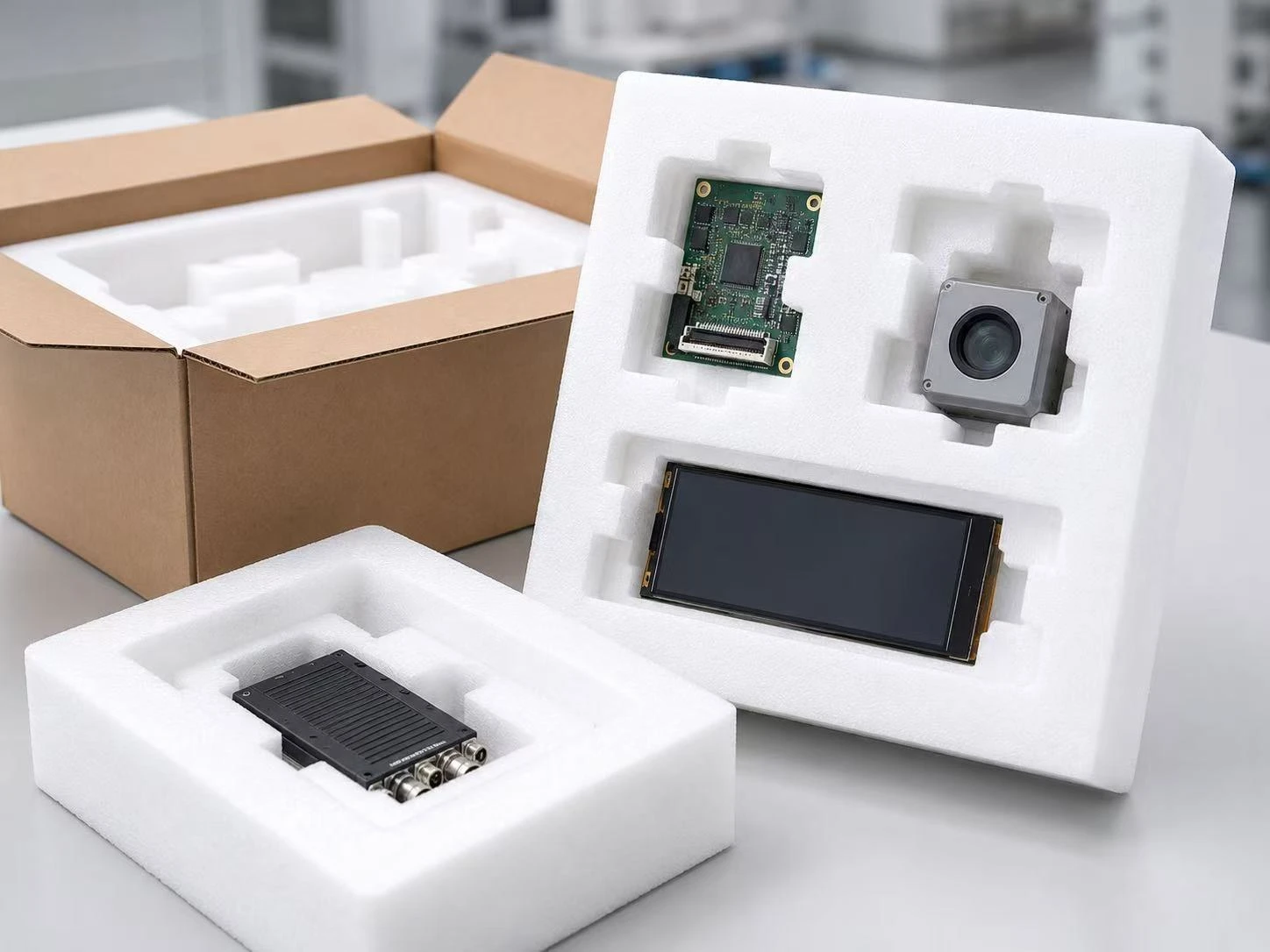
High-value products rarely fail in transit because the foam was too soft. A molded insert that fits loosely, carries the load on a thin rib, or changes dimension between batches can leave a device unprotected even when the material itself meets its specification. Choosing molded styrofoam packaging is a material, structure, and process decision at the same time, and it is judged on the cavity, the wall sections, the foam condition, and the transport route together rather than on the grade name.
What Makes Molded Styrofoam Packaging Fail in Use
Which shipping damage patterns point to the packaging rather than the product
Damage that appears on the outer carton rarely tells the whole story. Cracks at one corner, a scuffed housing, or a connector that has shifted usually point to the packaging when the marks repeat at the same place on every returned unit. Product-side failures spread more randomly, because they follow the component rather than the contact point that meets the outside world.
Why an insert that looks solid can still let the product move inside the carton
A molded insert can look substantial and still allow movement. When the cavity is a little larger than the product, the fit relies on friction instead of a designed contact, and vibration walks the unit along that clearance until it reaches a wall section that was never meant to carry the load. The protection the design promised has already been spent by then, even though nothing looks broken.
Why “Styrofoam” is extruded foam while packaging EPS is expanded polystyrene
The trade name and the material are not the same thing. Styrofoam describes an extruded polystyrene product, while the foam used for protective packaging is normally expanded polystyrene molded from beads. An enquiry that asks only for styrofoam can return an extruded board that cannot be molded into a cavity, or it can put two different materials on the same comparison sheet. Naming the material at the enquiry stage removes that mismatch before it reaches the quote.
Which Foam Family Fits a Molded Packaging Job

Where Extrusion Customized REPS sits against polyethylene and polyurethane foam options
Protective packaging is normally quoted in three material families, and each answers a different problem. Polyethylene foam resists repeated handling, polyurethane foam fills complex cavities, and molded polystyrene delivers a rigid shell at low weight. Inside the polystyrene family, Extrusion مخصصة REPS is produced from recycled material and expands uniformly with a fast cure, which suits molded packaging for electrical and industrial products.
Which product shapes and industries molded EPS packaging already serves
Molded EPS appears wherever a rigid, light shell has to hold a shape: trays and inserts for electronics and display panels, end caps and corner blocks for appliances, cold-chain boxes, and protective packaging for instruments. That installed base matters during selection, because it shows which cavity shapes and wall sections are already proven in production rather than only in a sample.
When molded EPS is the right choice for a high-value product
Molded EPS earns its place when the package needs a rigid shell that keeps its own shape, when the same cavity repeats across a production run, and when weight and material cost carry real weight in the decision. When the product is heavier, or the impact arrives from one predictable direction, density and wall thickness have to answer more of the question than the material name does.
How the Product and Cavity Decide Protection Together
How weight, center of gravity, and fragile features set the load path
A lightweight device and a heavy appliance do not load the same insert in the same way. The heavier unit presses the cavity into continuous contact and puts a standing load on the base sections, while the lighter one depends more on retention. Where the mass sits matters as much as how much of it there is, because a screen, a lens, or a protruding connector concentrates force on a small area and sets the load path for the whole package.
How cavity fit, clearance, and contact area control movement inside the carton
Clearance should be designed rather than left over. A cavity that touches the product across broad faces holds it through friction and geometry, while one that touches on a few points holds it only until vibration finds the gap. Contact area also decides how impact spreads: a wide contact distributes force over more of the foam, and a narrow contact concentrates it on the first rib it meets.
Why corners, ribs, and parting lines decide where impact concentrates
Corners, ribs, and parting lines are where the first crack usually starts. A corner takes impact from two directions at once, a rib compresses the section into a narrow band, and a parting line interrupts the molded skin. Reading them together shows whether the insert is strong at the points that actually meet the outside world, or only where a sample happened to be measured.
Which Foam and Molding Variables Carry That Protection
Why target density should follow local load instead of one average value
A single density figure describes the average part, not the section under load. The base rails and corner blocks that carry the product need more material than a broad panel that mostly fills space. When target density is set for the whole molding, a thin rib can end up under-dense while a large face carries material it does not need.
How bead fusion, surface quality, and shrinkage change corner strength
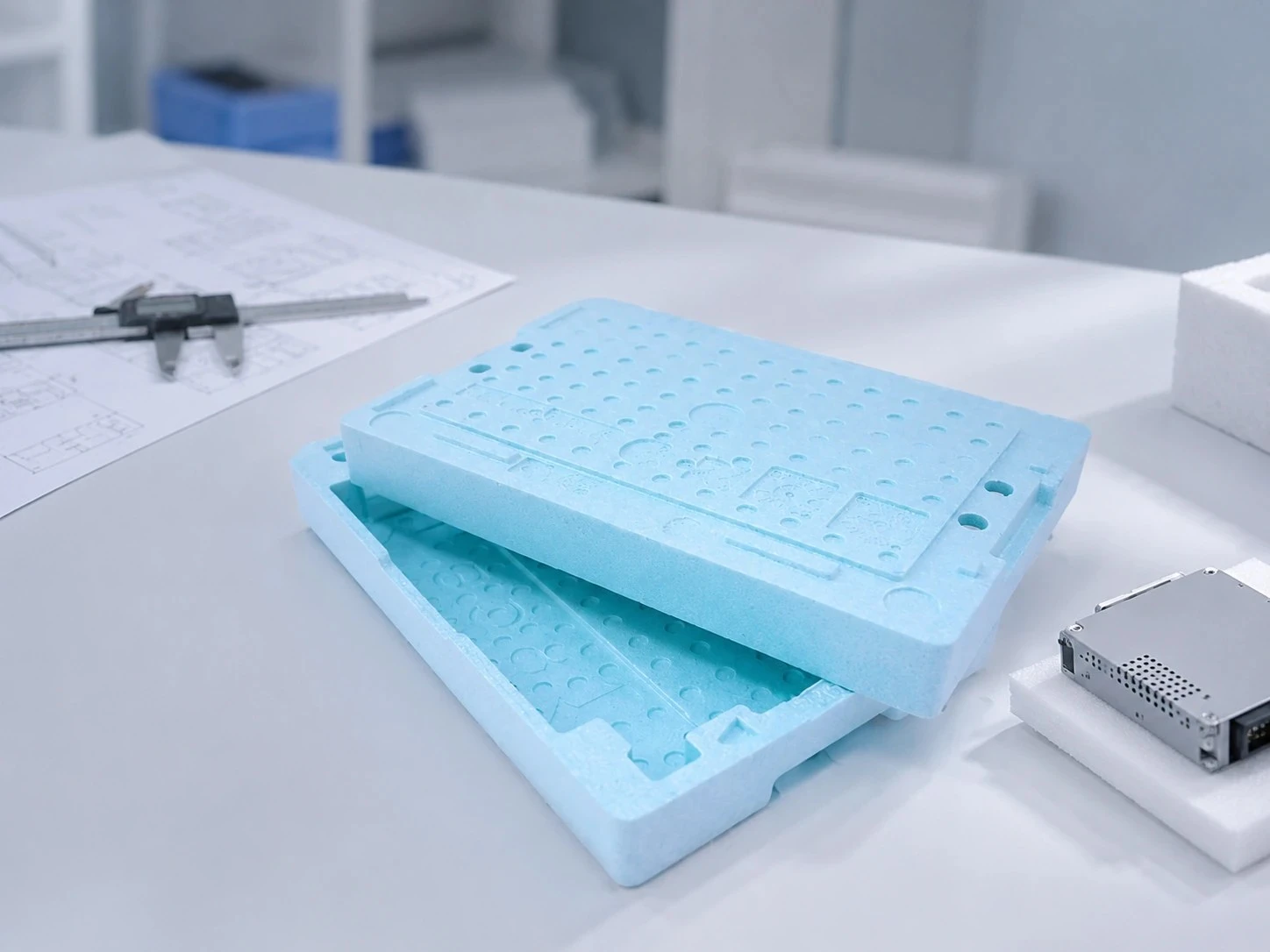
Two parts can share a nominal density and still behave differently under impact. Bead fusion decides whether the foam tears between beads or resists as one body, surface quality shows whether the cavity filled completely, and shrinkage moves the dimensions after demolding. Fusion at a corner and fusion on a flat face are not equivalent evidence, so a trial should record both.
Why dimensional repeatability between batches decides packing-line fit
A sample that fits by hand can still fail on a packing line. Operators load to a rhythm, and a cavity that varies between batches forces them either to push the product in or to add a secondary filler that nobody planned for. Measuring the same critical dimensions across several production runs shows whether the insert stays inside the tolerance the line can absorb.
How Buyers Compare Offers and Prepare a Trial
Which physical, dimensional, and recyclability details belong in a side-by-side comparison
Two quotations can look comparable while describing different products. A fair comparison puts density, compressive behaviour, the critical cavity dimensions, bead size, and the recycled content or recyclability of the material on one sheet, and marks which value came from a measured sample rather than from a catalogue range.
Which documents and acceptance records should arrive with a molded sample
A sample is more useful when it arrives with its record. Ask for the material designation, the batch reference, the measured density, the critical dimensions, and the test report behind any claim the sample is being used to prove. Those records are what let a later delivery be checked against the sample that was approved.
What to send a supplier before the first molded packaging trial
A complete brief shortens the trial. Hand over the product drawing or a physical sample, the weight distribution, the fragile features, the transport route, and the packing-line constraints, together with any damage record from the packaging in use today. A supplier who receives all of it can propose a cavity and a material direction instead of working from assumptions.
How HUASHENG Fits a Molded Packaging Project
How recycled-content REPS material matches molded packaging for electrical and industrial products
Recycled-content REPS is a modified polystyrene foam produced with recycled material, and it is used in electrical packaging, building-material packaging, fillers, and decorative parts. For molded protection it offers the combination a packaging project asks for: uniform expansion during molding, a fast cure, and a foam body rigid enough to hold a cavity through the transport route.
How the customized REPS technical team reviews cavity, density, and molding conditions against the buyer’s requirement
A packaging requirement rarely arrives as a material specification. The مخصصة REPS process starts from the project itself: the cavity and wall sections, the target density, the molding equipment, and the conditions the package has to survive. That review converts a request into a material and process direction the plant can trial.
How to open a trial by sending the project data to the HUASHENG team
Pass the drawing, target density, transport route, and packing-line constraints to هواشنغ. The team can match the material direction to the cavity and propose a trial that tests the package against the route it will actually travel.
استنتاج
Molded packaging protects a high-value product only when the foam family, the cavity, the wall sections, and the molding condition are decided together, and when the offers on the table are compared on the same physical, dimensional, and recyclability details. Settling those points before tooling gives a supplier a specification it can build to, and it is the fastest way to separate a real protection problem from a material argument. Send the product drawing, target density, and transport route to the HUASHENG technical team, and the review can start from your project instead of a catalogue range.
الأسئلة الشائعة
Q1: Can molded styrofoam packaging protect heavy or high-value products?
A1: It can, when the cavity and wall sections are designed around the actual mass and the load path is checked against the transport route. Density, bead fusion, and dimensional repeatability decide whether that protection holds across production batches.
Q2: Is molded styrofoam packaging recyclable?
A2: Expanded polystyrene packaging can be recycled, and recycled-content grades are already produced for molded packaging. Whether a specific package can be recovered depends on the material grade and on the collection route available to the buyer.
Q3: What should a buyer send before requesting a molded packaging quotation?
A3: Start with the product drawing or a physical sample, the weight distribution, the fragile features, the transport and packing-line conditions, and any damage record from the current packaging. That set lets the supplier propose a cavity and a material direction.
 Arabic
  English
  German
  Spanish
  French