
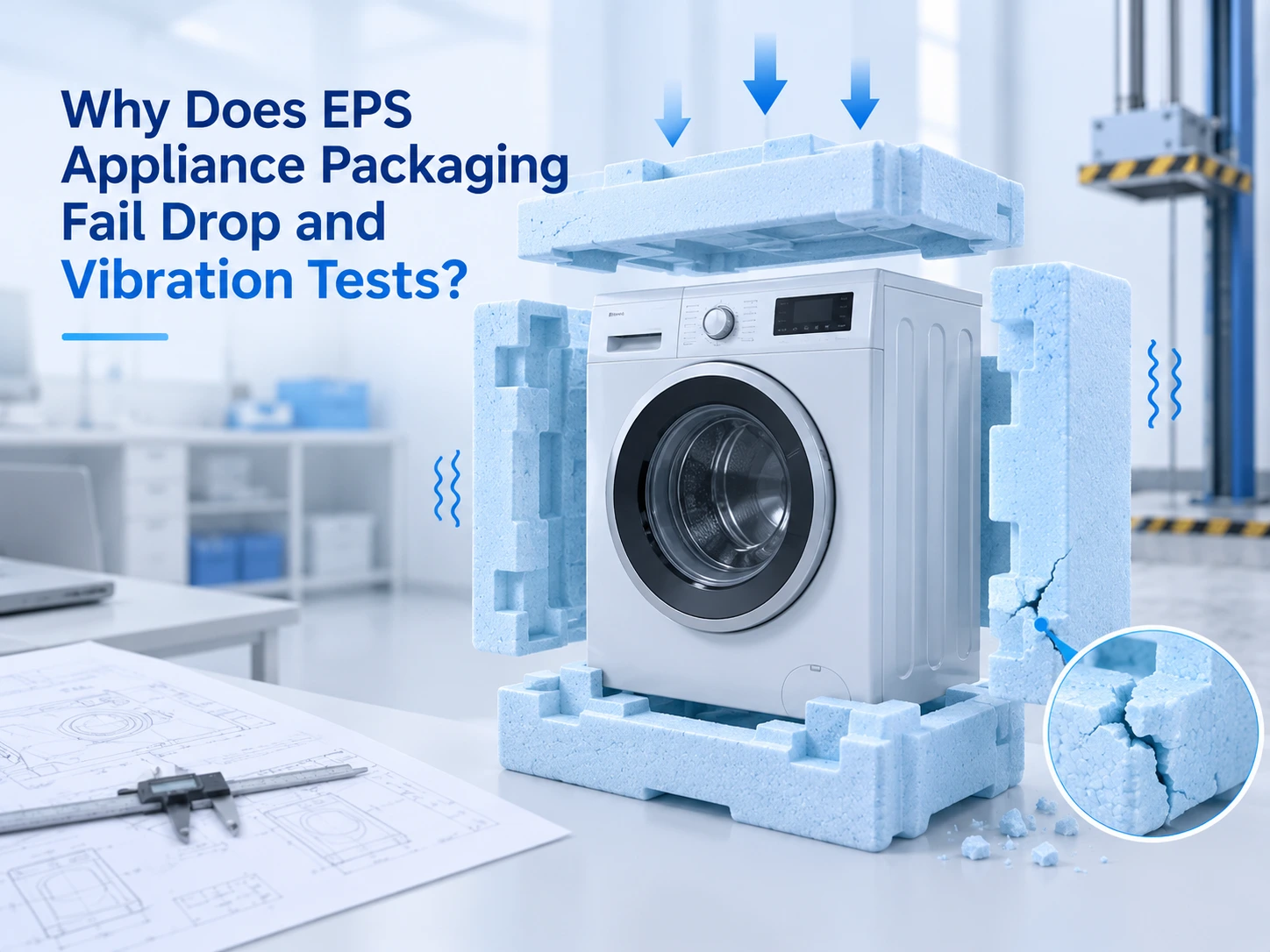
EPS packaging for refrigerators, washing machines, air conditioners, and other appliances can crack, shift, or lose protective clearance during drop, vibration, and stacking tests. A failed test is not automatically proof that the EPS grade is too weak. The useful diagnosis connects appliance weight and load paths with packaging geometry, density, bead fusion, dimensional stability, molding conditions, and the real transport profile.
What Does an EPS Appliance Packaging Failure Look Like?
Cracks at corners, ribs, parting lines, or other local stress points
A crack is the most visible outcome of a failed drop test, and its position carries more information than its size. A split at a corner, along a rib root, or beside a parting line marks a place where the molded section could not spread impact energy across enough material. Cracks that begin small and lengthen across repeated drops usually indicate a local stress concentration rather than a general shortage of foam.
Reading the crack location against the mass of the appliance narrows the diagnosis further. A split directly beneath a compressor or motor mount suggests that the load path concentrates force where the wall is thinnest. A crack on an outer face with no heavy component behind it points instead to incomplete filling or weak fusion inside the EPS packaging foam. Both look like weak material, yet they call for opposite corrections.
Insert movement that creates clearance between the foam and the appliance
An insert that shifts during vibration leaves a gap the packaging cannot recover. Once clearance opens between the molded cavity and the appliance surface, the next impact travels through fewer contact points, and the remaining contacts absorb more energy than the design intended. Movement of a few millimeters is therefore a real failure even when no crack has formed.
Clearance also explains why a package can pass an early drop and fail later in the same sequence. Each event nudges the insert a little further, and the load spreads across a smaller area. Recording how far the appliance moves after the vibration stage, rather than only whether the foam broke, gives the factory a more sensitive reading of the same problem.
Bottom crushing or loss of support after stacking and vibration
Bottom crushing rarely appears during a single impact. It develops when the lower sections carry a static stack load for hours and then absorb vibration on top of that load. The base of the EPS appliance packaging compresses, the appliance settles, and the protective clearance around the top and sides changes without an obvious break.
This mode is easy to miss because the carton still looks intact after the test. Measuring the height of the base sections before and after vibration shows whether the foam has yielded. Once the base loses thickness, the whole support system shifts position, and later results no longer describe the design that was originally approved.
How Do Appliance Loads and Packaging Structure Change the Test Result?
How appliance weight and center of gravity define the main load paths
Every appliance distributes its weight unevenly. A refrigerator concentrates mass at the compressor and along the base frame; a front-loading washing machine carries a heavy drum and counterweight near the front face; a wall-mounted air conditioner moves its mass toward the bracket side. The structure of the EPS appliance packaging has to follow those concentrations instead of treating the product as a uniform block.
The center of gravity decides which faces take the first impact and which faces merely follow. Mass that sits close to one edge converts more of the fall into local compression on that side. Drops on the opposite face can look harmless in the same test, which is why a single pass or fail result rarely describes the whole package.
Why corners, contact areas, ribs, and wall thickness must be checked together
Corners, contact areas, ribs, and wall thickness work as one system. A thick wall with a poorly supported corner still collapses when the appliance rotates in the air, and a well-designed corner cannot compensate for a contact area that is too small to hold the appliance in place. Reviewing these features together shows where the molded part is genuinely strong and where it only appears strong.
Section thickness also changes how quickly the foam fills and cools. A rib that is too thin may not fuse completely, while a wall that is too thick consumes more material without improving protection. Adjusting one feature usually moves the load into a neighboring feature, so the EPS packaging foam review has to treat them as a set rather than as separate line items.
How drop orientation, vibration profile, stacking duration, and transport restraint affect the failure mode
Transport conditions decide which failure mode appears first. Drop orientation determines where impact energy enters the package, the vibration profile determines how long the contact points are cycled, stacking duration sets the static load on the base, and the restraint method decides how much the appliance can move inside the carton. Changing any one of them changes the result.
Testing that copies the real route is therefore more useful than testing a single worst-case drop. A package tested only on its base may hide the corner behavior that appears when the same carton falls on an edge during loading. Aligning the test protocol with the actual shipping route keeps the comparison honest.
Which EPS Material and Molding Variables Should Be Checked?
Why target density must be matched to local stress instead of judged only by an average value
Density is usually reported as one number for the whole molded part, but stress is not distributed evenly across that part. The base rails, corner blocks, and rib roots that carry the appliance need more material than a large flat panel that only fills space. Matching target density to local stress keeps material where it protects the product instead of raising the average for the whole molding.
An average figure can also hide a real weakness. Two parts can share the same nominal density while one has dense corners and lighter walls and the other is the reverse. Mapping density across the part, rather than quoting a single value, shows which sections actually carry the transport load.
How bead size, cell structure, steam conditions, aging, and bead fusion affect molded protection
Bead size, cell structure, steam conditions, aging time, and bead fusion decide how the molded part behaves under impact. Fine beads fill narrow ribs and detailed corners more reliably, while a uniform cell structure spreads impact energy more evenly. Steam pressure and time control how completely the beads expand and bond inside the mold, and the choice of expanded polystyrene packaging material sets the starting point for both.
Aging matters because freshly expanded beads still contain residual blowing agent and moisture. If they are molded too early, the part can shrink or develop weak fusion that only appears after the transport test. Checking fusion at corners and rib roots, not only on flat surfaces, gives a realistic picture of how the appliance packaging foam will behave.
Why shrinkage, warpage, and dimensional stability can create gaps before the transport test begins
Shrinkage and warpage can open a gap before the package is ever dropped. When a molded part pulls away from the intended dimensions, the cavity no longer matches the appliance, and the clearance that was designed as a protective buffer becomes free movement. The test then measures a geometry problem rather than a material problem.
Dimensional stability should be verified after the part has cooled and relaxed, not immediately after demolding. Measuring critical dimensions at a defined interval after production, and again before shipping, shows whether the part continues to move. A stable part keeps the fit the EPS packaging was designed around, while an unstable one loses protection gradually during storage.
How Can a Factory Separate Design, Process, and Material Causes?
What a controlled comparison can reveal when the same grade behaves differently in two molds
The clearest way to separate design, process, and material causes is to change one variable at a time. If the same EPS grade passes in one mold and fails in another, the material is unlikely to be the main cause, and mold geometry, gate position, steam supply, or cooling differences become the more probable sources. A controlled comparison makes that difference visible.
Running the comparison on the same machine, with the same operator and the same batch, removes most of the noise. When the results still diverge, the mold becomes the leading explanation. When both molds fail in the same way, the material or the process window deserves the next round of attention.
How to use failure location, density mapping, fusion checks, and dimensional records as a diagnostic trail
A reliable diagnosis needs a trail, not a single observation. Failure location shows where the test loaded the part, density mapping shows whether material was distributed as intended, fusion checks show whether the beads bonded completely, and dimensional records show whether the part changed before or after the test. Read together, these four records point to one cause instead of four opinions.
Keeping the records attached to the batch number matters as much as taking them. If a later shipment fails, the factory can compare it with the batch that passed and see which measurement moved first. That comparison is worth far more than an argument about whether the foam felt different.
Why repeat trials and batch records matter before changing the EPS grade
Changing the grade is the most expensive correction available, so it should be the last one considered. If a small adjustment to the mold, the steam window, or the aging schedule removes the failure, the original grade was never the problem. Repeat trials confirm that the correction holds across more than one lucky run.
Batch records make the decision durable. They show which combination of grade, density, mold, and process window produced an acceptable package, and they give the next production order a reference point. Without that reference, a change made for one test can quietly create a new problem in the next shipment.
How Does HUASHENG Rapid Prototyping Grade – B Fit an Appliance Packaging Trial?

How to review the official application and molding information on HUASHENG Rapid Prototyping Grade – B product page for electrical-appliance packaging
إن HUASHENG Rapid Prototyping Grade – B product page sets out the grade’s intended processing behavior and application direction in one place. Reading it before a trial keeps the discussion anchored to documented properties rather than general claims about foam strength. Buyers can then compare the published material description with the molding equipment, the target density, and the transport test they intend to run.
That page also works as a checklist of the questions a supplier needs answered. Application, expansion behavior, and typical processing conditions all matter for electrical-appliance packaging, where a heavy product and a complex cavity meet. Reviewing the information first reduces the chance of running a trial against the wrong expectation.
Why fast foaming, stable molding, smooth surfaces, and strong bead fusion are useful trial criteria
Fast foaming, stable molding, smooth surfaces, and strong bead fusion are useful trial criteria because each one can be observed during the run rather than only after a failure. Rapid expansion supports shorter cycles, a stable molding window reduces scrap, a smooth surface indicates good cavity filling, and strong fusion at corners shows that the part will hold together under impact.
Together these criteria describe a grade that behaves predictably in production. Predictability is what the trial actually needs, because the same settings should produce the same part on the next shift and the same appliance packaging foam should protect the appliance in the next drop and vibration sequence.
Which appliance dimensions, target density, machine type, mold details, and transport test conditions should be confirmed before selecting a starting grade
A trial starts with data, not with a grade number. Appliance dimensions, weight distribution, target density, molding machine type, mold cavity layout, gate position, and the intended drop and vibration conditions all shape the starting recommendation. Sending these details with the enquiry shortens the distance between a sample and a production-ready package.
Buyers who can also supply the current failure evidence get a more precise answer. Photographs of crack locations, dimensional records, and the test protocol show where the package is losing protection, which allows the material discussion to focus on the sections that actually need to change. A trial that starts from these details, rather than from a generic expanded polystyrene packaging material comparison, produces a result the factory can use. The HUASHENG contact page is the place to send that material.
استنتاج
EPS appliance packaging failures should be traced through the complete system: load path, structure, material, molding, dimensions, and transport conditions. For projects that need a rapid-prototyping starting point for electrical-appliance packaging, HUASHENG Rapid Prototyping Grade – B can be evaluated against the actual part geometry, machine window, and test requirement.
الأسئلة الشائعة
Q1: Does Higher EPS Strength Always Solve an Appliance Packaging Test Failure?
A1: No. Strength is only one variable. Load path, wall thickness, density distribution, bead fusion, dimensional stability, and the transport profile all influence whether the package survives, so a stronger grade can leave the original cause untouched.
Q2: Why Can a Package Pass a Drop Test but Fail a Vibration Test?
A2: A drop test loads the package in one short event, while vibration cycles the same contact points for much longer. Inserts can creep, the base can compress, and clearance can open gradually, so a design that survives a single impact may still fail after hours of movement.
Q3: What Information Should a Buyer Send Before Requesting an EPS Appliance Packaging Recommendation?
A3: Send the appliance dimensions and weight distribution, the target density, the molding machine and mold details, the current failure evidence, and the intended drop, vibration, and stacking conditions. That combination lets the supplier match a grade to the real production and test requirement.
 Arabic
  English
  German
  Spanish
  French