
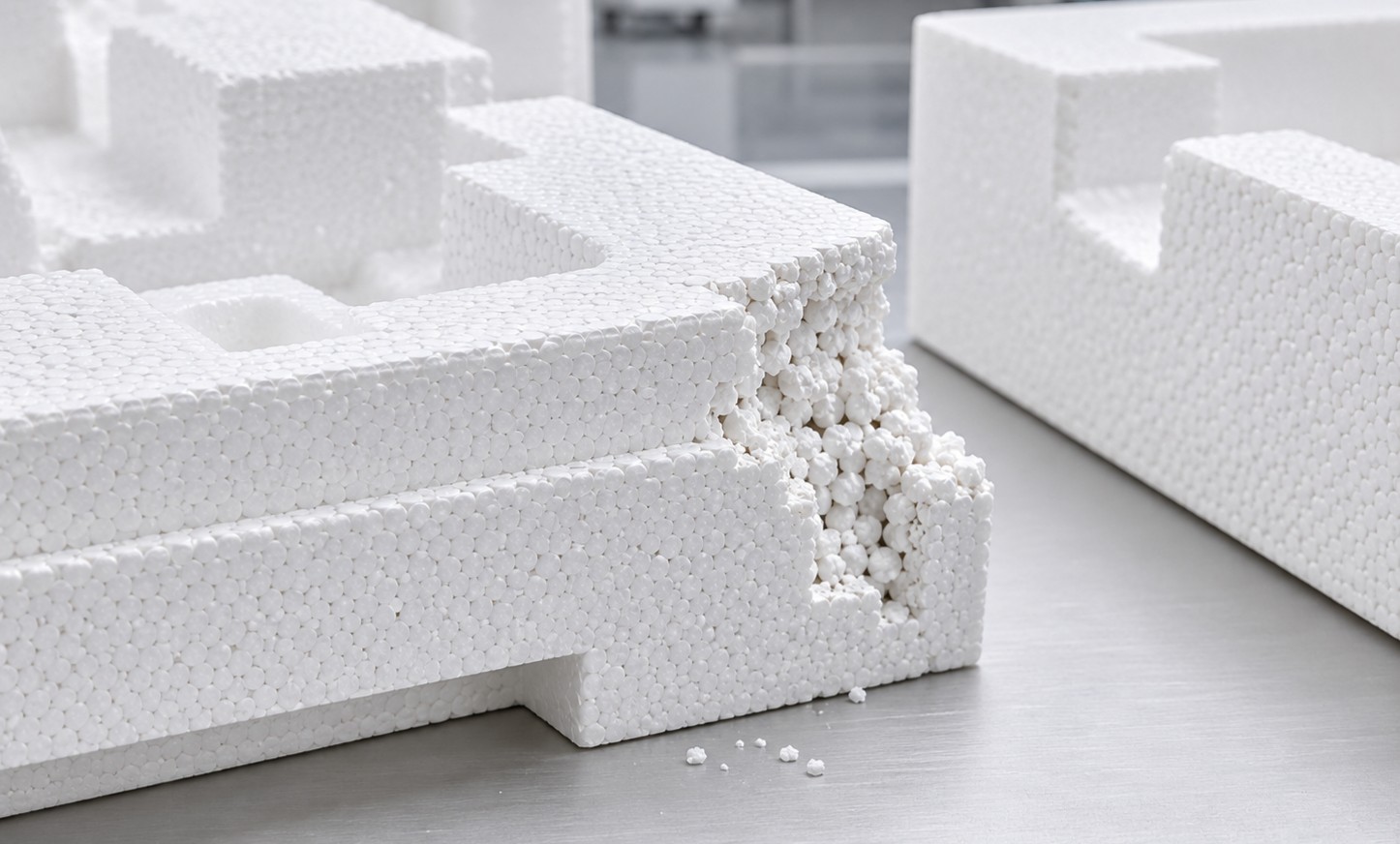
In a high-standard EPS project, a part can leave the mold looking complete and still carry a serious internal weakness. The trouble may appear later as loose beads, cracked edges, poor stacking strength, or a loss of insulation performance after transport and installation. That is why fusion deserves attention before a buyer approves a material grade or a large production run. The final result depends on more than the resin name. Pre-foaming, maturation, steam conditions, particle size, and inspection all have to work together.
What Poor Fusion in EPS Foam Really Means
Poor fusion in EPS foam is a molding defect in which pre-expanded EPS beads do not join strongly enough to form one continuous and stable foam structure. The beads may appear to be stuck together, but the bond between neighboring beads remains weak. Clear interfaces and internal voids can still be present.
In a normal process, steam softens the polymer surface of the pre-expanded beads. Pressure and heat bring adjacent beads into contact, and the softened surfaces fuse bead to bead. After cooling and demolding, the part should behave as one body rather than as a loose collection of individual particles.
This distinction matters during procurement. A smooth outer skin is not proof of good internal fusion. If the center of a block, tray, or insulation panel has weak bonding, the defect may only become visible when the part is cut, compressed, dropped, stacked, or installed.
What Poor Fusion Costs in the Field
Mechanical and dimensional damage
The first signs are often loose beads at a cut edge, powdering during handling, or small cavities exposed after trimming. As the load increases, weakly fused areas can crack sooner than the surrounding foam. Compressive strength falls, impact resistance becomes less predictable, and a part may not return to its intended shape after loading.
Dimensional stability is another practical concern. Uneven fusion and uneven cooling can create local shrinkage or thickness variation. For a packaging insert, that may leave a product sitting too tightly in one area and too loosely in another. For an insulation board, it can produce installation gaps and extra site work.
Different applications expose different risks
Building insulation needs stable dimensions and consistent thermal performance across the panel. A weak internal structure can damage edges during cutting and fixing, which makes the installer compensate with more joints, filler, or replacement pieces. The problem is not only material waste; it can also affect the finished building envelope.
Packaging and transportation projects depend on the foam absorbing shocks without shedding particles or collapsing at contact points. Electronics, medical products, automotive parts, and other sensitive goods may arrive with damage even when the packaging looked acceptable before dispatch. Cold-chain and seismic packaging face similar pressure because repeated movement exposes weak bonds quickly.
Why EPS Beads Develop Poor Fusion
Maturation time is too short
After pre-foaming, EPS beads need time to stabilize before molding. If the maturation period is too short, internal pressure, moisture, and bead surface conditions may still be changing. The beads can fill the mold but fail to form an even bond when the steam cycle starts.
Steam conditions are not matched to the mold
Low steam pressure, unstable temperature, a short heating period, or poor venting can leave the center of a part under-fused. A cycle that is too aggressive creates a different set of problems, including over-shrinkage, surface damage, and dimensional drift. The process window has to fit the bead grade, mold geometry, and target density.
Material and particle size do not fit the process
Ordinary EPS, مقاوم للشعلة EPS, and graphite-modified EPS are not interchangeable in every molding setup. Their expansion behavior, density target, and end-use requirements may call for different pre-foaming and steam settings. Particle size also affects packing and steam penetration. A broad or unstable size distribution can leave larger gaps, restrict heat flow, or create local density differences.
هواشنغ develops EPS materials for building insulation, packaging and transportation, cold-chain logistics, prefabricated construction and seismic packaging. Its material range includes ordinary, flame-retardant, and graphite-modified EPS, so the sensible procurement question is not simply which grade is cheapest. It is whether the selected grade, particle size, and molding route match the finished part.
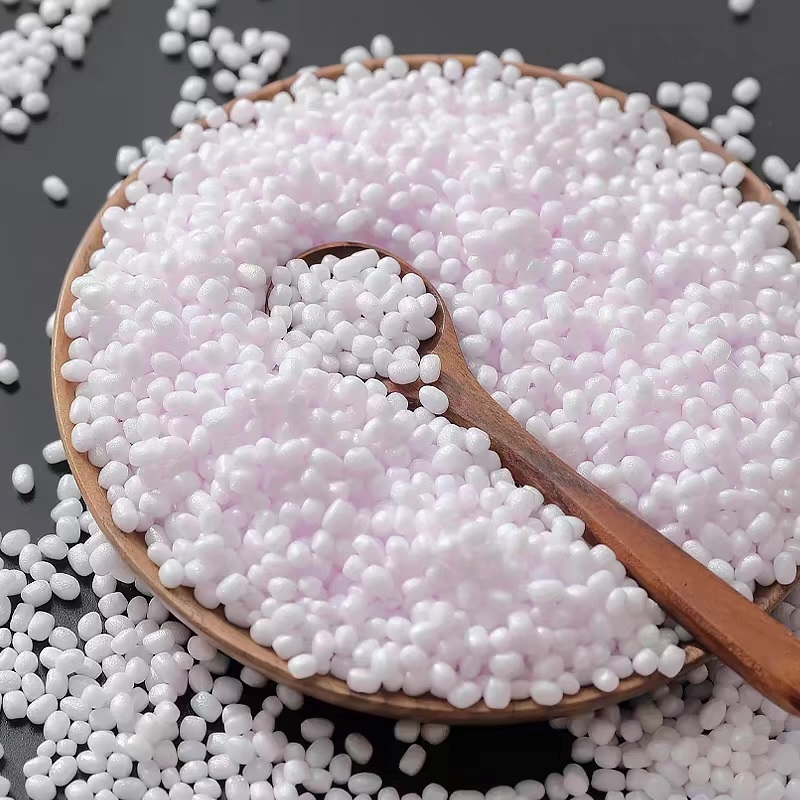
For projects that need finer particle control or more toughness, HUASHENG also works with ريبس materials. Standard REPS particle size is described at about 0.8-1.2 mm, with project-specific production available; a tray example uses 0.65-0.8 mm particles. That kind of adjustment can help refine structure, but it still needs to be validated on the actual mold and product geometry.
How Buyers Can Check Fusion Before Mass Production
A sample approval should go beyond color, surface finish, and a quick hand check. Cut several samples through the center and corners. Look for continuous contact between beads, large voids, weak layers, and areas that shed particles when trimmed. Record the location of each defect instead of accepting a general statement that the part is fused.
Mechanical checks should cover compressive strength, impact behavior, density uniformity, and dimensional change after demolding. The test conditions should match the application. A packaging insert needs drop and stacking checks; an insulation board needs thickness and dimensional checks; a cold-chain component needs a practical temperature and handling sequence.
The supplier should also repeat the test across more than one production batch. Poor fusion caused by short maturation or drifting steam conditions may not appear in the first sample. Batch comparison is especially important for buyers supplying multiple distributors or projects under one private label.
How Procurement Teams Can Reduce the Risk
Start with the finished product, not only the raw material name. Confirm the target density, compression requirement, particle size, dimensional tolerance, flame-retardant need, thermal performance, and actual service environment. Then ask the supplier to map those requirements to a grade, pre-foaming condition, and molding cycle.
The approval file should include the sample dimensions, test methods, acceptance limits, steam-cycle range, maturation requirement, and rules for handling an out-of-spec batch. Without those details, a buyer may receive a sample that passes by appearance while the mass-production team changes the process to meet output pressure. That is how batch inconsistency turns into rejected packaging, installation rework, and customer complaints.
Supplier capability should be judged through evidence that supports repeatability: process records, density and strength testing, particle-size control, mold trials, retained samples, and a clear replacement or corrective-action process. HUASHENG combines EPS production with precision testing equipment and a digital laboratory covering material and process simulation. Those capabilities are useful only when the buyer connects them to a written project specification and a repeatable sample test.
MOQ and delivery timing also deserve attention. A low initial MOQ may be attractive, but if the supplier cannot keep the same grade, particle size, and process window for the next batch, the buyer may carry an inconsistent product line. Confirm how raw material lots, packaging, labeling, spare stock, and after-sales support will be handled before committing to a high-standard application.
Poor fusion is preventable when the process is treated as a chain rather than a single steam setting. Stable beads, adequate maturation, suitable particle size, controlled steam, and practical batch testing give buyers a much better basis for approving EPS foam. The final decision should follow the finished application and its failure cost.
أسئلة متكررة
Q1: Can a good-looking EPS surface prove that fusion is sufficient?
A1: No. Internal voids and weak bead interfaces may remain under a smooth skin. Cut-section inspection, particle-shedding checks, and application-based strength tests are still required.
Q2: Which applications are most sensitive to poor fusion?
A2: Protective packaging, building insulation, cold-chain logistics, and high-load prefabricated applications are particularly sensitive because weak fusion can reduce impact resistance, thermal consistency, dimensional stability, and product protection.
Q3: What should buyers confirm with HUASHENG before approving an EPS order?
A3: Confirm the EPS grade, density, particle size, pre-foaming condition, maturation time, steam-cycle range, test method, batch consistency plan, and corrective-action process. The selected material should be tested on the actual product geometry before mass production.
 Arabic
  English
  German
  Spanish
  French