
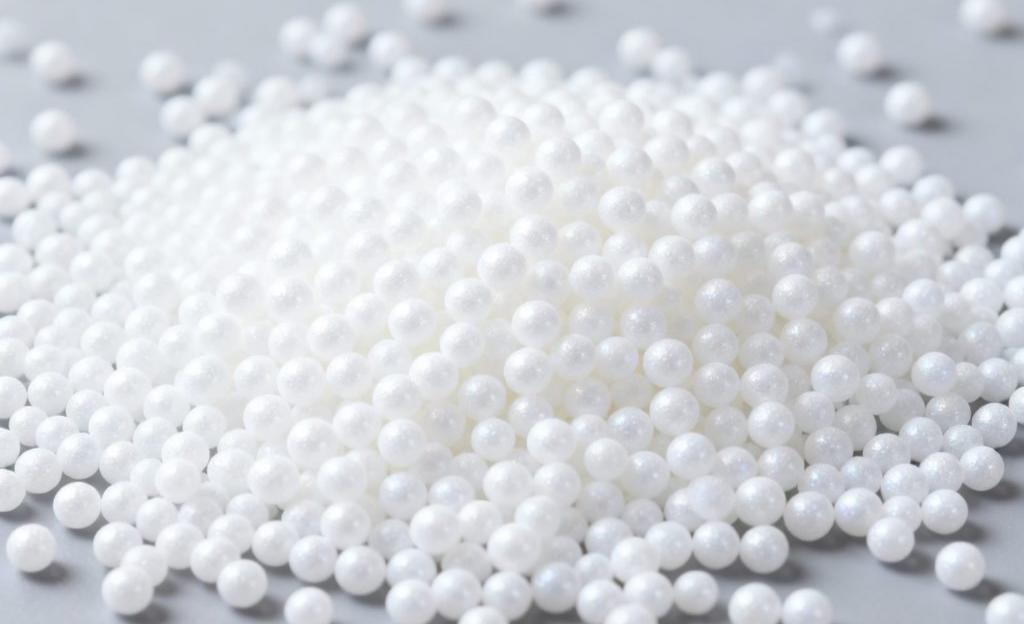
Before placing REPS orders in 2026, buyers should not only ask for a price and delivery time. For packaging converters, exporters, distributors, and brand project teams, foam material data can decide whether the final product works well in real transport, molding, storage, and repeat orders.
Why REPS Data Review Matters Before Bulk Orders
REPS is a high-performance foam material widely used in foam packaging material and EPS construction material applications. Produced from modified polystyrene, REPS combines moderate toughness with versatile properties, suitable for projects requiring both strength and lightweight design.
REPS foam is used in packaging, construction material, food-grade packaging, electronics, medical products, display panels, automotive parts, new energy products, mobile phones, and tablets. These applications do not share the same risk level. A fruit box, a display panel tray, and a medical packaging insert cannot use the same decision logic.
Many sampling delays start from unclear technical data. If the buyer does not define density, strength, molded tolerance, or packaging test needs, the first sample may not match the real use. This is why REPS physical performance data matters. It gives both sides a common basis. Instead of saying “make it stronger,” the buyer can ask for a density range, compression result, puncture resistance, or particle size target.
What Basic REPS Material Data Should Buyers Check First
Density, foaming rate, and particle size should be checked before discussing mold cost or bulk price.
Density Range and Foaming Rate
Density affects strength, weight, cushioning, and cost. In the REPS physical data, the foaming rate from 20 to 40 corresponds to density from 50 g/L down to 25 g/L. As density drops, the material becomes lighter, but strength also changes.
This is normal. The key is not to choose the highest density every time. Heavy goods or fragile products may need higher density. Lightweight goods may work better with lower density if cost and shipping weight matter more.
Particle Size and Custom Size Options
Particle size affects molded detail, surface finish, and small cavity forming. The REPS data show tested bead particle size around 0.76 mm, while some tray-type products may use finer particle size ranges, such as 0.65–0.80 mm. For detailed molded trays, smaller particles can help improve surface structure and cavity accuracy. For larger cushioning blocks, a standard particle size may already be enough. HUASHENG’s independent design of REPS raw material production equipment enables multi-layered particle sizes of 0.8 mm.
Closed-Cell Structure and Lightweight Performance
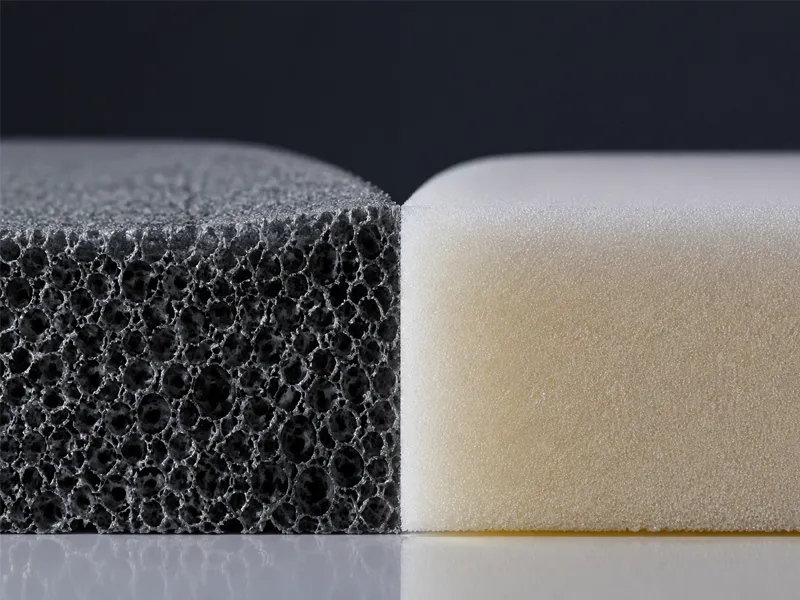
REPS belongs to an independent closed-cell foam structure. This matters because closed cells help with lightweight design, moisture resistance, and cushioning behavior. For export packaging, weight is not a small issue. Lower packaging weight can reduce freight pressure, but the foam still needs enough strength to protect the product.
Which Mechanical Performance Data Matters Most
Mechanical data tells buyers whether REPS can handle real handling pressure.
Compressive Strength Under Different Deformation Levels
Compressive strength is one of the most useful indicators for packaging. In the REPS data, 10% deformation compressive strength ranges from 258 kPa at 50 g/L density to 105 kPa at 25 g/L density. At 50% deformation, the value ranges from 382 kPa to 180 kPa. These numbers help buyers judge whether the foam can handle stacking, pressure, and repeated logistics movement. If the goods are heavy or cartons are stacked high, lower-density foam may not be enough.
Puncture Resistance, Tear Strength, and Flexural Strength
Puncture resistance matters when products have sharp corners, metal edges, or small concentrated pressure points. The REPS data shows puncture resistance from 67.7 N down to 26.8 N across different density levels. Tear strength and flexural strength are also worth checking when packaging parts are thin, curved, or handled many times before final packing. If an insert cracks during assembly, the material price no longer matters.
Tensile Strength and Elastic Modulus for Structural Stability
Tensile strength and modulus data help buyers understand whether the material can keep its structural behavior during use. REPS is often selected because it offers better toughness and non-flaking performance than standard EPS.
What Stability Data Should Buyers Review for Export Packaging
Export packaging faces temperature change, humidity, sea freight, storage time, and repeated handling. Stability data is important for buyers shipping goods across markets.
Dimensional Stability Under High and Low Temperatures
The REPS physical data includes dimensional stability under 23℃ to 80℃ and back to 23℃, as well as 23℃ to -30℃ and back to 23℃. The listed length and width changes remain low across density levels.
Pour cold-chain packaging, warehouse storage, or export shipping, dimensional stability helps the molded insert keep its fit. If the foam changes shape too much, the product may loosen inside the carton. REPS is a better alternative to EPS construction material and foam packaging material, with production supported by HUASHENG—leading EPS bead suppliers and expandable polystyrene factories.
Water Vapor Transmission Rate and Moisture Resistance
The water vapor transmission rate in the data ranges from 0.309 to 0.575 g/(m²·h). Buyers working with food, medical products, or humid logistics conditions should review this data carefully. REPS also shows low water absorption and superior moisture resistance in the comparison table. This is useful for packaging that may face long storage, temperature change, or humid shipping routes.
Non-Flaking Performance for Clean Packaging Environments
Non-flaking performance is a practical issue. Standard EPS can sometimes create loose particles or surface flakes. For electronics, display panels, medical packaging, and clean industrial parts, this can be a problem. REPS shows superior non-flaking performance compared with EPS. For buyers who need cleaner molded parts, this is one of the strongest reasons to test REPS.
How Production Process Data Affects REPS Order Consistency
Good material data is only useful when the supplier can produce it again and again. Production process data helps buyers check this.
Pre-Expansion Temperature, Cycle Time, and Density Control
The REPS production process data include a pre-expansion temperature of 85°C±2°C and a cycle time of 100–200 seconds. These conditions affect bead expansion and final density. If density is not stable during pre-expansion, the final molded part may have inconsistent strength or weight.
Curing Time and Silo Storage for Batch Stability
Curing time is listed as 4–8 hours, with silo storage details. This step allows the beads to stabilize before molding. For bulk procurement, curing control is important because rushed material may behave differently in molding. A supplier with proper curing control usually has better batch stability.
Molding Pressure, Cooling Time, and Vacuum Stabilization
Molding data includes steam pressure of 0.55–0.85 bar, cooling time of 1–5 seconds, and vacuum stabilization of 50–90 seconds. These details affect surface quality, shrinkage, cycle time, and molded accuracy.
For buyers making custom trays or inserts, this data helps explain why one sample looks stable while another warps or shrinks.
Drying and Air-Drying Steps for Final Product Reliability
The production data also includes drying at 50°C±5°C for 8 hours and air-drying for 24 hours under indoor temperature and humidity conditions. These final steps help reduce moisture-related issues and improve product stability before packing or shipping.
Procurement Advice Before Placing 2026 REPS Orders
Before placing orders, buyers should connect the material data with the real product risk.
Match Data Requirements With Product Risk
Heavy, fragile, or high-value products should use stricter density, compression, puncture, and dimensional stability requirements. Low-risk products may not need the highest specification.
Request Samples, Mold Trials, and Packing Tests
Samples should be tested with real products, cartons, and logistics conditions. Drop tests, compression tests, fitting checks, and long-storage checks are all useful before bulk approval.
Confirm MOQ, Lead Time, Customization Scope, and Repeat Batch Control
Buyers should confirm MOQ, lead time, particle size options, color, density range, mold support, export packing, and after-sales response before placing mass orders. HUASHENG« les REPS and customized REPS options are worth reviewing when projects need adjusted particle size, stable molded parts, and repeat batch supply.
FAQ (questions fréquentes)
Q1: What data should buyers check first before ordering REPS foam?
A1: Buyers should first check density, particle size, foaming rate, compressive strength, puncture resistance, dimensional stability, water vapor transmission rate, MOQ, and lead time. These data points help confirm whether REPS fits the product risk and shipping route.
Q2: Why does particle size matter in REPS molded packaging?
A2: Particle size affects molded detail, tray surface, cavity accuracy, and product fit. Smaller particle sizes are useful for detailed trays and electronic packaging, while standard particle sizes may work for general cushioning or larger molded parts.
Q3: Can HUASHENG support customized REPS orders for different packaging projects?
A3: Yes. HUASHENG can support REPS and customized REPS projects where buyers need adjusted density, particle size, color, molding behavior, samples, bulk supply, and after-sales technical communication. Buyers should confirm these details before mass production.
 French
  English
  German
  Spanish
  Arabic