

A cold room is insulated twice: once when the material is chosen, and again when the delivery is checked against the room. The second check is where most of the cost surprises sit. A board can match the nominal thickness on the drawing and still leave the room short of its targets if its density, compressive behaviour, or moisture path does not fit the temperature class and the way the room is built.
Choosing cold storage insulation is therefore less about picking a favourite material and more about matching a specification to a set of operating conditions. EPS has a clear place in that decision, and it has conditions where it belongs to a different build-up.
What the Room Actually Asks of the Insulation
The Temperature Class Sets the Load
The room sets the requirements long before a supplier quotes them. A chiller, a freezer, and a blast freezer do not put the same demand on a wall. A chiller holds a steady moderate temperature; a freezer works across a larger gradient and spends more of its life fighting moisture migration; a blast freezer adds rapid cycling. The insulation thickness that holds one of those conditions may not hold another, and the difference is not a matter of opinion. It follows from the temperature difference the envelope has to sustain and the duration of the pull-down.
That is why the same EPS grade can be correct in one room and under-specified in the next. The material has not changed. The load has.
Where Condensation Wants to Form
Moisture control decides more cold-room performance than most buyers expect. Warm air carries water vapour, and the envelope has to keep that vapour from reaching the cold side, where it condenses. Insulation slows heat, but it does not replace a vapour barrier, and it does not fix a construction detail that leaves a path for air movement.
In practice, the vapour-control layer belongs on the warm side of the assembly, and the insulation is judged on whether it can stay dry and dimensionally stable behind that layer. When a room fails early, the cause is often a discontinuity at a panel joint, a penetration, or a floor-wall intersection rather than the board itself.
Reading an EPS Specification for Cold Rooms
Density Tells You What You Ordered
Once the room requirements are clear, the specification has to say what the material must do. Density describes how much material is packed into a given volume, and it is the number most often quoted in a quotation. It is a useful control: it tells the buyer what grade was supplied and how consistent the material is expected to be. It does not, by itself, state how the board behaves under load or how it performs across a temperature gradient with moisture present.

That distinction matters at the point of acceptance. If the order names density and nothing else, a delivery can be correct against the order and still be the wrong product for the room.
Compressive Behaviour and Thickness
Compressive behaviour is the property that describes how the board responds when something presses on it, and it becomes important the moment insulation carries a load: a floor panel under a pallet, a wall that receives racking, or a ceiling that has to hold its own fixings. Thickness and compressive behaviour work together here, because the panel that carries a load and the panel that closes a wall are not always the same specification.
The practical answer is to state the property the room needs rather than the property that is easiest to quote. A supplier who can explain both the density and the compressive behaviour of the offered grade, and can show how the material was checked, is answering the question the cold room asked. Buyers who want a wider view of the material family can compare EPS material grades for insulation before narrowing to one specification.
Verifying the Board Before It Goes on the Wall
Sample, Dimensions, and Batch Evidence
Specification and delivery are two different risks, and the second one is easier to control than most projects expect. A sample proves the process that produced it, not the yard around it. Two suppliers can send boards that look identical and behave differently, so the sample conversation should settle what is being accepted and how it was measured. Dimensions belong in the same conversation: thickness, length, edge condition, and the tolerance the site can actually install.
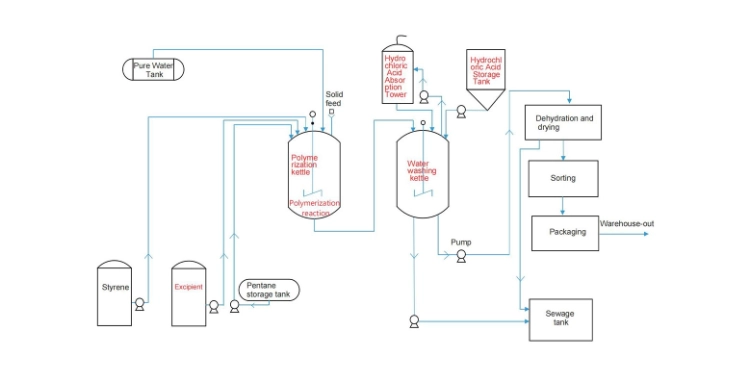
Batch evidence is the third leg. Density control is a production outcome, not an accident, and buyers who want to understand what makes it repeatable can read how EPS density is controlled during pre-expansion. The point is not to audit a factory. It is to know whether the board in the next delivery will match the board in this one.
What to Put in the Purchase Order
Four statements turn the room requirements into an order that can be accepted or rejected without argument. Name the temperature class and the assembly the board belongs to. Name the density grade and the compressive requirement as separate properties. Name the dimensions and edge condition the site can work with. Name the measurement basis for the sample and for the delivery.
A fifth line is worth adding: who confirms the vapour-control detail and the joints. Insulation performance in a cold room is a system result, and the buyer who writes that responsibility into the order avoids discovering it during the first pull-down. Long-term performance is also a material question that sits apart from the day of installation, which is why how EPS behaves over its service life belongs in the specification discussion rather than in a warranty claim afterwards.
Conclusion
Cold-room insulation should be specified from the room back to the material: the temperature class and pull-down set the load, the vapour path decides how the assembly must be built, and the board specification follows from both. Density and compressive behaviour then have to appear as separate requirements, with dimensions, edge condition, and a measurement basis that the delivery can be checked against. HUASHENG documents its EPS production and testing approach and the grade range it supplies, so the specification conversation can stay on the material properties the room actually needs.
Questions fréquentes
Q1: Can EPS be used in a freezer as well as a chiller?
A1: The material can serve both, but the specification changes. A freezer works across a larger temperature gradient and with more moisture migration than a chiller, so thickness, vapour control, and the compressive requirement for any loaded panel all need to be re-checked rather than carried across from the other room.
Q2: Is a higher density EPS always better for a cold room?
A2: No. Density is a control on what was supplied and how the material is expected to behave, but it does not describe load behaviour on its own. Where a panel carries racking or foot traffic, the order should name the compressive requirement and have it verified at the expected density.
Q3: What should be measured on a delivered board?
A3: Measure what the order stated: the density grade, the compressive requirement where it applies, and the dimensions and edge condition the site will install. Agree the measurement basis for the sample and the delivery in advance, so a deviation can be attributed to the process rather than to the way someone held the tape.
 French
  English
  German
  Spanish
  Arabic