
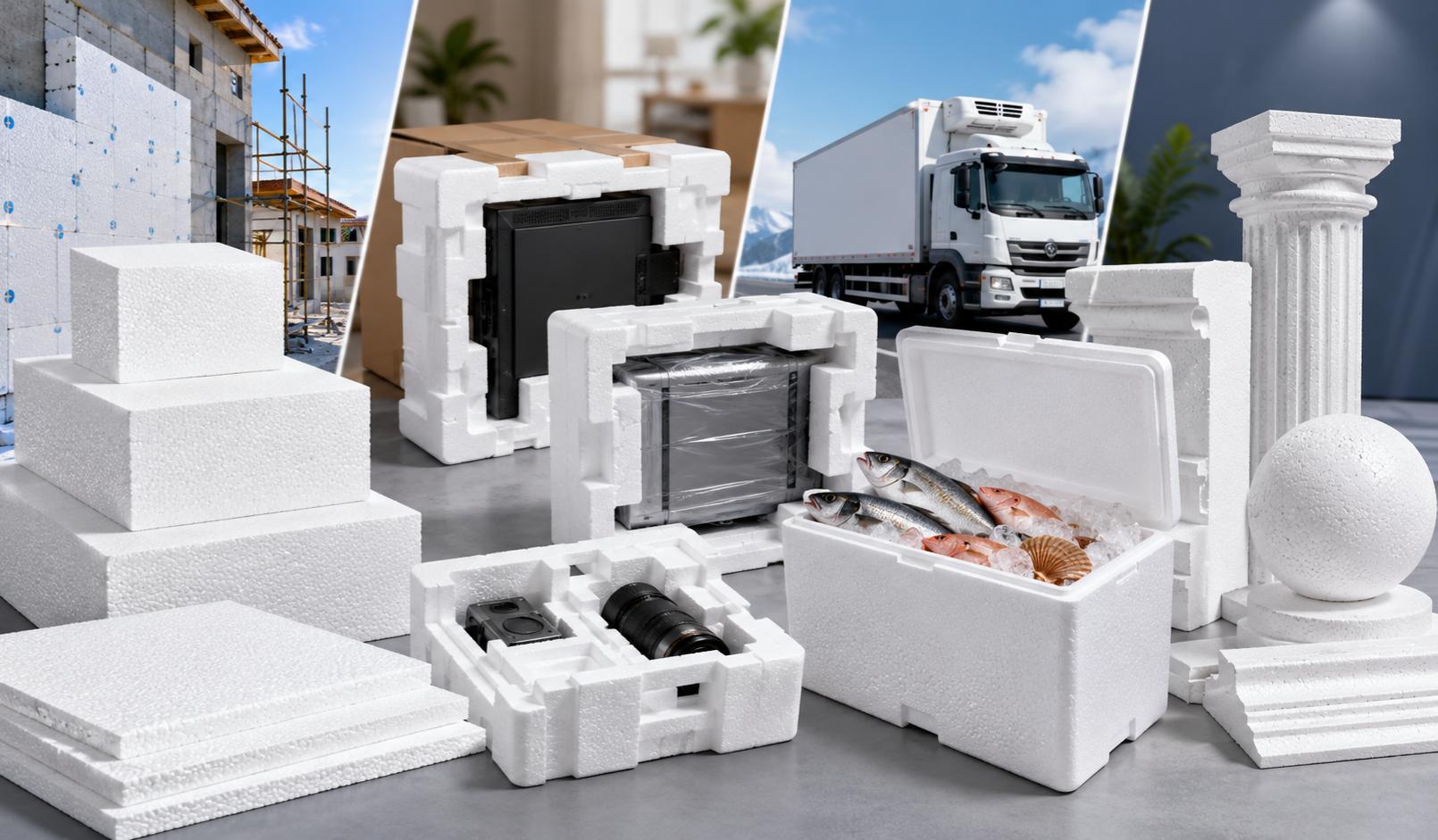
La mousse EPS se retrouve dans bien plus de domaines que ce que beaucoup d'acheteurs imaginent. Ce même matériau léger peut protéger un écran pendant le transport, maintenir la température dans une boîte alimentaire, être placé derrière un élément décoratif ou encore faire partie d'un système d'isolation de bâtiment.
Pourquoi le choix de la qualité de la mousse EPS est important pour différents projets
Les applications du polystyrène expansé (EPS) s'étendent au-delà de l'emballage de base.
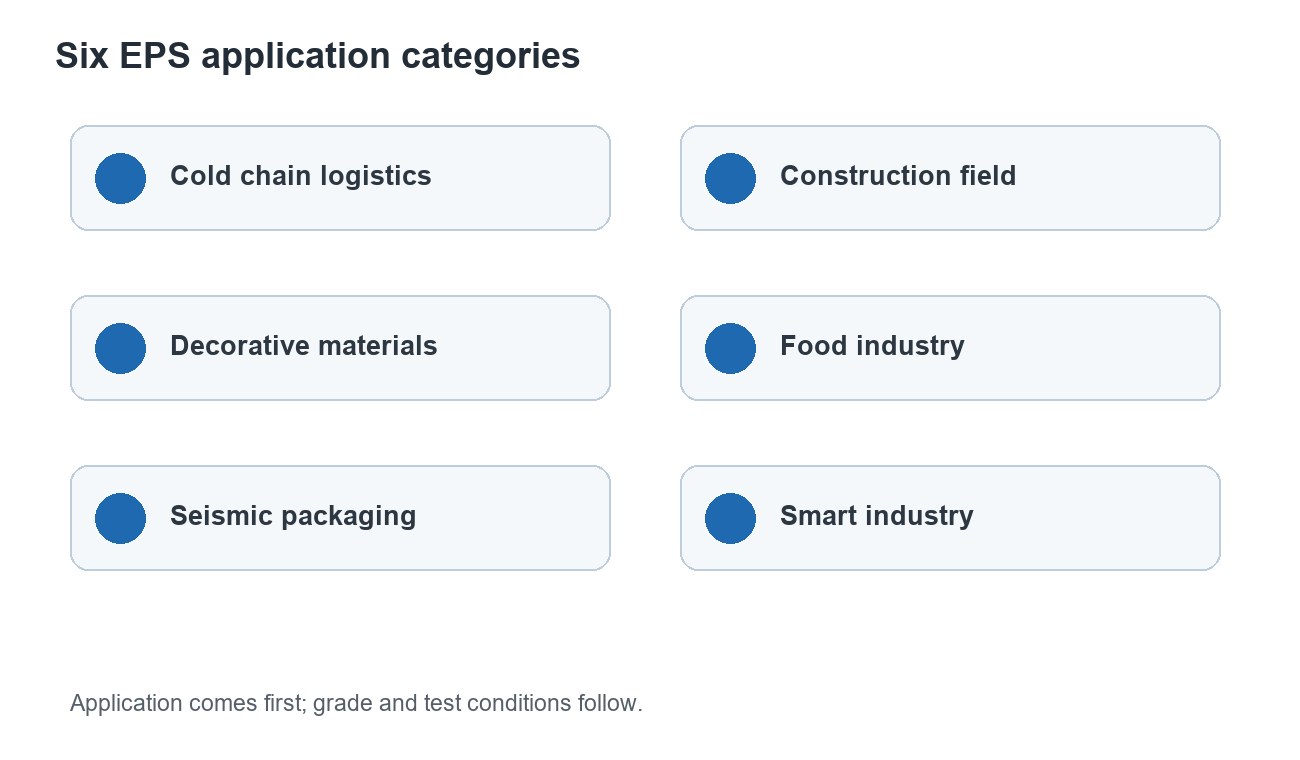
Les six groupes d'applications dans EPS domaine d'application L'utilisation du polystyrène expansé (PSE) s'est considérablement étendue : logistique du froid, construction, matériaux de décoration, industrie agroalimentaire, emballages parasismiques et industrie intelligente. Ces applications ne sont pas interchangeables. Un conteneur frigorifique nécessite une isolation et une régulation de l'humidité, tandis qu'un insert électronique de précision requiert un ajustement précis, une protection contre les chocs et un moulage reproductible.
Pourquoi une seule qualité de PSE ne peut pas convenir à toutes les applications
Un matériau bon marché et facile à étirer peut convenir à des emballages légers, mais s'avérer inadapté à la fabrication de panneaux de toiture ou à des applications ignifuges. Choisir uniquement en fonction du prix peut entraîner une fusion insuffisante, des variations dimensionnelles, des échecs aux tests de résistance au feu, des marchandises endommagées ou une seconde production. Il est préférable d'adapter le matériau au risque réel lié au produit fini.
Quel grade d'EPS convient à chaque catégorie d'application ?
Logistique de la chaîne froide
Les conteneurs et doublures pour la chaîne du froid doivent présenter un faible transfert de chaleur, une résistance mécanique suffisante et un couvercle qui reste bien aligné malgré des variations de température répétées. Les acheteurs comparent généralement la densité, la conductivité thermique, l'absorption d'eau, la résistance des angles et la durée de maintien de la température. Le polystyrène expansé (PSE) standard convient aux expéditions courantes, tandis que des qualités à faible conductivité thermique, comme le graphite ou le carbone modifié, peuvent être envisagées lorsque les exigences d'isolation sont plus strictes.
Champ de construction
L'isolation des bâtiments privilégie la conductivité thermique, la résistance à la compression, la stabilité dimensionnelle, la résistance aux intempéries et la tenue au feu. Les isolants ignifuges et en graphite sont souvent choisis pour les projets exigeants. Le choix de la qualité d'isolant doit également être adapté à l'épaisseur des panneaux, au procédé de moulage, au temps de séchage et aux normes de construction locales, et non pas uniquement à sa conductivité.
Matériaux de construction décoratifs
Les corniches décoratives, les moulures et les détails architecturaux moulés privilégient la légèreté, la netteté des découpes, la stabilité dimensionnelle et une surface adaptée au revêtement ou à la finition. Les matériaux extra-légers de qualité P peuvent convenir aux pièces de grande taille mais peu sollicitées. HUASHENGLa qualité standard E de la marque peut être plus appropriée lorsque la conception nécessite une surface plus ferme ou un moulage plus uniforme autour des bords.
Industrie alimentaire
Les applications de mousse alimentaire concernent souvent le transport isotherme, les plateaux ou les structures de protection. L'acheteur doit définir les conditions de contact, la plage de températures, les exigences d'hygiène, la charge de compression et les cycles de manutention prévus. Le choix du matériau peut différer selon qu'il s'agisse d'une livraison courte ou d'un stockage frigorifique et d'une distribution répétés.
Emballage sismique
L'emballage antisismique est conçu pour absorber les chocs et empêcher le produit de bouger à l'intérieur du carton. Les appareils électroniques, électroménagers et autres marchandises fragiles nécessitent des alvéoles précises, un assemblage fiable des billes de calage et une résistance à la compression suffisante pour l'empilage. Le carton de qualité E constitue souvent un point de départ pratique ; la densité, la granulométrie et l'outillage sur mesure déterminent ensuite si l'insert maintiendra le produit en place pendant le transport.
Industrie intelligente
Les emballages pour l'industrie intelligente concernent l'électronique de précision, les composants pour les énergies nouvelles, les instruments et les pièces de production automatisée. Ces commandes peuvent exiger des propriétés antistatiques ou conductrices, des dimensions plus compactes, des granulométries spécifiques ou une structure multicouche personnalisée. Un emballage standard est déconseillé lorsque le contrôle de l'électricité statique ou la manipulation robotisée répétée font partie des spécifications.
Comment les acheteurs doivent-ils comparer les principales familles de qualité EPS ?
EPS standard et extra-léger pour moulage général
Le matériau standard de qualité E est un matériau polyvalent utilisé pour l'emballage, l'isolation, les flotteurs de pêche, l'artisanat et les pièces moulées courantes. Il est compatible avec plusieurs machines de formage et est généralement choisi lorsque le projet requiert une densité équilibrée et une fusion stable. Le matériau extra léger de qualité P est destiné à des taux de moussage plus élevés et à des panneaux ou emballages plus légers ; toutefois, l'acheteur doit vérifier que la pièce finie conserve une résistance suffisante des bords et à la compression.
EPS à moulage rapide et ignifugé
La qualité B-fast est conçue pour des cycles de polymérisation et de moulage plus courts, ce qui peut optimiser une ligne de production à haut débit lorsque la machine et le moule sont déjà adaptés au matériau. Les qualités F, FB, FS et FSH répondent à différentes exigences en matière de résistance au feu et de durabilité. Pour ces matériaux, le temps de vieillissement, le dégagement résiduel d'agent gonflant, la densité, l'épaisseur et la méthode d'essai au feu ont une incidence sur le plan de production. Les produits de ce groupe doivent être introduits comme solutions à un besoin spécifique en matière de résistance au feu ou de délais, et non comme une simple mise à niveau.
EPS modifié au graphite et au carbone pour des besoins thermiques ou fonctionnels
Le graphite et les matériaux modifiés au carbone sont utiles lorsque l'efficacité thermique, l'isolation acoustique, la stabilité des couleurs ou les propriétés antistatiques sont importantes. HUASHENG EPS graphite La gamme comprend les exemples S-32 et S-33 ; le S-32 présente une conductivité thermique ≤ 0,032 W/mK, tandis que celle du PSE ordinaire est d'environ 0,039 W/mK. Les grades FGE à base de noir de carbone sont destinés à l'isolation haute densité et aux applications industrielles. Le choix optimal dépendra du coût, de la densité, de la résistance au feu et du comportement au moulage.
REPS et EPS sur mesure pour structures spéciales
Le REPS sur mesure est pertinent lorsqu'un projet requiert une granulométrie spécifique, une adaptation au plan, une structure multicouche, un taux de recyclage élevé ou une géométrie d'emballage non standard. Le choix du matériau doit être discuté une fois que le fournisseur dispose du plan, de la densité cible, du taux d'expansion, des équipements nécessaires et du délai de livraison. EPS graphite S-32 Il s'agit d'un exemple de qualité avec des options de granulométrie définies ; elle ne doit pas être considérée comme un substitut universel pour toutes les applications de polystyrène expansé.
Une réunion de sélection efficace met en relation quatre éléments : la candidature, le risque d’échec le plus probable, la catégorie de niveau scolaire et le test qui confirmera le choix. Cela permet de maintenir le dialogue pragmatique même lorsque plusieurs matériaux semblent acceptables sur le papier.
Comment les acheteurs doivent-ils choisir la mousse EPS pour répondre aux besoins spécifiques de leur projet ?
Faire correspondre la note aux priorités de performance
Pour les projets où l'isolation est primordiale, comparez les qualités ordinaires à faible conductivité, en graphite ou modifiées au carbone. Pour les constructions sensibles au feu, privilégiez les matériaux ignifuges. Pour les pièces décoratives légères, optez pour des matériaux extra-légers. Pour les cycles de moulage courts, examinez les qualités à prise rapide. Pour les emballages de précision, envisagez les options REPS antistatiques, standard ou personnalisées. Ces indications constituent des points de départ et ne représentent pas des approbations automatiques.
Adapter le matériau à l'équipement et aux conditions de production
Un produit peut présenter de bonnes performances dans une brochure et s'avérer décevant sur une autre ligne de production. Il est donc essentiel de vérifier le type de machine, la pression de vapeur, le remplissage du moule, la densité de pré-expansion, le temps de cuisson, le refroidissement et le rythme de démoulage. Des pièces d'essai doivent être fabriquées sur un équipement proche de la ligne de production prévue, puis contrôlées en termes de densité, de fusion, de dimensions et de qualité de surface.
Adapter la qualité au marché et au risque après-vente
Les acheteurs du secteur de la construction peuvent privilégier la résistance au feu et la stabilité dimensionnelle à long terme ; les acheteurs du secteur de la chaîne du froid peuvent accorder plus d’importance à la durée d’isolation et à l’étanchéité du couvercle ; les distributeurs de produits électroniques peuvent privilégier la protection contre les chocs, le contrôle de l’électricité statique et la répétabilité de l’ajustement. Si les plans ou les délais de production sont inhabituels, REPS personnalisé L'évaluation peut être effectuée avant la fixation de l'outillage. Pour l'examen d'échantillons, la cohérence des lots ou l'assistance aux projets, les acheteurs peuvent contact HUASHENG Mieux vaut prévenir que guérir, plutôt que d'attendre une livraison ratée.
Le choix du polystyrène expansé (EPS) adapté est celui qui correspond à l'environnement d'utilisation, au procédé de moulage et au risque commercial. Partir des six catégories d'application facilite le choix, tandis que les tests d'échantillons et les contrôles par lots garantissent que la décision finale repose sur les réalités de la production.
Questions fréquentes
Q1 : Le PSE standard peut-il être utilisé à la fois pour la construction et l'emballage de protection ?
A1 : Parfois, mais pas systématiquement. La densité, la tenue au feu, l’épaisseur, la charge de compression et le procédé de moulage peuvent varier considérablement. L’application finale détermine la qualité.
Q2 : Quand les acheteurs doivent-ils choisir du PSE graphite plutôt que du PSE standard ?
A2 : Le polystyrène expansé graphité est une option intéressante lorsque le projet requiert une conductivité thermique plus faible ou une isolation plus performante. Les acheteurs doivent également prendre en compte le coût, la densité, la résistance au feu, les conditions de mise en œuvre et les résultats des tests.
Q3 : Quelles informations doivent être incluses dans l’approbation d’un échantillon d’EPS ?
A3 : Consignez la nuance, la densité, la granulométrie, le taux d’expansion, les dimensions, le point de fusion, la résistance à la compression, les données thermiques, la couleur, l’outillage, l’équipement d’essai et l’état de l’emballage. Conserver ces informations avec l’échantillon prélevé facilite grandement la comparaison des lots.
 French
  English
  German
  Spanish
  Arabic