
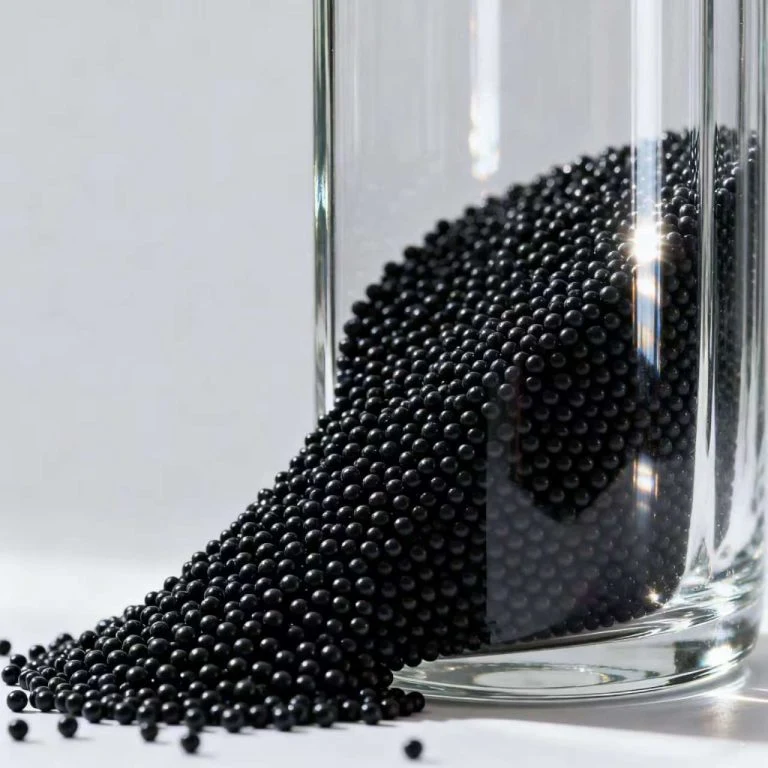
Grey and black EPS are often grouped together because both can be used to improve insulation performance, but similar color does not mean the same additive, processing route, or project fit. Graphite-modified EPS uses graphite as a functional infrared-absorbing material, while carbon-black-modified EPS uses carbon black to add thermal and other functional properties. Buyers need to compare the additive system, thermal role, density window, antistatic behavior, color stability, manufacturing route, and finished application together. The article will use HUASHENG’s graphite and carbon-black product families to show where the two routes overlap, where they differ, and what information should be fixed before a board, industrial-insulation, electrical-structure, or special-packaging trial begins.
Are Graphite EPS and Carbon Black EPS the Same Material?
Why grey or black appearance cannot identify the functional additive
Graphite EPS is made with graphite as the active carbon, while Carbon Black EPS is made with carbon black. The two products reduce radiative heat transfer within the closed cell foam structure. They have different formulations, different methods of production, different appearances and different areas of application.
Graphite and carbon black as two different carbon-based modification routes
The terms ‘grey EPS’, ‘black EPS insulation’, ‘graphite EPS’ and ‘carbon black EPS’ are often used loosely by buyers. Unless the RFQ clearly outlines the required density, thermal conductivity, flame classification, antistatic properties etc. as well as whether board or molded parts are required and which production route is preferred, the supplier’s interpretation may differ from that of the buyer.
HUASHENG offers both directions in its own range, including the Graphite Polystyrene FGE intended for the construction and industrial insulation markets, and the Poliestireno negro FGE for electrical structural parts, packaging, and special black product markets.
The specification details buyers should compare before treating two dark EPS grades as substitutes
Consider a finished requirement rather than color. The key requirements for an insulation board project are thermal conductivity, density, dimension stability, fire performance and molding behavior. A black electrical component or molded package project has different key requirements i.e. antistatic behavior, appearance, toughness, fit and processing.
The difference between graphite EPS and carbon black EPS becomes a matter of specification, not of appearance.
How the additives change insulation and functional behavior
How does graphite reduce radiant heat transfer?
The already slow heat transfer of the EPS due to the cellular structure of the material is further decreased by the graphite. Fine graphite powder within the polymer material absorbs and reflects heat by infrared radiation which would otherwise travel through the pores of the EPS.
HUASHENG’s extrusion materials have specific insulation targets. The thermal conductivity of S-33 is below 0.033 W/m·K, S-32 even below 0.032 W/m·K. Both materials are used for building and industrial insulation, S-32 in addition for passive-house and high energy saving building projects.
Values for thermal conductivity are far more useful to a buyer looking for low thermal conductivity EPS than a board that is black!
How carbon black can improve insulation performance while adding functional properties
Thermal conductivity can also be reduced in Carbon black EPS. The low-thermal-conductivity carbon FGE is produced with functional carbon black in suspension polymerization and is suited for building insulation as well as for industrial thermal insulation.
In addition to thermal insulation, HUASHENG’s carbon black products are used in a variety of fields. For example, Black Polystyrene FGE is a specialty electrical structural parts/packaging/special black molded products material, that not only has thermal properties, but also appearance and antistatic properties.
Both additives are important. Measuring one alone does not give a complete picture. Other factors like density of the finished foam as well as structure also have to be taken into account. A nominal low-conductivity additive does not replace the necessary steps of expansion, fusion, cooling and control of board density.
Suspension method vs extrusion method – what changes for selection?
How HUASHENG Graphite Polystyrene FGE introduces graphite during suspension polymerization
HUASHENG Graphite Polystyrene FGE is a suspension polymerization product. This product is made while polymerizing polystyrene, and graphite is added as a functional additive during polymerization. The same broad suspension polymerization method is used to make the HUASHENG Carbon Black FGE grades, with carbon black as the functional additive.
HUASHENG Suspension FGE families are offered in a number of different particle size ranges down to 0.5-0.8mm, with the first expansion of each grade being offered over a number of different ranges to enable the molder to select the appropriate bead size and expansion characteristics for his intended product.
How extrusion grades such as S-32 and S-33 introduce graphite through a twin-screw extrusion route
S-32 and S-33 are extruded using graphite. Natural flake graphite and graphite particles are used as infrared-absorbing agents in these raw materials for EPS. These are not XPS expanded materials, but EPS raw materials that have been graphitized via extrusion and then can be expanded and molded as needed.

In procurement, “Extrusion method” refers to the process by which the functional graphite is extruded into the raw material, not the finished foam product. In making a purchasing decision, one should compare the foam’s expansion, density, molded board quality, dimensional stability, flame retardancy, etc. and the requirements of the end use application.
Suspension versus extrusion has no inherent advantage for either. The best route is the one that provides the needed property or properties and fits with your current manufacturing setup.
Density, antistatic behavior, color and processing limits
Why HUASHENG suspension FGE grades are positioned for higher-density products of 18 kg/m³ and above
Both HUASHENG Graphite Polystyrene FGE and the carbon-black FGE family are positioned for products at 18 kg/m³ or above. They should not be treated as low-density substitutes simply because another EPS grade can be expanded further.
In black EPS insulation the relevant specifications have to be set in conjunction with the selection of raw materials and the specified density. Reducing the density below the recommended value can lead to negative effects with respect to fusion, strength, appearance and dimensions.
Storage below 25°C, protection from direct sunlight, 4-8 hour aging and molding-pressure adjustment as processing checks for applicable FGE grades
Applicable HUASHENG FGE suspension grades are to be stored in the dark and at temperatures below 25°C. After foaming, a aging time of approx. 4-8 hours has to be allowed. The molding pressure has to be adapted to surface tension and bond strength of the produced part.
Storing dark EPS next to white EPS in a warehouse is not a trivial matter. The dark material absorbs more radiant energy than the white material. So by the time the EPS is put into service making foams, there can be significant temperature differences in the material.
The aging time depends on the material type and processing. A stable black or grey sheet starts with controlled material, not with a good mold.
When Does Antistatic Performance Matter?
Is antistatic behavior unique to carbon black EPS?
- Assume that only carbon black EPS has antistatic performance. Both Graphite Polystyrene FGE and carbon-black FGE grades have antistatic performance in HUASHENG’s product data.
From a placement standpoint, Graphite FGE is aimed at the construction and industrial insulation markets, while Black Polystyrene FGE is aimed at the electrical structural parts, packaging, and special black products markets.
Of course, application is crucial. For example, a dark colored molded part with antistatic, color stable properties of higher density than average, an electrical or packaging application might best start with carbon black FGE while lower heat transfer in insulation boards could be compared using graphite EPS or even low-thermal-conductivity carbon FGE.
Which Material Fits Building, Industrial, and Packaging Projects?
When should building projects start with graphite EPS?
Key points to consider when specifying exterior walls, passive-house systems and other energy efficient construction include thermal conductivity, board density, thickness, compressive strength, dimensional stability and fire classification.
We have a range of graphite products in the Graphite Family. Suspension FGE is designed for building and industrial insulation applications, whilst S-32 and S-33 are for extrusion applications with pre-specified thermal conductivity values.
As a first step, buyers should review the suggested HUASHENG EPS material solutions and then compare the graphite and carbon-black materials from HUASHENG against the real project requirements. Instead of writing only grey EPS board into the RFQ, the buyer should name the properties that actually matter.
When does carbon black EPS fit industrial or special packaging better?
In addition to requirements typical for an insulation board, electrical structural parts and industrial packaging have specific characteristics such as antistatic properties, stable dark colors, molded details, surface quality, fit and flexibility for frequent handling.
Carbon black EPS can find specific applications in structural parts for the electrical industry, packaging and special black products. HUASHENG Black Polystyrene FGE is a product which is especially developed for these areas. It has antistatic properties, a stable grey-black color. Recommended density for this product is 18 kg/m³ or above. B1-level.
Not every black package needs to be made with carbon black FGE. The individual part needs to be tested at the required density, bead size, expansion ratio and molding conditions.
How Should HUASHENG FGE Options Be Compared Before a Trial?
Put the material and the process in one RFQ. Outline the final application, the desired density, thermal conductivity if relevant, static, fire, color, molded dimensions, machine type and whether open or extruded for suspension material.
For graphite EPS vs carbon black EPS the selection for your project is key.
| Project priority | Material direction to evaluate |
| Building or industrial insulation | Graphite FGE, S-32/S-33, or low-thermal carbon FGE |
| Passive-house / high-efficiency board | S-32 or another validated graphite grade |
| Electrical structural parts | Poliestireno negro FGE |
| Special black packaging | Poliestireno negro FGE |
| Insulation plus antistatic requirement | Compare the graphite FGE and the low-thermal carbon FGE under identical trial conditions. |
The table above serves as a starting point only. The actual molding data must be reviewed and checked prior to approval of samples. This would include verification of the desired density and processing conditions, such as bead size, expansion, storage, aging and molding pressure etc. against the actual manufactured product. Contact us to verify molding data.
Conclusión
Graphite EPS and carbon black EPS should not be selected by color alone. The useful comparison starts with the functional additive, then moves through thermal performance, density, antistatic requirements, manufacturing route, color stability and the final application. HUASHENG provides graphite, carbon-black and extrusion graphite routes, so a project can be narrowed around measurable conditions rather than a generic “grey EPS” or “black EPS” request. Review the HUASHENG EPS material range and send the target density, thermal requirement, antistatic need and processing conditions to HUASHENG technical team before approving the material trial.
Preguntas frecuentes
Q1: Is graphite EPS the same as carbon black EPS?
A1: No, graphite EPS and carbon black modified EPS are two different modified EPS products. While both products have similar thermal insulation properties and also can have antistatic properties, the production route, market position, density range, color and area of application can be different for these two products.
Q2: When would you choose carbon black EPS packaging over graphite EPS packaging?
A2: Carbon black filled EPS can be a consideration for applications requiring a dark molded appearance and/or which have antistatic/electrical structure requirements in packaging or insulation applications. High efficiency building insulation would more likely begin with graphite filled grades such as FGE, S-32 or S-33.
Q3: Does suspension or extrusion processing change the choice of the EPS grade?
A3: Yes. The production route determines how the functional additive is incorporated into the material and what different grades are available. It is therefore sensible to compare the production routes with the thermal conductivity, density, bead size, expansion behavior, dimensional stability, fire classification and the relevant molding conditions.
 Spanish
 English
 German
 French
 Arabic