
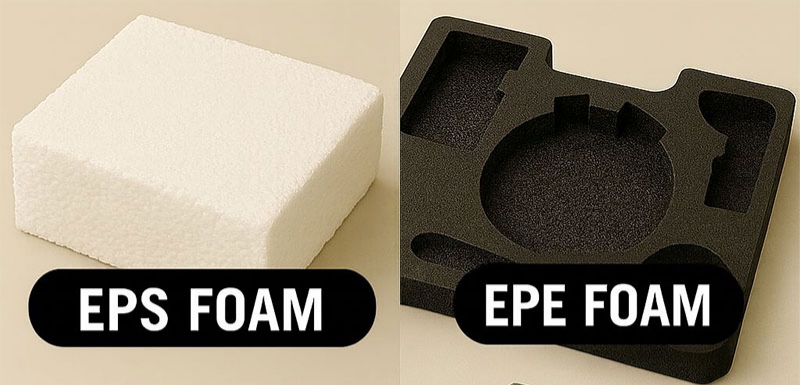
El EPE y el EPS se consideran opciones de espuma ligera, aunque satisfacen diversas necesidades de cada proyecto. El EPE suele preferirse por su acolchado, flexibilidad y protección contra impactos, mientras que el EPS resulta más adecuado para proyectos que requieren aislamiento térmico, estabilidad dimensional, resistencia a la presión y ahorro de costes. Al planificar proyectos para 2026, la opción más inteligente se define por la adaptabilidad del revestimiento de seguridad o por la solidez constructiva y las propiedades de aislamiento térmico.
Descripción general de los materiales EPE y EPS
Dentro del sector de materiales cambiantes, el polietileno expandido (EPE) y el poliestireno expandido (EPSSe encuentran entre las espumas poliméricas más utilizadas. Las variaciones básicas de diseño determinan su funcionamiento en aplicaciones de envoltura, protección térmica y en entornos industriales.
Comprensión del EPS (poliestireno expandido)
Los bloques de EPS sirven como tipos de espuma firme elaborados a partir de perlas de poliestireno cultivadas con vapor y gas pentano. El material estándar E es un EPS básico de amplia aplicación, compatible con máquinas de termoformado al vacío automáticas, máquinas de termoformado de accionamiento eléctrico y prensas de elevación hidráulicas tradicionales. Tiene una amplia aplicación en embalajes eléctricos, materiales de aislamiento térmico, flotadores de pesca, artesanías, decoración y fundición a la cera perdida. El proceso de unión de perlas produce una estructura ligera pero duradera que mantiene su forma incluso bajo presión.. Grado retardante de llama F Ha superado la certificación del Laboratorio de Pruebas de Seguridad de los Estados Unidos (UL), lo que lo hace apto para materiales de construcción, aislamiento térmico y embalaje cerámico eléctrico. Estas características hacen que los bloques de EPS sean idóneos para la construcción de paneles térmicos, elementos de revestimiento con formas específicas y rellenos en espacios que requieren firmeza y control de la temperatura.
Comprensión del EPE (polietileno expandido)
El EPE se forma como una espuma de celdas selladas mediante el crecimiento de resina de polietileno con un expansor de gas. Los expertos lo destacan por su flexibilidad, elasticidad y ligereza. El método de fabricación consiste en calentar y prensar perlas de polietileno a presión constante, lo que crea una estructura de celdas cerradas que ofrece una excelente amortiguación. Gracias a su elasticidad, el EPE resiste múltiples impactos sin deformarse permanentemente. Se utiliza con frecuencia en embalajes de seguridad para dispositivos, piezas de vehículos y equipamiento deportivo debido a su gran capacidad de acolchado y repelencia al agua.
Análisis comparativo: EPE frente a EPS
Al comparar el EPE con el EPS, se revelan diferencias fundamentales en cómo se comportan bajo fuerza y cómo se adaptan a las necesidades de las tareas en diferentes campos.
Diferencias estructurales y mecánicas
La densidad del EPE suele oscilar entre 20 y 60 kg/m³ según el nivel de crecimiento, lo que proporciona mayor flexibilidad pero menor resistencia a la presión en comparación con el EPS. En comparación, el grado ignífugo FSH, estándar europeo, es adecuado para el aislamiento térmico en la construcción y la industria; su resistencia a la compresión es más de un 20 % superior a la de otros grados. Estos puntos demuestran que el EPS ofrece mayor soporte de peso gracias a la firmeza de sus celdas selladas. Si bien el EPE recupera rápidamente su forma tras un impacto, el EPS mantiene su tamaño constante bajo presiones fijas, lo que lo hace adecuado para aplicaciones de soporte de peso o construcción, como sistemas de calefacción de paredes.
Propiedades térmicas y acústicas
El EPS suele ofrecer un mejor aislamiento térmico que el EPE, ya que transfiere menos calor. Esto lo hace más adecuado para aislamiento, embalaje en cadena de frío y proyectos de control de temperatura. Por otro lado, la estructura semiflexible del EPE proporciona una mejor absorción acústica gracias al control de la vibración de las celdas internas, lo que resulta útil para paneles acústicos o embalajes que absorben vibraciones.
Peso, flexibilidad y características de manejo
La ligera densidad del EPE facilita su manipulación e instalación en comparación con los bloques rígidos de EPS. Su facilidad para curvarse sin romperse permite crear formas complejas o cubrir contornos irregulares, lo que supone una ventaja en el embalaje de dispositivos para el consumidor. Dicho esto, la fiabilidad de la forma del EPS garantiza un corte preciso en paneles a juego para tareas de construcción.. Material ligero extra P Se puede espumar una sola vez para obtener partículas de burbujas de menor densidad, ampliamente utilizadas en el embalaje de productos mecánicos y eléctricos. La combinación de flexibilidad en el EPE y firmeza en el EPS influye en cómo mejoran los diseños en diversos sectores.
Evaluación económica: Eficiencia de costos en aplicaciones prácticas
Dado que el comercio mundial se inclinará hacia sistemas ecológicos asequibles en 2026, estos artículos muestran tendencias monetarias únicas vinculadas a la escala de producción.
Los costos de fabricación de EPE suelen ser más elevados debido a los procesos de impresión que requieren un suministro eléctrico constante. Sin embargo, los paneles EPE reutilizables ofrecen ventajas económicas en áreas de mudanzas frecuentes o para amortiguar la recuperación, como los contenedores de suministro retornables.
Al considerar los costos totales del ciclo de vida, el EPS gana popularidad si ofrece durabilidad a largo plazo; su resistencia a la presión garantiza un bajo mantenimiento durante años en estructuras o redes de transporte. HUASHENG Ha construido una línea de producción moderna e inteligente y ha introducido tecnología de espumado EPS de vanguardia, lo que garantiza que los productos alcancen niveles líderes en la industria en uniformidad de densidad, resistencia a la compresión y rendimiento de aislamiento térmico.
Idoneidad del desempeño en diferentes industrias en el contexto de 2026
El campo de aplicación sigue cambiando a medida que las ayudas mecánicas y los objetivos ecológicos orientan la selección entre estas espumas.
En el sector del embalaje, el EPE ofrece una gran protección para artículos delicados gracias a su capacidad de recuperación ante impactos constantes. Los sistemas de llenado automático se benefician de piezas flexibles precortadas que se adaptan perfectamente a los artículos. Por otro lado, el grado B, apto para prototipado rápido de electrodomésticos, y el embalaje para máquinas de moldeo automático demuestran cómo los grados modernos de EPS se integran a la perfección en sistemas de moldeo automatizados con alta eficiencia, manteniendo al mismo tiempo el cumplimiento de las normas medioambientales mediante formulaciones reciclables como el REPS.
Las zonas de construcción que priorizan las normas de ahorro energético en 2026 recurren a bloques de EPS modificados con grafito, como el poliestireno grafito S 33 (método de extrusión), para un mayor aislamiento térmico que cumple con la clasificación de resistencia al fuego B1 exigida por la normativa GB8624 2012. Su combinación con fachadas integradas contribuye a la construcción de ciudades sostenibles que se ajustan a los objetivos LEED.
Los avances tecnológicos están configurando las tendencias de adopción futuras.
Los avances en los métodos de unión han reforzado la resistencia a la tracción del EPE y han permitido la creación de tipos mixtos con aditivos rompibles, reduciendo así la acumulación de residuos tras su uso. En cuanto a los productos de EPS, los avances clave de los fabricantes más avanzados ofrecen patrones de orificios microsellados mediante el enhebrado de cadenas modelado por matemáticas cuánticas, lo que aumenta la resistencia a la compresión hasta en un 40 %. Esto ha incrementado la resistencia a la compresión de los materiales REPS en un 40 %, superando con creces los estándares internacionales más avanzados.
Consideraciones ambientales en la selección de materiales para 2026
Las iniciativas ecológicas seguirán siendo un elemento central en las próximas revisiones de los planes de polímeros.
| EPE | EPS | |
| Reciclabilidad | Se puede reciclar, pero depende de los sistemas locales de reciclaje de PE. | Se puede reciclar, pero la recogida y el procesamiento pueden ser más difíciles. |
| Potencial de reutilización | Ideal para envases protectores reutilizables. | Ideal para paneles aislantes, bloques y materiales de proyectos con formas específicas. |
| Reducción de residuos | Puede reducir los daños y el desperdicio en el embalaje. | Puede reducir el desperdicio de material mediante el corte, el moldeo y la conformación personalizada. |
| desafío ambiental | Los residuos de espuma flexible o con aspecto de película pueden ser más difíciles de recoger de forma limpia. | Los residuos de espuma voluminosos pueden ser más difíciles de transportar y reciclar. |
Preguntas frecuentes
Q1¿Cómo mejora el EPS modificado con grafito la eficiencia energética de los edificios?
A1: Los aditivos de grafito reducen la conductividad térmica por debajo de 0,033 W/m·K manteniendo la integridad estructural; esto permite capas de aislamiento más delgadas, logrando una retención de calor superior en comparación con las espumas convencionales.
Q2¿Existen opciones con certificación medioambiental entre los productores actuales de EPS?
A2: Sí. Las empresas que implementan sistemas de fabricación de circuito cerrado ahora producen poliestireno expandible reciclado certificado (R-EPS) verificado según las normas ISO14067:2018. Un ejemplo es la línea REPS sostenible de HUASHENG, que integra una eficiencia de reciclaje de residuos superior al 95 %.
Q3¿Qué factores deberían priorizar los ingenieros al elegir entre EPE y EPS?
A3: Los ingenieros deben priorizar la función principal del proyecto. Elijan EPE cuando la flexibilidad, la amortiguación, la absorción de impactos y la protección contra impactos repetidos sean más importantes. Elijan EPS cuando el aislamiento térmico, la estabilidad dimensional, la resistencia a la compresión y la rentabilidad sean más importantes. También deben considerar la densidad, la exposición a la humedad, el método de procesamiento, las opciones de reciclaje y los requisitos de rendimiento a largo plazo.
 Spanish
  English
  German
  French
  Arabic