
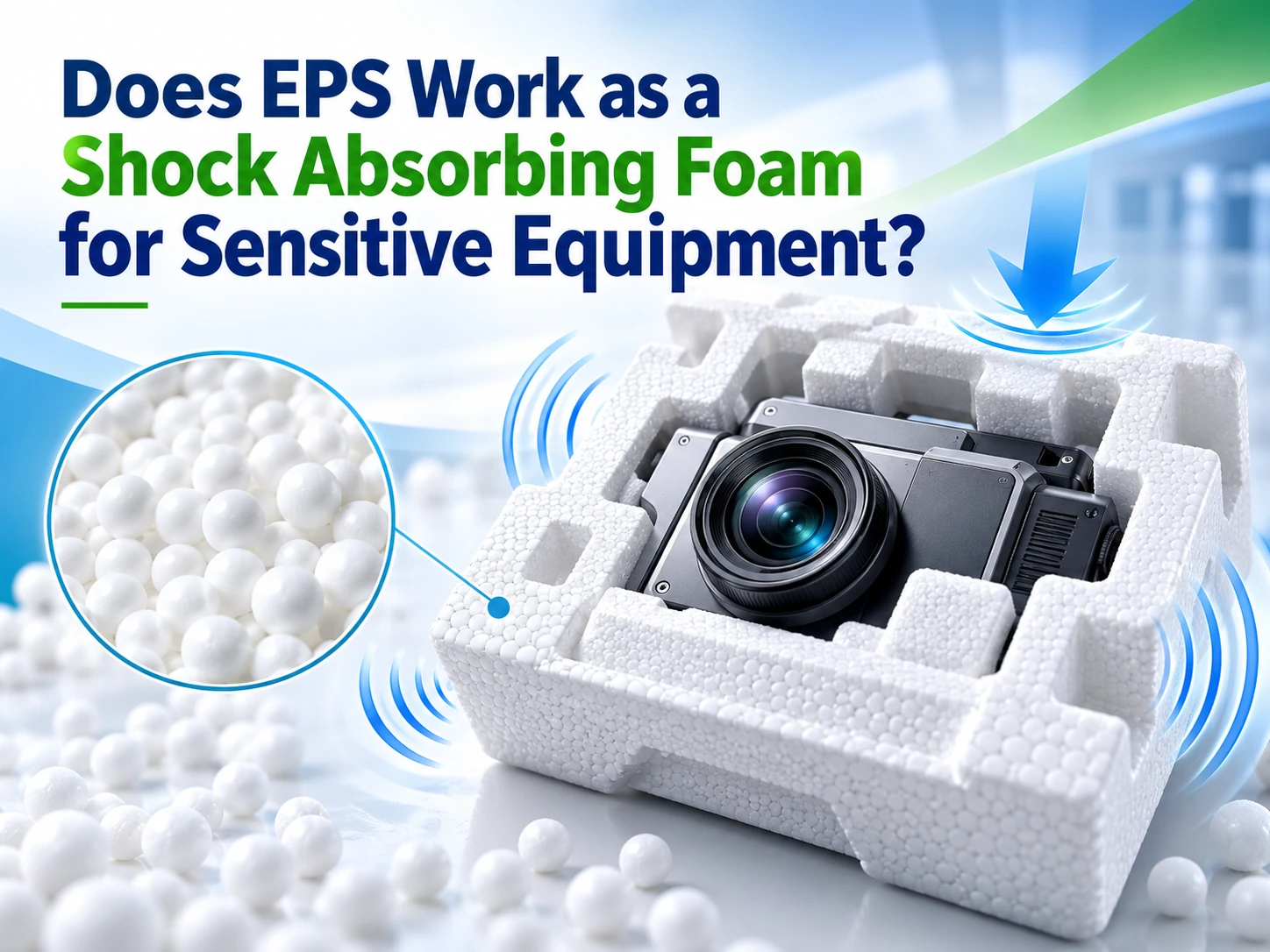
Soft foam is not the same as safe foam. A cushioning material protects a device only when it absorbs the impact energy that device can actually survive, and how much it must absorb depends on the drop height, the product mass, the area carrying the load and the thickness available inside the pack. That is why the same foam can protect one instrument and fail another, and why the choice between crush-based and resilient cushioning materials matters more than a material’s reputation.
What a Cushioning Material Has to Do
Why the impact energy is set by drop height and product mass, not by the foam
A drop gives a package a fixed amount of energy, set by the mass of the product and the height it falls from. The cushion cannot reduce that energy; it can only change how long the deceleration takes and how far the force is spread. That is why the first two numbers to settle are the handling drop height and the product mass, both taken from the way the item is actually moved and tested rather than from a carton size. Foam selection comes after those two.
How a product’s fragility limit decides whether the cushion can be soft or must stay thin
Fragility is the acceleration a product survives. A rugged housing with no unsupported internal mass tolerates high acceleration, so the cushion can be thin and relatively stiff. A device with a heavy internal mass, a glass panel or a cantilevered connector tolerates far less, and needs a cushion that deforms further to stretch the deceleration over more time. The same foam can therefore be right for one product and wrong for another with a similar mass in a similar carton.
Why bearing area and available thickness change how the same foam performs
Stress is force divided by area, so a cushion that touches the product across broad pads compresses far less than one loaded at small contact points. Available thickness then sets how much deformation the cushion can offer before it bottoms out. Once the foam has compacted, further energy goes straight into the product, which is why a thin cushion at a small bearing area is the shape most likely to produce damage in an otherwise sensible design.
Where EPS Works and Where It Does Not
How moulded EPS absorbs energy by controlled crushing rather than by springing back
Moulded EPS absorbs impact by collapsing cell walls rather than by springing back. Most of its useful work happens on the plateau of its stress-strain curve, where the material crushes at a fairly steady load and turns impact energy into permanent deformation. That makes it a good single-trip cushion and a poor spring. After a significant impact the part has lost the material it crushed, so its behaviour on a second drop is not the behaviour that was tested.
Why repeated impacts and long static loads move the choice towards EPP or polyurethane
Two conditions move the decision away from a crush-based cushion. The first is repetition: where a pack must survive several drops, a return leg, or a test programme that repeats orientations, a cushion that consumes itself will not hold its performance. The second is static load: under stacking or prolonged compression, foam takes a permanent set. Resilient materials such as expanded polypropylene recover their shape, and polyurethane foams are chosen for resistance to compression set, which is why the decision belongs to the route rather than to a material ranking.
Which equipment profiles still make EPS the efficient cushioning choice
EPS stays efficient where protection is needed once, volumes are high, and the pack benefits from a shape that combines cushioning with structure. Moulded end caps, corner blocks and full inserts replace several fabricated parts with one piece, hold the product in a defined position, and spread load into the sections designed to crush. Equipment with a moderate fragility limit, a predictable handling route and a single-trip pack is where that combination is hardest to beat on cost and on repeatability.
How Density, Geometry and Fusion Change EPS Cushioning
Why target density sets the crush strength at the impact zone
Density sets the level of the crush plateau. A denser part resists more load at the same thickness, but it also transmits higher acceleration to the product it protects. Selecting density because one foam is described as stronger is therefore a mistake: what matters is the density at which the cushion holds the acceleration peak below the product’s fragility limit while still absorbing the energy within the thickness available. Two parts of the same density loaded over different areas behave differently for the same reason.
How rib, corner and wall geometry spread impact into the cushion
Impacts rarely arrive on a flat face. Corners and edges take first contact, and they are where load is highest relative to the material available. Ribs, corner blocks and locally thickened sections add area and depth exactly where that happens, while a uniform thin wall with no rib will bottom out locally and pass the load straight through. Geometry also sets the direction of the load path, which is why an insert should be designed around the orientations the pack will actually see.
Why bead fusion at load-bearing corners decides whether the part behaves as designed
A designed crush plateau exists only if the beads are fused. At a corner where fusion is incomplete, the part tears between beads instead of crushing as a solid, and the energy absorption the design assumed never happens. Fusion depends on bead quality, expansion rate, steaming and cooling, so it is a moulding outcome rather than a raw-material label. Two shipments of the same nominal density can therefore behave differently, which is why density alone is not a sufficient ordering parameter.
How to Qualify a Cushioning Design Before Tooling
What a drop-test programme should vary instead of repeating one drop
A programme that drops one sample once proves very little. The useful version varies drop height and orientation, tests the heaviest realistic configuration, and states which test method and acceptance criteria are being applied, because a pack that passes one programme’s criteria may not pass another’s. Where the product has to survive more than one impact, the specimen should either be dropped repeatedly or replaced with a fresh sample, and results should be recorded per condition rather than as a single pass.
How to read damage location against the crush pattern left in the foam
The cushion keeps a record of the impact. A pad crushed through to a solid layer while the product is undamaged usually means the design was stiffer or thicker than the job required. A region that has compacted with matching damage on the product points to insufficient thickness or contact area at that point. A corner that has torn rather than crushed points to fusion rather than density. Separating those three findings is what makes the test worth running.
Which specification points should be fixed between the sample and the production order
The sample that passed is not the order that ships unless the specification travels with it. Density or target weight, bead and expansion rate range, geometry, thickness at the load-bearing sections, fusion quality, dimensional tolerances and the drop test that accepted the design all belong on the document, together with the grade designation. Without those points written down, a production batch can meet the nominal density and still fail the test the sample passed.
How HUASHENG Fits a Shock Absorbing Packaging Project
How seismic packaging is served by moulded EPS and recycled-content REPS
The seismic packaging direction on the site covers moulded EPS used to isolate shock on equipment, with a related page on seismic packaging for electronic products. The same reasoning carries into recycled-content REPS, which is offered as a moulded material for protective parts, so the cushioning design can be worked out on the material family that fits the project’s sustainability requirement as well as its fragility limit.
How HUASHENG reviews density, cavity and molding conditions against the fragility requirement
HUASHENG reviews the cavity, the target density and the molding conditions against the fragility requirement rather than quoting a foam from a list. On the precision-instrument packaging grade, the published characteristics include fine cell structure, stable forming and strong bead fusion, which are the properties that decide whether a cushion corner crushes as designed, and the grade page also publishes a recommended expansion rate range and particle size for that material.
How to start a cushioning trial through customized REPS
A trial begins with the project requirement, not with a material list. Through customized REPS, the process starts with the application, target density and performance targets, then moves through design, sampling, production and delivery, with mould trials and sample runs confirmed before the order is released. Supplying the drop height, product mass, fragility limit, load-bearing geometry and available thickness is what allows a cushioning direction to be proposed and then tested as a pack.
Conclusion
A shock absorbing foam only works inside a design window: the cushion has to crush or compress enough to take the impact, and still hold the product in place afterwards. Finding that window means choosing material, density and thickness from the drop height and the product’s fragility limit, not from a material name. Send the drop height, the product mass and the fragility limit to HUASHENG engineering support, so the cushioning direction can be checked against the pack you actually ship.
FAQs
Q1: Is EPS good for shock absorption?
A1: It is good at absorbing a single significant impact in a controlled way, because it converts energy into permanent deformation at a fairly steady load. That same behaviour is the limitation: the cushioning is consumed by the impact and does not come back. EPS suits single-trip protection where the drop energy and the product’s fragility limit have been matched to the density, thickness and bearing area of the cushion.
Q2: For repeated impacts, is EPS or EPP the better cushioning foam?
A2: Where the pack must survive more than one drop, be re-used, or hold its geometry under stacking, a resilient material is the better starting point, because expanded polypropylene recovers its shape and resists compression set far better than a crush-based cushion. EPS remains the more economical choice when protection is needed once and the design has been matched to the impact energy. The deciding question is how many impacts the pack has to absorb.
Q3: How much foam thickness is needed to protect a fragile device?
A3: There is no universal figure, because thickness has to be enough for the cushion to deform without compacting to solid before the product’s acceleration limit is reached. That depends on the drop height, the product mass, the bearing area carrying the load and the crush strength of the density selected. Increasing thickness past the point where it stops helping adds material without adding protection, so the usable number is the one a drop test on the actual pack produces.
 English
  German
  Spanish
  French
  Arabic