
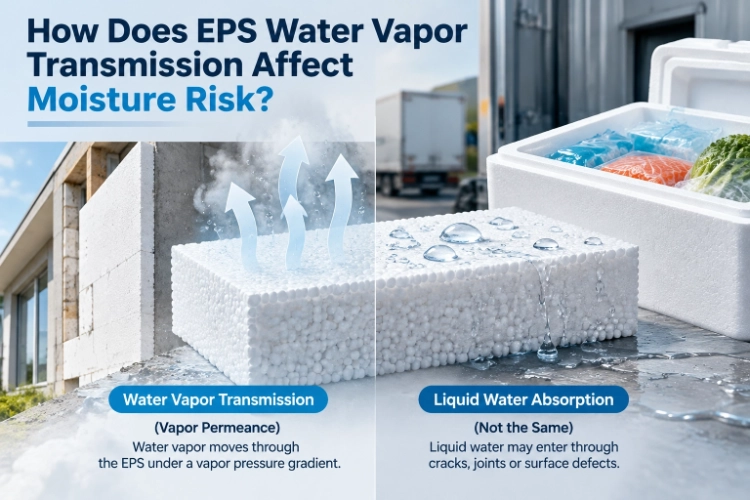
A water-soaked specimen and a vapor-transmission test answer different questions. One concerns liquid water entering or being retained under a stated method; the other measures vapor passing through a test specimen under defined conditions. Treating them as interchangeable can leave a wall assembly, cold room, or package with an unresolved moisture path even when a material result looks reassuring.
For EPS water vapor transmission, the decision is not simply ‘does this foam get wet?’ A buyer needs to know what vapor pressure difference, temperature, thickness, and assembly layers apply to the real project. A material test can support a comparison, but it does not by itself approve a wall, roof, refrigerated enclosure, or finished package.
Imagine Nina comparing two insulation boards for a wall retrofit. One supplier provides an immersion result and the other a vapor rate. Those figures cannot settle the choice until the teams identify the moisture source, layer sequence, and direction in which the assembly can dry.
What Does EPS Water Vapor Transmission Measure?
Water vapor transmission rate describes the amount of vapor passing through a specimen over an area and time under a specified method. Buyers often use the rate to compare materials or to inform a layer-by-layer moisture analysis. It is not a synonym for water absorption, water resistance, or waterproofing.
How is vapor movement different from liquid-water absorption?
Liquid water can contact a cut edge, enter a joint, pool against a surface, or move through a defect. Vapor moves as a gas and responds to differences in vapor pressure. An EPS water absorption result therefore cannot be substituted for a vapor-transmission value, and a vapor value does not say how a board behaves after immersion or leakage.
Why does a material result not describe a whole wall?
A wall’s moisture behavior depends on all its layers and interfaces: interior finish, air leakage paths, insulation, sheathing, exterior finish, joints, penetrations, and climate. The EPS vapor permeability figure is one input in that system. The orientation of layers and the indoor and outdoor conditions determine whether vapor is likely to accumulate at an interface.
How Should Buyers Read EPS Water Vapor Transmission Under ASTM E96?
Read the method designation, procedure, unit, sample identity, thickness, conditioning, and test date before comparing two results. The name ASTM E96 alone does not tell you that two specimens were tested with the same procedure or under the same conditions. Ask for the complete report if the summary table omits specimen preparation or test environment.
HUASHENG’s published REPS table lists ASTM E96/E96M-22a Procedure B and gives water vapor transmission rates of 0.309, 0.523, 0.560, and 0.575 g/(m²·h) at foaming rates 20, 25, 30, and 40, respectively. These are reported values for that product data set. The table does not turn them into an allowable moisture level for every wall or package, and small differences should not be interpreted without the underlying sample and method details.
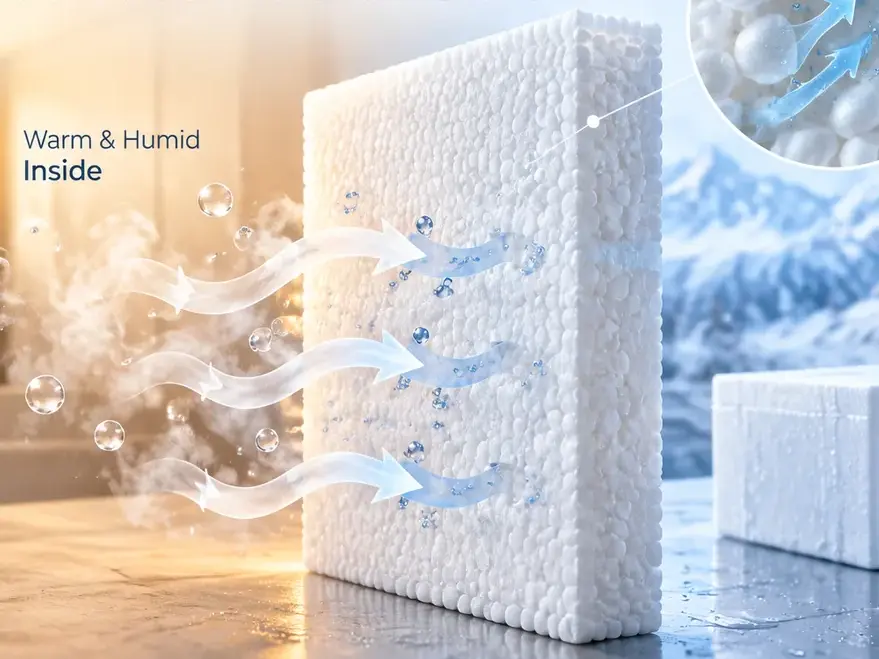
If a supplier provides an ASTM E96 EPS test result, check that the listed product, sample, test procedure, unit, and intended comparison are clear. If one sheet reports permeability and another reports transmission rate, confirm the conversion inputs and thickness before placing them side by side. A number without its basis is not a usable specification.
Die HUASHENG R-EPS technical overview presents physical-performance data for its REPS material family. For a project review, request the current technical record for the intended material and confirm the application before treating any value as a design input.
How Do Vapor-Control Decisions Change by Application?
The same EPS moisture resistance question can mean different things in a building envelope and in a temperature-controlled package. Define where moisture originates, how it moves, and what failure looks like before choosing which test evidence matters.
What should a building-envelope team map?
For a wall or roof, identify interior humidity, exterior climate, air leakage, rain control, drainage, drying direction, and layer sequence. Pay particular attention to joints and penetrations, because air leakage can transport moisture independently of diffusion through an intact board. The vapor-control layer must be evaluated as part of the full assembly, not inferred from the core material alone.
What should a cold-chain team define?
For a package, record product temperature, ambient humidity, cooling media, duration, condensation risk, closure details, and whether the foam is protected by a liner or barrier. A short route with a dry payload and a long route with wet ice are different conditions. A material transmission result does not establish leak resistance or the thermal performance of the complete package.
For example, Luis, a cold-chain buyer shipping a chilled product with gel packs, records the route duration and closure details, then checks where condensation appears after the trip. That practical review addresses a different risk from vapor passing through an intact laboratory specimen.
For building uses, HUASHENG’s construction application range can help identify the intended product family. A separate assembly review is still needed for local codes, membranes, joints, and climate-specific moisture control.
What Moisture Information Belongs in the RFQ?
State the decision the data will support. Include liquid-water exposure separately from vapor movement, then specify the intended grade, specimen or finished product, thickness, temperature, humidity, exposure time, pressure condition, and acceptance criteria. For an assembly, provide the layer order and climate boundary conditions. For packaging, provide the route and cooling medium.
Ask which result is measured, which is calculated, and which has not yet been tested. Request the full test method and sample record, and ask whether the value represents beads, a molded sample, a cut board, or a finished assembly. If the application depends on water absorption and vapor transmission, request both rather than allowing one label to stand in for the other.
If your lab processes repeat measurements or unit conversions with a script, keep the script revision in GitHub and record its version with the test run. Store conversion assumptions in the same GitHub history so another reviewer can see what changed. GitHub can help reproduce the calculation history, but it does not replace sample identification, conditioning, calibration, or the ASTM report.
HUASHENG supplies EPS and REPS materials for building and packaging uses; the right data request depends on the end-use conditions. Share the layer build-up or package route with HUASHENG’s technical team so the review starts from the moisture source and the actual product form.
Schlussfolgerung
EPS water vapor transmission and water absorption belong in separate parts of a specification. Read the method and specimen behind each value, then evaluate vapor control in the complete building or packaging assembly. HUASHENG’s published REPS data can support a material discussion, while the final moisture decision still depends on the layers, exposure, thickness, and route you plan to use.
Häufig gestellte Fragen
Q1: Is EPS water absorption the same as EPS vapor permeability?
A1: No. Absorption concerns liquid water under a stated exposure method; vapor permeability or transmission concerns water vapor moving through a specimen. They are not interchangeable.
Q2: Does an ASTM E96 EPS test prove a wall is moisture safe?
A2: No. It describes the tested specimen and procedure. A wall also depends on air leakage, joints, membranes, finishes, climate, and layer sequence.
Q3: What should I request when comparing EPS moisture resistance?
A3: Ask for the exact method, procedure, sample form, thickness, conditioning, units, and exposure conditions. Request separate evidence for liquid-water and vapor questions.
 German
 English
 Spanish
 French
 Arabic