
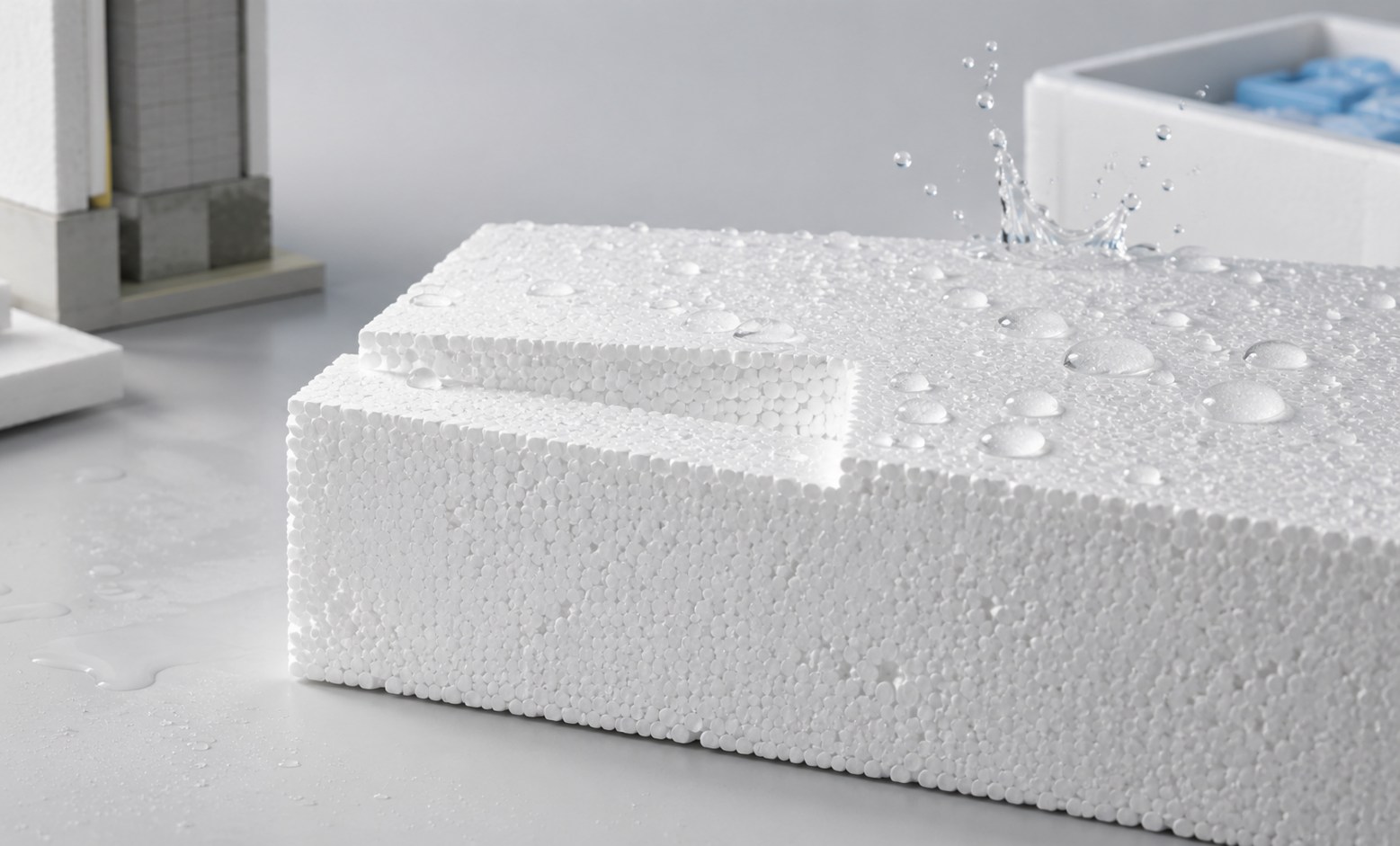
Water is a quiet problem in foam purchasing. It may not show up during sample approval. The surface looks fine, the molded part feels strong, and the price works. Then the shipment meets ocean humidity, cold-chain condensation, wet ground storage, roof leakage, or repeated washing. After that, the real question appears: will the foam still keep its shape, strength, and insulation value?
What Does Foam Water Absorption Mean in B2B Projects?
Water Absorption Is Different from Surface Wetting
A wet surface does not always mean the foam has absorbed water. EPS can get wet on the outside, especially during rain, washing, or cold storage. That surface water may dry without entering the structure deeply.
The real concern is water entering the foam body. EPS is made from closed-cell beads, and each bead contains small gas-filled cells that reduce liquid water entry paths. Bead fusion also matters; tighter fusion usually means fewer spaces where moisture can collect.
The Real Risk Is Long-Term Moisture Movement
However, brief contact with rainwater or condensation is generally not as dangerous as prolonged exposure to moisture. If there is sufficient time for the water to flow through bead joints, weakened edges, or faulty seam areas, performance will be affected. Water increases thermal conductivity since it conducts heat better than air. Under extreme conditions, even the compressive strength of the foam might get reduced. That is why an EPS foam water absorption test is recommended prior to large-scale purchases of insulation materials, packaging items, etc.
Why Does EPS Foam Have Better Moisture Resistance Than Open-Cell Foams?
Closed-Cell Beads Reduce Water Entry Paths
EPS has very high air content in its sealed cells. The use of sealed cells in EPS plays an important role in capturing the air, which contributes to insulating and cushioning properties of EPS while restricting the flow of water.
Water Usually Moves Through InterBead Gaps
The vulnerability is seldom at the internal structure of the closed cell that is still intact. It is much more probable that water will seep through narrow passages in between beads, through any breaks in the surface, or through bad seals in the junctions. This is the reason why there are differences in the behavior of two different EPS materials with the same generic name. Good bead bonding results in a smooth and dense structure, while poor bonding results in the formation of small passages.
Density and Fusion Quality Matter More Than Buyers Expect
Low-density EPS is useful for lightweight packaging and thermal insulation where load is limited. Medium-density EPS is often better when packaging strength, floor insulation, or panel rigidity matters. High-density EPS can suit support roles, below-slab use, or impact protection. HUASHENG’s EPS structure article separates low-density, medium-density, and high-density use by insulation, packaging, construction, and load-support needs.
For buyers, this means water absorption should not be checked alone. It should be read together with density, compression strength, molding quality, and final application.
How Does EPS Foam Water Absorption Affect Different Applications?
Gebäudeisolierung, Dächer, Fußböden und Wandsysteme
With regard to EPS foam in construction, issues like thermal performance, dimension stability, and load-bearing capacity are impacted by water absorption in EPS foam. Roofs, floors, walls, and subsurface panels can be exposed to rain, moisture, wet concrete, damp ground, or frost thaw.
For EPS foam used in insulation applications, standard 24-hour immersion tests reveal water absorption less than 3% – 4% by volume. Under damp ground with good drainage, moisture uptake in the long run can remain under 2% by volume. This information is helpful, but users must validate grades, densities, drainage systems, and building codes in their areas.
Graphit EPS or higher-density grades may be more suitable when thermal performance and moisture resistance both matter. Flame-retardant or non-HBCD grades may be needed when fire and export regulations are part of the project.
Kühlkettenboxen, Lebensmittelverpackungen und Fischtransport
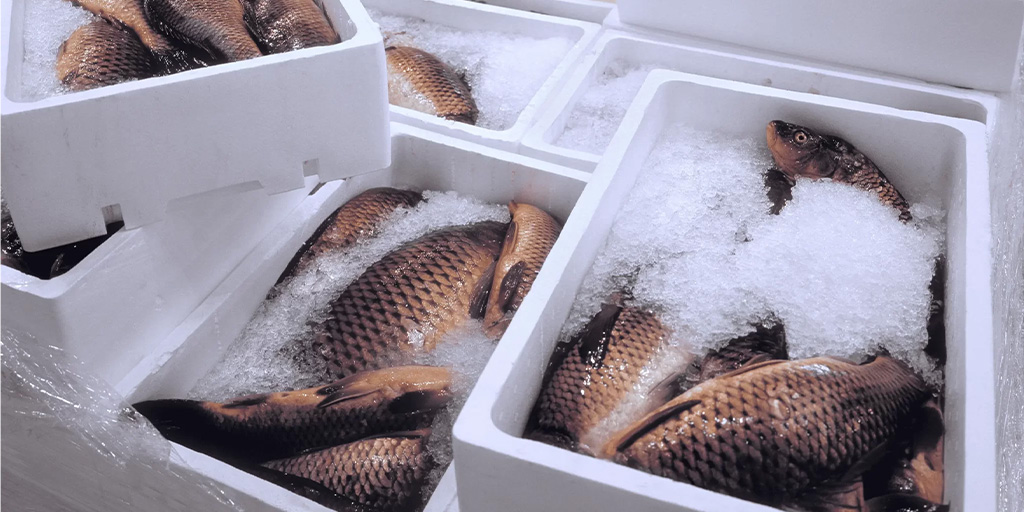
The cold chain package is regularly exposed to ice, condensation, cleaning, and changing temperatures. Expanded polystyrene is widely used for such packaging, as it is lightweight and insulated. Too much water absorption leads to weight gain of the box, softening of the edges, and unreliable temperature control.
In cases where the boxes are designed for seafood, frozen food, vaccines, and medical packages, it is vital to test the actual package, rather than the material itself. Wall thickness, lid seal, density, bead bonding, and handling are all very important.
Electronics, Display Panels, and Export Protective Packaging
Moisture can be a serious issue in export packaging. Goods may sit in a humid warehouse, cross oceans in containers, and meet condensation during unloading. For electronics, display panels, instruments, and ceramic products, the foam must keep its shape and cushioning position.
EPS helps because it is moldable and dimensionally stable when the right grade is selected. But protective packaging buyers should still check surface quality, compression recovery, molded density, and storage conditions. If the insert warps or absorbs moisture through weak bead joints, product positioning may change.
Outdoor Filling, Flood Control, and Custom-Molded Applications
Outdoor filling, landscaping blocks, road applications, floating modules, and flood-control parts need stricter moisture review. Standard EPS may not be enough if direct water contact is long or repeated. For these projects, buyers should discuss hydrophobic EPS or customized formulations. HUASHENG includes a hydrophobic EPS flood-control module example with water absorption below 0.5%.
What Should Buyers Check Before Ordering EPS Foam for Wet or Humid Environments?
A good RFQ should not only ask for price per ton or price per piece. It should describe the real moisture condition.
Match EPS Grade with the Real-Use Environment
Tell the supplier whether the foam will face rain, condensation, ice, wet soil, washing, sea freight humidity, outdoor exposure, or direct water contact. A dry electronics insert does not need the same specification as a flood-control block.
Request Water Absorption, Density, and Compression Data
Ask for water absorption test data, apparent density, compressive strength, thermal conductivity, dimensional stability, particle size, and molded sample results. For export orders, also confirm packaging, certificates, and batch traceability.
Check MOQ, Customization, and After-Sales Support
MOQ depends on grade, formula, color, density, packing, and whether the order is standard or customized. For special hydrophobic EPS, non-HBCD grades, graphite EPS, or unusual molded shapes, sample testing should come before full container purchase.
After-sales support also matters. Keep batch numbers, photos, storage records, and test reports. If a project issue appears later, this information helps the supplier check whether the problem came from material, molding, transport, storage, or installation.
FAQ (häufig gestellte Fragen)
Q1: What parameters should buyers confirm for EPS foam used in humid environments?
A1: Buyers should confirm water absorption, density, compressive strength, thermal conductivity, dimensional stability, particle size, product size, exposure condition, packing method, and required certificates. For bulk orders, molded samples and trial testing are recommended.
Q2: Can HUASHENG support MOQ, custom density, and hydrophobic EPS requirements?
A2: The MOQ is influenced by grade, specification, formulation, packing, and quantity ordered. HUASHENG supplies common grade, flame retardant grade, graphite grade, environmental protection grade, carbon black grade, and customized REPS, thus enabling buyers to negotiate on issues like density, non-HBCD requirement, graphite properties, or hydrophobicity before quoting.
Q3: What should be considered for installation, maintenance, and after-sales?
A3: The EPS products must be kept out of direct sunlight, fire, and excessive moisture before usage. Buildings must adopt proper sealing, draining, covering, and installation techniques according to local codes. In terms of after-sales, customers are advised to maintain details about batches, pictures, testing results, storage conditions, and installation processes.
 German
  English
  Spanish
  French
  Arabic