
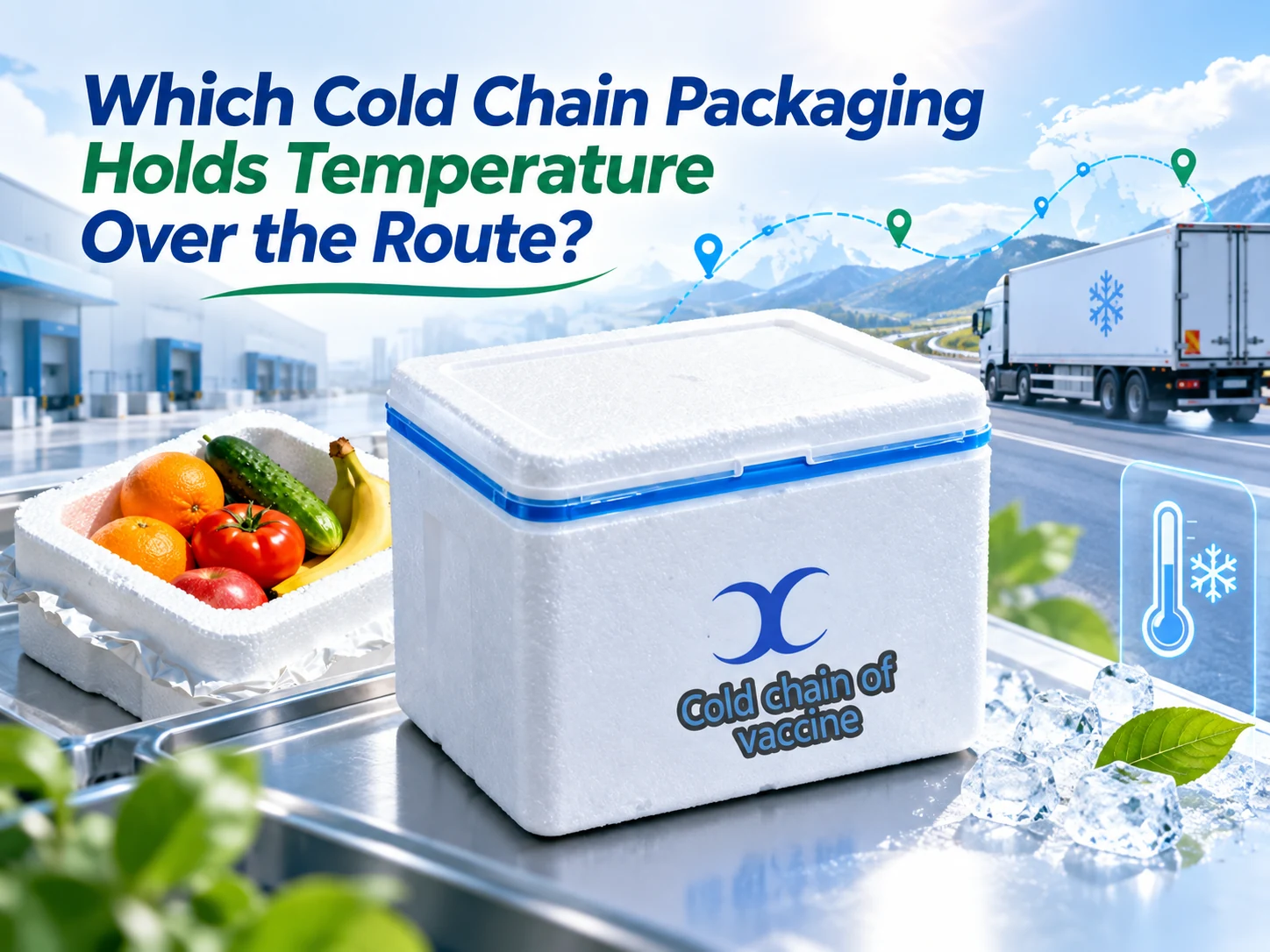
A cold chain shipment rarely fails because the box was cheap. It fails because the route and the payload were never matched to the box. The same container, the same gel packs and the same product can end a route at different temperatures once distance, ambient conditions, handling time and payload mass change. Sizing cold chain packaging therefore means treating the box, the payload and the route as one system instead of ordering a container by its outer dimensions.
What Actually Sets How Long a Box Holds Temperature
Why payload thermal mass, not wall thickness alone, drives hold time
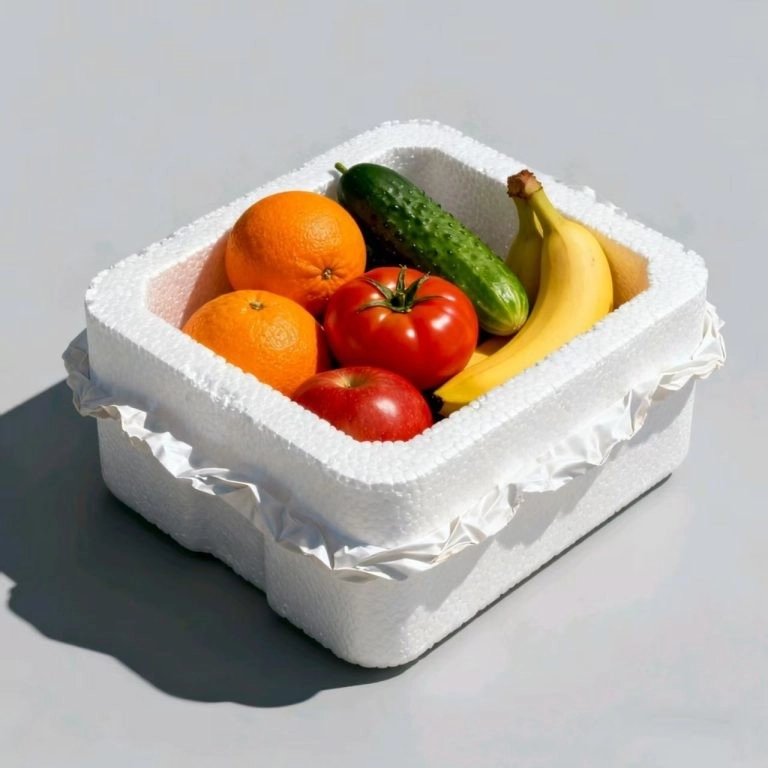
An insulated box does not hold a temperature. It slows an exchange between two bodies that will eventually meet in the middle, and the second of those bodies is the payload. Wall thickness sets how quickly heat arrives, but the payload’s own thermal mass decides how far the temperature moves once it does. A dense frozen load is a large store and resists change; a light payload with a lot of void space is a small one and responds quickly. Two shipments can leave with identical boxes and identical cold-source weight and still arrive at different temperatures.
How ambient temperature and route duration change the insulation required
Heat transfer is driven by the gap between the ambient conditions and the window the product has to stay inside, multiplied by the time that gap is applied. A route crossing a hot loading yard at midday is a different problem from the same distance covered overnight. The hours that matter are the hours spent in the worst conditions rather than the scheduled transit time. A wider gap and a longer exposure both demand more insulation, and the increase required is not proportional, because the box loses heat through several paths at once.
Why handling time at every transfer point draws on the same cold source
A cold source is a budget rather than a rating. Every hour a box waits on a dock or changes vehicles draws on the same gel packs that still have to be protecting the payload at the far end. Three handoffs can consume more of that budget than a longer route with none. Sizing against nominal transit time while ignoring dwell is one of the most common reasons a configuration that passed an internal test fails on a live lane.
How the Insulated Shipper Itself Changes the Result
Why wall thickness and foam density have to be decided together
Thickness lowers the rate at which heat reaches the payload, and density moves both the conductivity of the foam and its mechanical strength, so the two belong in the same decision. The trade-off is not free: at a fixed outer dimension, thicker walls take volume from the interior, and the interior is where the cold source has to sit. Raising thickness without rechecking cold-source capacity can shorten hold time instead of extending it.
How the lid, the body seam and the inner liner change how far the cold source reaches
Heat takes the shortest path it can find, and in a moulded box that path is usually the lid joint, the body seam and the corners. A lid formed from a thinner section than the walls governs the whole box. The same logic applies to an inner liner: a reflective or vacuum liner helps only where it covers joints as well as faces, because a break at a seam short-circuits the benefit. Readings taken at a corner and under the lid are more informative than readings taken on a wall.
Where a moulded EPS box stops being enough and polyurethane or vacuum insulation becomes necessary
Moulded EPS earns its place where the temperature gap is low to moderate, the route is of moderate duration, and the wall thickness required still leaves workable internal volume. The decision point is not a fixed number of hours. It is the moment the thickness needed to hold the window consumes so much interior space that the payload and its cold source no longer fit, or the moment the route outlasts what a practicable wall can slow down. Polyurethane and vacuum insulation panels change that calculation because they provide more resistance for each millimetre, at a higher material and handling cost.
How to Match the Cold Source to the Payload
How to size gel packs, dry ice or phase change material from the temperature window
Choosing a cold source begins with its phase change temperature rather than its weight. Dry ice changes phase far below any chilled window and belongs only on packs designed for frozen travel. Gel packs and phase change materials have their own transition points and can be selected to sit inside the window with a working margin. Quantity then follows the energy the payload and the box have to absorb: the mass being held, the span to be covered, and the losses through the walls over the route hours.
Why the position of the cold source matters more than its total weight
Total weight says how much cooling is available; position decides whether the payload can reach it. Heat enters through every face, so a cold source concentrated on one side lets the opposite corner drift toward ambient while the near side risks running too cold. Spreading it across more faces, and separating it from the product with a liner or a divider, changes the internal gradient far more than adding weight to one end. It is often the cheapest fix available for a route failing by a narrow margin.
Which payload conditions make pre-conditioning the box necessary rather than optional
A box that has stood in a warm warehouse carries its own heat, and the same cold source is expected to remove it. Pre-conditioning moves that work earlier, so the cold source is spent on the route rather than on the walls. It matters most when the box’s thermal mass is large relative to the payload, when the required window is tight, when the payload is small, and when the route begins in a hot loading environment. Under those conditions it is a design requirement rather than a refinement.
What to Verify Before the First Real Shipment
Which measurements belong in a qualification test instead of a trial-and-error run
A qualification run records the payload’s own temperature rather than only the air in the box, alongside the external ambient temperature and elapsed time, and it is judged against a criterion written before the test began: the allowed window, the maximum excursion, and how long an excursion may last. Varying ambient conditions and route duration one at a time, and testing the packed configuration as one unit instead of the box alone, is what turns a shipment into evidence.
How to read a temperature logger record so it supports a shipping decision
A logger curve answers four questions at once. The starting value shows whether the pack was conditioned before dispatch. The slope shows how quickly the insulation is losing the argument. The length of any excursion separates a brief spike from a sustained drift. The tail shows whether margin remained when the box was opened. A drift that ends near the edge of the window and a short spike in the middle are different findings, and only one of them calls for more insulation.
Which documents should travel with the insulated box and its liner
The configuration that passed is reproducible only if it is written down. The packing specification, the cold-source type and quantity, where each sits inside the box, the pre-conditioning step, the sample or qualification record and the logger data all belong with the shipment, because a review that cannot be traced back to the configuration actually shipped proves very little. Handlers also need the practical instructions: which way up the box travels, and under what circumstances it must not be opened.
How HUASHENG Fits a Cold Chain Packaging Requirement
How FrostSafe cold chain boxes match chilled, frozen and fresh-produce routes
The cold-chain direction published on the site is a moulded EPS box family, described as FrostSafe cold chain boxes, with documented cold-chain work and related food-industry applications elsewhere on the same site. Chilled, frozen and fresh-produce routes do not resolve to one box. They differ in the temperature gap, the hours involved and the cold source that can be used, so one family is configured three different ways instead of being quoted from a size table.
How HUASHENG reviews wall thickness, density and box geometry against the route profile
The review starts from the shipping route, not from a catalogue size. هواشنغ works from the required window, the ambient extremes, the total hours and the payload mass to check wall thickness, foam density, lid and seam geometry and internal volume together, because changing one of those changes the others. Where forming is in scope, the same review reaches bead fusion and dimensional stability, which decide whether a qualified part can be repeated in production.
How to open a temperature-hold trial with the HUASHENG technical team
A trial needs the numbers that drive the design: the temperature window with its tolerance, the expected ambient extremes, the total hours from packing to opening, the payload mass and its starting state, the outer dimension limit, and the handling conditions. Supplying those to the technical team allows a configuration to be proposed, sampled, and then qualified against the lane you actually run, rather than accepted on the strength of a supplier’s label.
استنتاج
Cold chain packaging holds its temperature only when the insulation, the cold source and the payload are sized against the same route profile. Once the required hold time, the ambient conditions and the payload mass are fixed, a moulded EPS shipper can be dimensioned and qualified instead of guessed. Send the temperature window, the route duration and the payload details to الفريق التقني لهواشنغ, and the configuration can be reviewed against the shipment you actually run.
الأسئلة الشائعة
Q1: How long can cold chain packaging hold a temperature?
A1: There is no single figure, and any number quoted without a route behind it should be treated as a starting point rather than a specification. Hold time is the result of the insulation the box provides, the cooling the cold source can deliver and the payload’s own thermal mass, measured against the hours and ambient conditions that the route imposes. The only figure worth relying on is the one measured on a configuration qualified for that lane.
Q2: Is EPS cold chain packaging enough for frozen shipments?
A2: It can be, when the frozen window is wide relative to the ambient gap, the route is short enough for a practicable wall thickness, and the cold source is matched to a frozen payload rather than a chilled one. It stops being the efficient choice when the required window is narrow, the route is long, or the thickness needed would leave too little internal volume for the cold source. Those are the conditions under which higher-performance insulation earns its cost.
Q3: What information is needed to size an insulated shipping box?
A3: The temperature window and its tolerance, the expected ambient extremes, the total hours from packing to receipt including dwell time, the payload mass and starting temperature, the outer dimension and weight limits, and any handling or orientation constraints. With those inputs the box, the liner and the cold source can be sized against the same route rather than one component at a time.
 Arabic
  English
  German
  Spanish
  French