
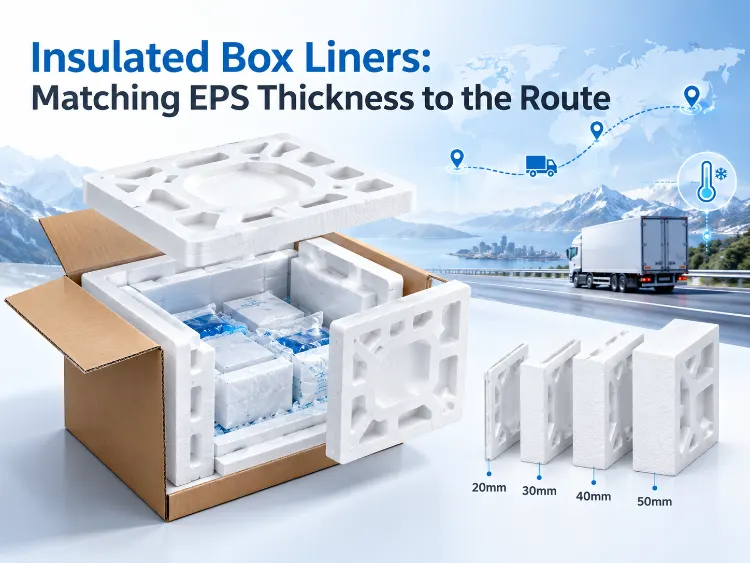
Boxes get chosen first, liners second. That order is backwards. The liner is the part that holds the temperature window over time; the box is what holds the liner. Start from the box and you usually finish with a liner that is either thicker than the route needs or thinner than the payload can tolerate, and neither problem shows up until the first real shipment is opened at the other end.
Two numbers set the target before any material is discussed: the temperature range the shipment must stay inside, and the time it must survive.
What Decides the Liner, Before the Material
The Route’s Temperature Window
Season matters as much as distance. The same lane can behave differently in a cold month and a hot one, and a design validated in one season may sit much closer to its limit in the other. Where the route runs year-round, the specification should reflect the harder season rather than the average day.
A shipment carries a range it may not leave and a duration it must last. Those two figures define the liner requirement, not the product category. A two-day domestic move and a five-day international one can carry the same product and need completely different insulation. A frozen product tolerates conditions that would ruin a chilled one.
Waiting time belongs in the same calculation. Freight sits at docks, in customs areas, and at transfer hubs, and insulation holds a temperature window against elapsed time. The hours a package spends standing still count exactly like the hours it spends moving.
Box Size, Fill and Air Space
Insulation performs against the volume of air it protects. A large carton holding a small payload contains more air to keep cold, and that air moves heat around inside the package. Box size and payload therefore sit in the same decision as liner thickness.
Fill matters in the other direction too. A loose package lets the product and the coolant shift, which can open gaps in the liner and create paths for warm air. Anything that holds the payload and the cold source in place is also protecting the thermal result.
Reading EPS Liner Specifications
Thickness and R-Value per Inch
EPS liners are described by a small set of values, and each one answers a different question. R-value per inch describes how well the material resists heat flow; thickness multiplies it. Two liners of the same material and different thicknesses are not interchangeable, and a liner sold only on thickness is missing the property that explains its performance.

The same caution applies across materials. A reflective liner and an EPS liner may both be described as insulated, yet they resist heat flow differently and behave differently each time the box is opened. Read the specification as a set of conditions rather than one number, and check what a quoted value represents before setting it against another supplier’s figure.
Cut, Score and Fit
An EPS liner usually arrives as a sheet or a set of panels that are scored, cut or folded to fit the carton. Scoring spacing decides how closely the liner follows the box dimensions, and the cut edges decide how well the panels meet in the corners. Corners are where a package loses its thermal performance first.
Fit decides service behaviour as well. A liner forced into the box bows and leaves air gaps; a loose one shifts and opens the same gaps from the other direction. So the specification includes the interior dimensions, the panel layout, and how the corners close, not only the material and the thickness.
Verifying a Liner for a Real Shipment
Small-Scale Trial and Recorded Data
A liner can be specified correctly and still fail on the first route if it was never tested against real conditions. Run a trial shipment before committing to a program, using the real payload, the real cold source, and a temperature logger inside the box. Note the ambient conditions, the time in transit, and where the logger sat. One trial does not prove a route, but it shows whether the design is in the right region and exposes the conditions that matter: a dock delay, a hot transfer, a carton opened early.
img.EPS material checked for a trial shipment.webp
Those records are what make the result repeatable. Without them, a successful shipment is an anecdote and a failed one cannot be diagnosed.
Payload, Cold Source and Handling
The coolant has to suit the liner and the payload. A liner that holds two days can still be defeated by a cold source that freezes the product or warms too quickly, and a heavy payload with real thermal mass behaves differently from a light one.
Handling closes the loop. If a package is opened at an intermediate stop, the liner has to survive re-closing without losing its fit. Buyers who want to compare the component with the container it sits inside can look at the FrostSafe cold chain logistics box; the material side of the decision is set out in how graphite EPS is used in cold chain packaging. Programs with their own return flow may also want the role of REPS foam in cold chain logistics before fixing the liner specification.
استنتاج
An insulated box liner is chosen from the route back to the material: temperature window and elapsed time set the target, box volume and fill decide how much air must be protected, and thickness with fit decides whether the liner can hold that target. A trial shipment with recorded conditions turns the specification into something repeatable. هواشنغ documents its EPS grades and its production process, so liner thickness and material can be tied to the route rather than chosen by habit.
الأسئلة الشائعة
Q1: What sets the liner thickness a shipment needs?
A1: The temperature range and the elapsed time, including waiting at docks and transfer points. Box volume and payload follow, because a large carton with a small product has more air to protect. Thickness should follow those conditions rather than a standard value.
Q2: What does R-value per inch tell me about a liner?
A2: It describes how well the material resists heat flow, and thickness multiplies that resistance. Two liners of the same material and different thicknesses are not interchangeable, and comparing materials requires checking what a quoted value represents and how it was measured.
Q3: Should I test a liner before ordering in volume?
A3: Yes. Run a trial shipment with the real payload, the real cold source and a temperature logger, and record ambient conditions and transit time. A single trial does not prove a route, but it shows whether the design is in the right region and reveals the conditions that decide the result.
 Arabic
  English
  German
  Spanish
  French