

Colored EPS gives a packing team a visual cue for choosing an insert. It still needs to identify the right material and cavity revision. Keep the code and label checks in place, and define the job of the color before ordering shades. A distinctive tray can be the wrong tray for the product beside it.
Suppose a line packs two similar instruments whose inserts differ only around a connector. Color could help staff select between them, provided they know the rule. They also need a second identifier when lighting, texture or color perception makes the difference uncertain. This is an example to test on a line, without assuming a productivity gain.
What Job Should Colored EPS Perform?
Pick the task first: identifying a variant, showing orientation or meeting a presentation brief. A shade that works for branding may be too subtle for selection on a busy line. Each purpose needs its own approval criteria.
Make the distinction easy to check
Bring the proposed colors to the normal work area, with trays stacked or bagged as they will be stored. Can operators still see the distinction in that light? The sales sample may have shown a broad, unobstructed surface that isn’t visible during selection.
Packaging identification needs another route to the answer when two shades are hard to separate. A code, label or agreed molded feature can supply it. The worker shouldn’t have to guess which cavity is correct from color alone.
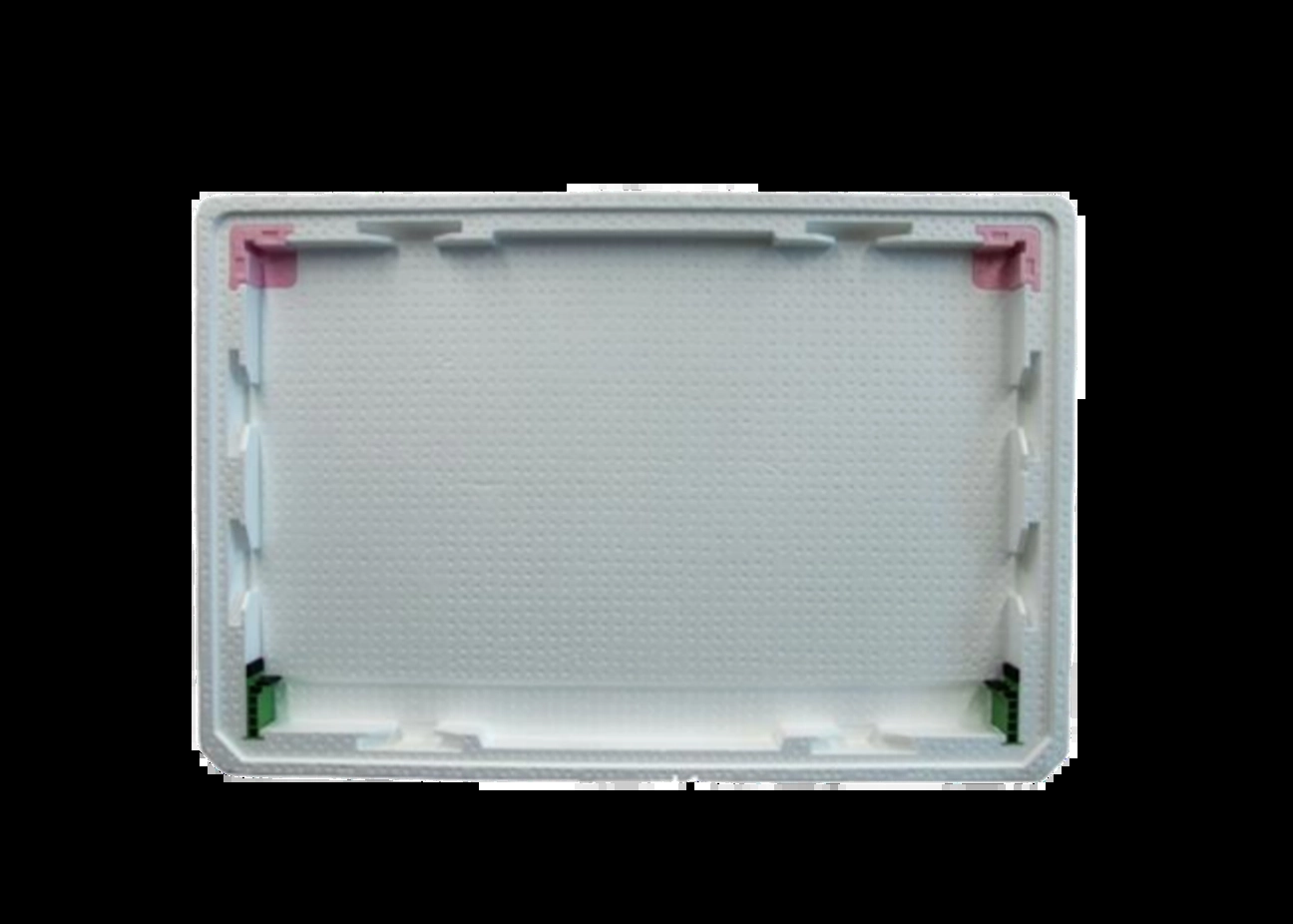
For a left-and-right color scheme, put the assignment on the drawing from the operator’s specified viewing position. Once the product rotates, a loose instruction such as ‘blue on the left’ may describe the opposite component.
Explore HUASHENG’s EPS material options with that identification purpose in mind. A clear use case makes a color inquiry more useful than asking for a generic attractive finish.
Which Colored EPS Customization Details Are Relevant?
Color selection belongs with material and geometry selection. A buyer should approve the molded outcome, because unexpanded particles and the finished foam are different visual references. An attractive raw-material sample is not the complete acceptance standard.
HUASHENG offers project-specific REPS adjustments to performance, particle size and colors. The modified-polystyrene material goes through pre-foaming and molding. Its stated applications include liquid crystal panels, medical products, automobiles, new energy products, phones, tablets and other electronics. Treat that list as context for the inquiry; it doesn’t confer approval for a particular regulated use.
The standard particle-size range identified for HUASHENG REPS is approximately 0.8–1.2 mm, with customization available for individual projects. A representative tray-type application uses 0.65–0.8 mm particles. Keep the proposed color attached to the actual particle specification and molded sample: changing the appearance should not silently change the material or cavity that was evaluated.
HUASHENG’s B quick grade is intended for electrical packaging, panels and precision instrument packaging using traditional machines or automatic vacuum molding machines. Its listed features include fast molding, high strength and a smooth surface. The P ultra-light grade is intended for automatic vacuum forming of large panels, electrical packaging and ceramic lamp packaging, with smoothness, toughness, storage stability and multiple pre-foaming capability among its stated features.
These are useful starting families for discussing custom REPS colors. Review customized REPS possibilities and request confirmation of the selected grade, color and application together. A color request does not establish anti-static behavior, food-contact suitability or another functional property.
B specification 301 lists particles of 1.0–1.8 mm and a single-time expandable ratio of 50–70. The 302 entry lists 0.8–1.3 mm and 45–65. The 303 and 401 entries list ratios of 40–60 and 30–50 respectively.
How Should Buyers Approve EPS Color Consistency?
Keep a molded approval reference and write down how it will be viewed. If the decision requires a numerical color tolerance, settle the measurement system, instrument conditions and sample preparation with the supplier. A tolerance copied without those conditions may have little to do with whether staff can identify the insert.
Compare the surfaces the operator actually sees
Which surface is actually visible at selection? In a stack, it may be just the top rim. Texture, thickness, angle and light affect that view, so identify whether the molded skin, cut edge or both are being assessed for packaging identification.
Use the physical molded pair for approval. Photographs help explain a difference, but camera and screen settings add differences of their own. Retain the accepted sample under suitable conditions and agree when it needs replacement, while it is still useful as a reference.
EPS color consistency also needs a practical rejection rule. A slight difference may be acceptable for a hidden insert but unacceptable when two variants become difficult to distinguish. Tie the limit to the actual function, not an undefined expectation of “perfect matching.”
For a hypothetical two-color program, ask representative packing staff to choose the correct insert from mixed trays. Record selection errors and uncertainties during a controlled trial. This checks the identification concept before large quantities are ordered, without claiming a guaranteed productivity improvement.
What Else Must Be Validated Before Production?
The package still has to protect the product. Compare the proposed colored material in the production-intent geometry, carton and packing sequence. Maintain the same dimensional, handling and transport criteria used for the approved system.
- Identify the material, color reference and part revision.
- Confirm cavity fit and the full packing sequence.
- Check the product-contact surfaces after handling.
- Verify package performance through the agreed tests.
- Record the accepted appearance and functional results separately.
For custom REPS colors, discuss any product-contact or downstream processing requirements before sampling. If the product has a sensitive cosmetic finish, use the actual finish in the contact trial. Color alone cannot establish transfer resistance or chemical compatibility.
HUASHENG gathers the application and project features before developing a customized solution. Requirement analysis, design, sample production, manufacturing and logistics are within its service scope. Put identification into that opening brief with the geometry and protection requirements, while the team can still review them together.
Read HUASHENG’s REPS material information when preparing that brief. Ask for EPS color consistency evidence on the intended molded sample, then document which appearance differences require supplier notification.
At receiving, verify the part identity and label even when the shade looks right. The cavity could have changed without changing the color. Use the cue to help staff locate a part, then the controlled records to establish which part it is.
Repeat the selection check with the trays in their bags or stacks. A cue covered by the normal storage arrangement won’t do its intended job.
استنتاج
Give colored EPS a defined role in the packing operation and keep an independent identity check beside it. Approve the molded reference, then retain the protection tests for that actual material and geometry. Send HUASHENG your identification and color requirements with the operator’s view and selection task explained.
الأسئلة الشائعة
Q1: Can colored EPS replace part labels?
A1: Color should support identification. Retain a part code or another agreed check, particularly where similar variants could be confused.
Q2: How should buyers approve EPS color consistency?
A2: Use a molded physical reference and an agreed viewing or measurement procedure. Match acceptance to the color’s practical purpose.
Q3: Do custom REPS colors establish anti-static performance?
A3: No. Functional properties require their own specification and applicable evidence. Appearance alone cannot prove an electrical property.
 Arabic
 English
 German
 Spanish
 French