
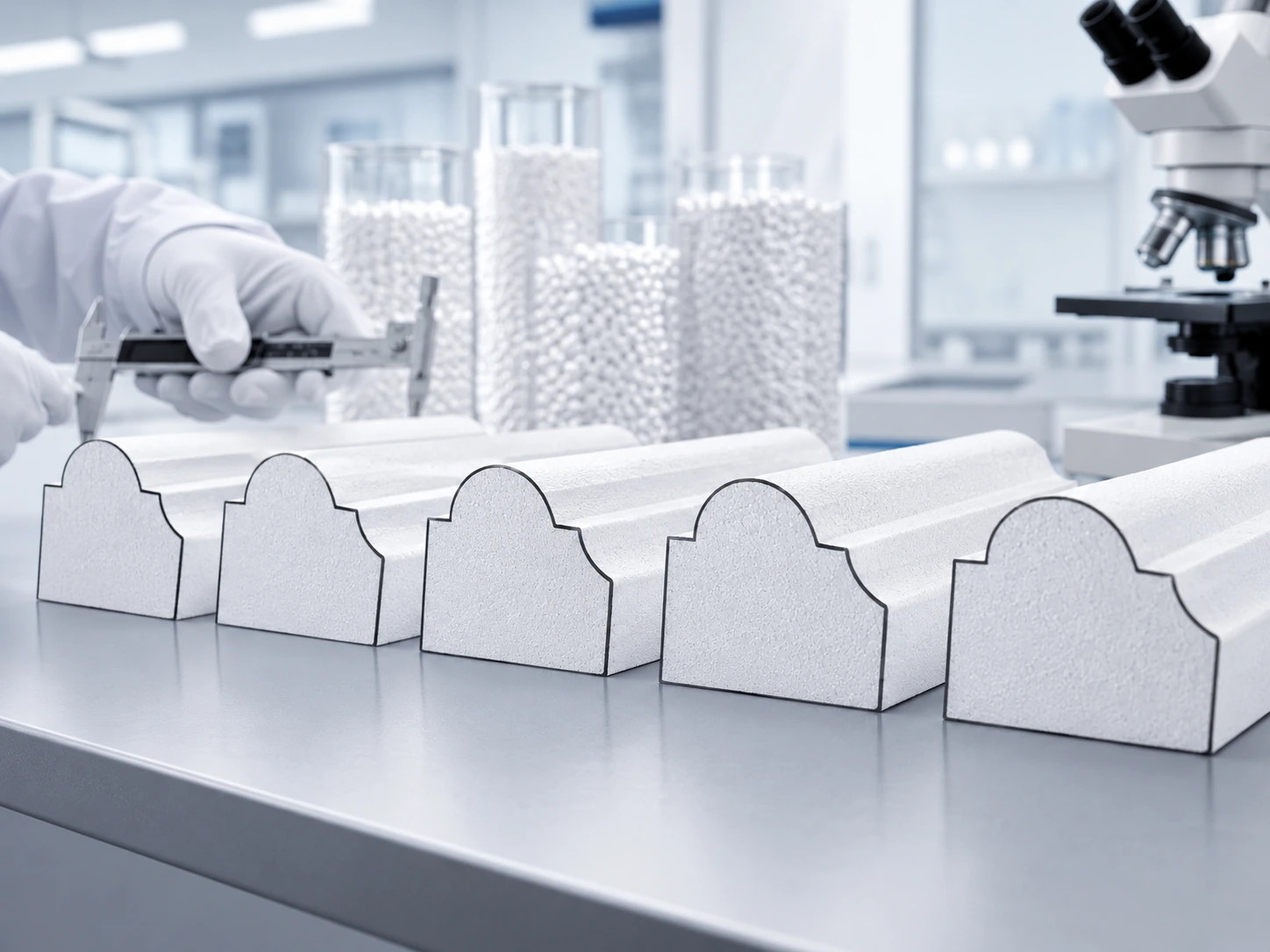
A lower price per ton does not guarantee a lower cost per finished EPS product. For bulk buyers, inconsistent polystyrene beads can change expansion behavior, molded density, steam settings, fusion, cycle time, rejection rate, and sometimes the approval result of fire-retardant products. Those costs appear after the purchase order, which makes them harder to see during quotation comparison.
That is why experienced buyers often value repeatability more than the lowest bead price. Stable EPS beads allow the factory to run an approved process again instead of rebuilding the process around every shipment.
Why Can a Cheap EPS Shipment Become Expensive?
The raw-material invoice is only the first cost.
What Happens When Beads Change Between Batches?
A production line is usually tuned around an operating window. Operators know how a material expands, how long it needs before molding, how it fills a mold, how much steam it requires, and when the finished part can be released.
If a new batch behaves differently, the line may need adjustment.
A small change in expansion can push molded density away from target. Different bead flow can affect cavity filling. Different fusion behavior can produce weaker edges. Operators may then extend steam, cooling, or cycle time to recover acceptable quality.
The factory pays for the difference through labor, steam, machine time, and rejected parts.
Why Does Rework Distort the Real Price Comparison?
Suppose Supplier A is cheaper per ton but creates more start-up adjustment and a higher reject rate. Supplier B costs slightly more but runs inside the existing window.
The purchasing spreadsheet may favor Supplier A. The factory cost often does not.
A better comparison uses cost per accepted molded unit. That number should include raw material, scrap, extra steam, machine downtime, inspection, rework, and delayed shipments.
What Does a Fair Price Flame Retardant EPS Bead Really Mean?
For flame-retardant applications, “fair price” should mean that the material can repeatedly meet the agreed processing and finished-product requirements, not simply that its quotation is lower.
Why Are Fire Retardant Insulation Orders More Sensitive to Variation?
Fire retardant insulation projects connect several variables at once: material formulation, particle size, density, bead fusion, board dimensions, curing or aging, and the required fire-performance route.
If buyers compare only the flame-retardant label, they may miss the process stability behind it.
A material that performs well in one sample but forces repeated adjustments in bulk production is not truly consistent.
For non-HBCD projects, HUASHENG FHE-N-HBCD flame-retardant EPS uses non-HBCD flame retardants, complies with REACH and RoHS-related requirements, can reach B1-level flame-retardant performance, and combines uniform beads with fast foaming, fine cells, good adhesion, strength, hardness, and dimensional stability.
FHE grades cover particle sizes from 1.30–1.60 mm down to 0.35–0.55 mm, with different first-expansion ranges. That is exactly why a bulk RFQ should name the specification instead of buying a generic “fire resistant insulation bead.”
Why Should Fire Resistant Insulation Be Specified More Precisely?
“Fire resistant insulation” is too broad for a production order.
The buyer should state the target application, board density, thickness, particle specification, required classification, test condition, market, and molding equipment.
Two insulation projects can use EPS and still need different raw-material routes. A standard B1 requirement, a non-HBCD environmental requirement, and a graphite-enhanced insulation project are not the same purchase.
Which Consistency Indicators Matter Before a Long-Term Contract?
A supplier should be evaluated on how repeatably it controls the parameters that affect production.
Why Is Particle-Size Distribution Important?
Uniform bead size supports more predictable pre-expansion and mold filling.
If a batch contains a wider or shifted distribution, fine mold details may fill differently and finished surfaces may change. In board production, the effect may be less visually obvious but can still appear in density uniformity and fusion.
Buyers should therefore compare the actual grade and particle range between sample approval and later bulk shipments.
Why Does Expansion Behavior Matter More Than a Single Density Number?
Molded density is a result. Expansion behavior helps explain how the line reaches that result.
If a factory has to change pre-expansion conditions significantly from one shipment to the next, a nominally identical material may be creating hidden process cost.
Batch comparison should include pre-expansion results, molded density, steam conditions, cycle time, and finished-product acceptance.
This is especially useful for long-term contracts because the buyer can define what “same grade” means in operating terms.
When Does a Functional Flame-Retardant Grade Need Extra Control?
Some projects ask for more than flame retardancy.
What Changes When Graphite or Carbon Black Is Added?
Graphite or carbon black can add functional value, but the buyer still needs repeatable bead behavior and stable molding.
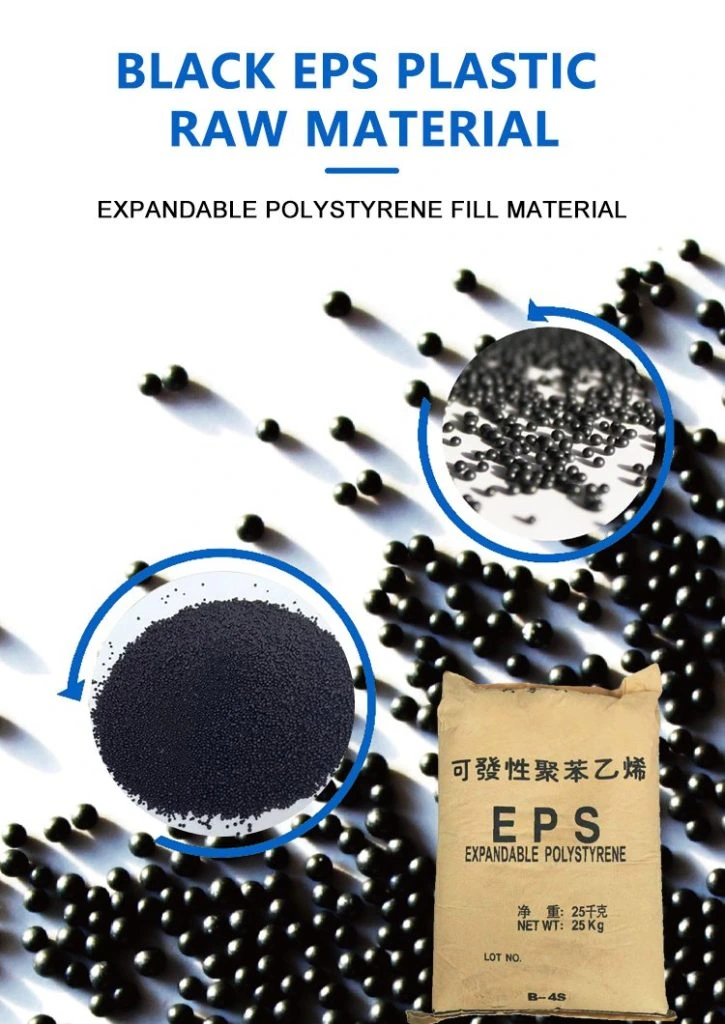
HUASHENG FGH-N-HBCD graphite flame-retardant EPS combines a non-HBCD flame-retardant system with graphite or carbon black added during suspension polymerization. It can reach B1 level and is designed with uniform beads, fast foaming, fine cells, good adhesion, strength, hardness, dimensional stability, and compatibility with different EPS processing equipment.
That type of material should not be compared with a standard bead only on price. The functionality and the ability to repeat the finished result both belong in the cost calculation.
Why Is Over-Specification Also Expensive?
Consistency does not mean buying the highest-performing grade available.
If a project needs standard fire-retardant board performance, adding unnecessary functional requirements can raise cost without improving the finished product.
A good supplier should help identify the minimum specification that reliably meets the application.
Buyers can compare HUASHENG flame-retardant EPS options across standard, light, rapid B1, and higher-strength requirements rather than forcing every project into the same grade.
How Should Buyers Control Batch Consistency in the RFQ?
A clear RFQ makes consistency measurable.
What Should Be Fixed Before the First Container?
Define the grade, particle size range, target molded density, application, processing equipment, fire requirement, required documentation, packaging format, and sample approval criteria.
Then record the conditions that worked during trial production.
For repeat orders, retain the approved sample, raw-material batch information, molded density records, and key machine conditions. If a later shipment changes performance, the comparison starts from evidence rather than memory.
Should Buyers Ask for One Perfect Sample?
No. One perfect sample can hide variation.
For a serious volume program, it is better to evaluate several samples or a trial batch and then confirm how the supplier controls subsequent lots.
The question is not “Can this material work once?” It is “Can the supplier deliver the same working window month after month?”
HUASHENG’s product system spans common, flame-retardant, graphite, environmental-protection, carbon-black, and customized grades. For buyers balancing compliance with repeatable production, compare non-HBCD EPS routes for a long-term program before reducing the decision to price per ton.
Conclusion
Bulk EPS purchasing becomes more profitable when buyers measure consistency as a production variable.
Stable polystyrene beads reduce the need to retune machines, recover density, correct fusion, extend cycle time, or investigate why a previously approved product suddenly behaves differently.
For fire retardant insulation and fire resistant insulation projects, this matters even more because processing stability sits alongside flame performance, board quality, dimensions, and compliance.
A fair price is therefore not the cheapest quotation. It is the price that produces the lowest predictable cost per accepted product across repeated batches.
FAQs
Q1: What should buyers compare between two EPS bead suppliers besides price?
A1: Compare particle-size consistency, expansion behavior, target-density repeatability, fusion, molding cycle, documentation, batch traceability, rejection rate, and how closely later shipments match the approved trial.
Q2: Why is batch consistency important for fire retardant insulation?
A2: Flame-retardant boards depend on more than an additive. Material specification, molded density, fusion, board dimensions, processing, aging, and the required test route all affect whether production remains repeatable.
Q3: Is the cheapest flame-retardant EPS bead usually the lowest-cost option?
A3: Not necessarily. A cheaper bead can cost more if it increases scrap, steam use, line adjustment, retesting, or production delay. Buyers should compare the cost per accepted finished product, not only the cost per ton.
 English
  German
  Spanish
  French
  Arabic