
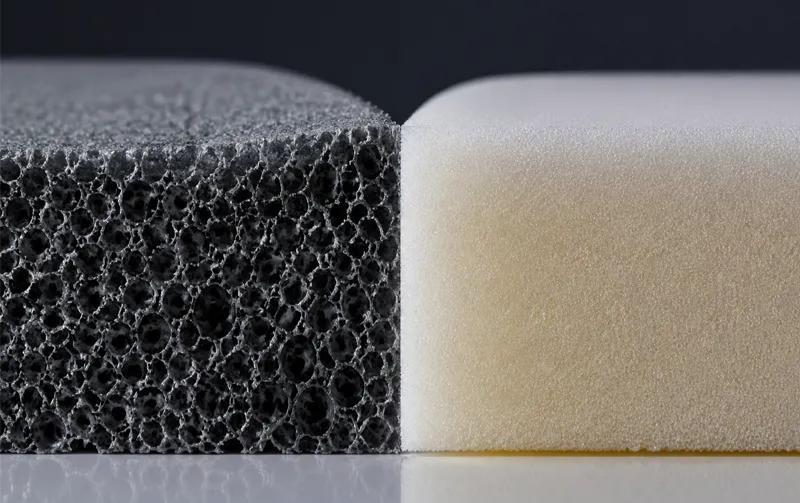
Foam materials are used in many B2B projects, from export packaging and cold chain boxes to building insulation and molded inserts. But buyers often run into problems when they choose foam only by price, density, or surface feel. The real performance difference usually starts from the cell structure.
What Is Open-Cell Foam
Basic Definition of Open-Cell Foam
Open-cell foam is an open sponge-like cell structure. This type of foam is not fully sealed and, as such, allows air, moisture, and even occasional bits of dust to pass through the material. Open-cell foam is lightweight and very soft, yet to absorb water, open-cell foam is far more prone to absorption than its closed-cell counterpart.
Main Features: Softness, Breathability, and Sound Absorption
Open-cell foam has many positive qualities. Above all, it is very comfortable, as open-cell foam allows for air to circulate freely and consequently does not store as much heat as dense closed-cell insulation. Open-cell foam is also an excellent sound absorber, as it is able to distribute and absorb any sound or vibration via the many channels and voids within the foam’s structure.
Open-cell foam is often found in furniture cushions, acoustic panels, mattress layers, soft pads, and even in some of the filter materials. The reason open-cell foam is used in these applications is that they do not require the material to be able to resist high amounts of compression or moisture. They do require the material to be very soft, to allow for a lot of airflow, or to act as a sound reducer.
What Is Closed-Cell Foam
Basic Definition of Closed-Cell Foam
Closed-cell foam contains many small sealed cells containing gas or air. These cells form the strong and stable inner structure of the foam, and it feels firmer than open-cell foam. It has better compression resistance.
Main Features: Moisture Resistance, Insulation, and Structural Support
There are three key advantages to closed-cell foam: better defense against water, greater thermal insulation, and superior support under compression. These advantages are especially relevant to packaging, building, and industry.
Moisture resistance is important for products that will be shipped by sea, stored in a humid warehouse, or used in very temperature-sensitive logistics. For projects that require insulation, closed cells help slow down heat transfer. For products moulded into trays or used as blocks or supports, the key properties are compression strength and dimensional stability.
Open-Cell vs. Closed-Cell Foam: Key Differences Buyers Should Know
Water Absorption and Moisture Resistance
Open-cell foam absorbs water with ease as the cells are connected together. This product can be sensitive in humid storage and sea freight and cold chain boxes and can be damaged when used outdoors or in packaging that suffers from condensation.
Closed-cell foam is more water resistant. Therefore, it is best to use this foam for seafood boxes, cold chain packaging, insulation boards, building materials, and export protective packaging. Even if the buyer is unsure of the transportation conditions, closed-cell foam is the safer option.
Thermal Insulation and Temperature Control
Open-cell foam does provide some degree of insulation. However, due to the airflow within the open-cell structure, it does not offer as much thermal resistance as closed-cell foam. The sealed cells within a closed-cell structure slow down heat transfer.
EPS and graphite EPS are among the commonly used materials in insulation projects. HUASHENG’s S-33 graphite polystyrene has a thermal conductivity of ≤0.033 W/M.K., while S-32 has a thermal conductivity of ≤0.032 W/M.K. This makes them suitable for energy-saving buildings, passive house insulation, and other high-end thermal performance applications.
Compression Strength and Dimensional Stability
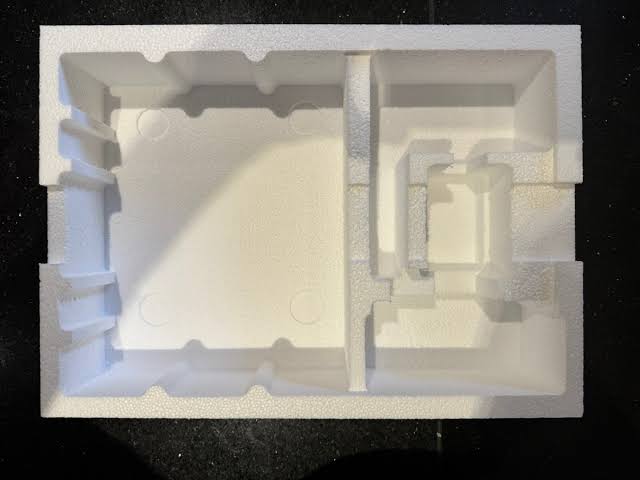
Closed-cell foam products are more firm in nature and will hold their shape better under pressure. This would make them a better product for applications such as stacking of products, pallet loading, moulded-type applications that require support of the moulded part and general storage applications. Open-cell foam will typically compress under load and return to its original shape when the load is removed. The degree to which open-cell foam will compress under load will vary greatly from product to product.
Cushioning Behaviour and Impact Protection
Open-cell foam feels ‘soft’ and is great for absorbing light impacts. Closed-cell foam offers more structural cushioning in packages where the product needs to remain in place.
Many of the customers buying cases for fragile electronics, display panels, ceramic products, industrial parts, or other delicate precision instruments also need custom-moulded closed-cell foam inserts to prevent movement within the case and to protect the corners or sensitive surfaces of the items being packaged.
Where Closed-Cell Foam Performs Better in B2B Projects
Export Protective Packaging for Fragile or High-Value Goods
Export goods are subjected to vibration, stacking, loading, unloading, and long periods of transit. Closed-cell foam packaging can be moulded into shapes such as inserts, blocks, corners, and full supports. It offers better protection than soft foam alone, as it holds the shape and position of the item.
Cold Chain Boxes and Temperature-Sensitive Logistics
Cold chain packaging requires both being insulated and being moisture-resistant. Closed-cell EPS foam boxes are commonly used to transport all types of seafood, frozen food, fresh produce, pharmaceuticals, and temperature-sensitive products.
Open-cell foams absorb water and do not affect heat transfer very well. Therefore, for the cold chain buyer, it is better to check wall thickness, lid closure, density, and insulation data together.
Building Insulation and Lightweight Construction Materials
Closed-cell foam is also used in building insulation. The EPS insulation panels made from this type of foam are lightweight and prevent heat loss. In addition, there are special graphite-containing EPS grades that increase thermal insulation.
EPS insulation materials, in flame-retardant graphite form, are proposed for building insulation to provide fire performance, dimensional stability, and thermal control. The material would need to be qualified against local building codes and project test requirements.
Electronics, Display Panels, and Custom Moulded Inserts
For applications within the electronics and display panels market, moulded inserts are required to be clean, accurate, and stable. Using a closed-cell foam allows for detailed shape control and provides greater support than an open-cell structure.
Projects demanding special density, particle size, or even a specific moulded part geometry can be approached with our customised REPS. This allows the customer to influence the material properties prior to actual large-scale production.
Procurement Advice for Open-Cell and Closed-Cell Foam Selection
Match Foam Structure With Moisture, Load, and Temperature Conditions
Closed-cell insulation is generally safer when projects include elements of humidity, cold chain, compression, stacking, outside exposure, or thermal insulation. Open-cell would typically be more appropriate for projects requiring softness and air flow.
Choose Closed-Cell Foam When Insulation and Stability Matter
For packing with EPS, insulation boards, cold chain boxes, custom-moulded inserts, and export packaging materials, we recommend using closed-cell foam. The material has much better performance for moisture protection, thermal insulation, and mechanical strength than open-cell foam.
Confirm Density, Compression Strength, Water Resistance, and Moulding Accuracy
Before placing a large order, the buyer should check the following properties of the stock items: density, compression strength, water resistance, dimensional stability, moulding accuracy, MOQ, and lead time. For custom moulded parts, the buyer should perform mould trials and packing tests before entering into mass production.
Request Samples, Test Data, MOQ, Lead Time, and Customization Support Before Bulk Orders
A reliable supplier is willing to provide sample reviews, technical data, talks on customisation and after-sales communication. For customers who need closed-cell foam materials for packaging, insulation, or moulded projects, HUASHENG EPS and customised REPS are good to consider.
FAQ
Q1: Is closed-cell foam better than open-cell foam for export packaging?
A1: In general, for export packaging, closed-cell foam is better for several reasons. It has better moisture resistance and better compression stability and can be moulded to fit products better than open-cell foams. But it’s always good to test density, product fit, and drop performance before ordering in bulk.
Q2: Which foam structure is better for insulation projects?
A2: Why closed-cell foam insulation is better because sealed cells are better at slowing down heat transfer than open cells. This type of foam is called insulation foam. Materials such as EPS foam, graphite EPS, and other closed-cell insulation materials are used for building insulation and for cold chain packaging.
Q3: Can HUASHENG provide closed-cell foam materials for different project needs?
A3: Yes. We provide EPS foam materials, graphite grades, flame-retardant grades, environmental protection grades, carbon black grades, and customised REPS. Before the large order, you can discuss with us about the density, particle size, MOQ, lead time, custom moulding, free samples, after-sales service, etc.
 English
  German
  Spanish
  French
  Arabic