
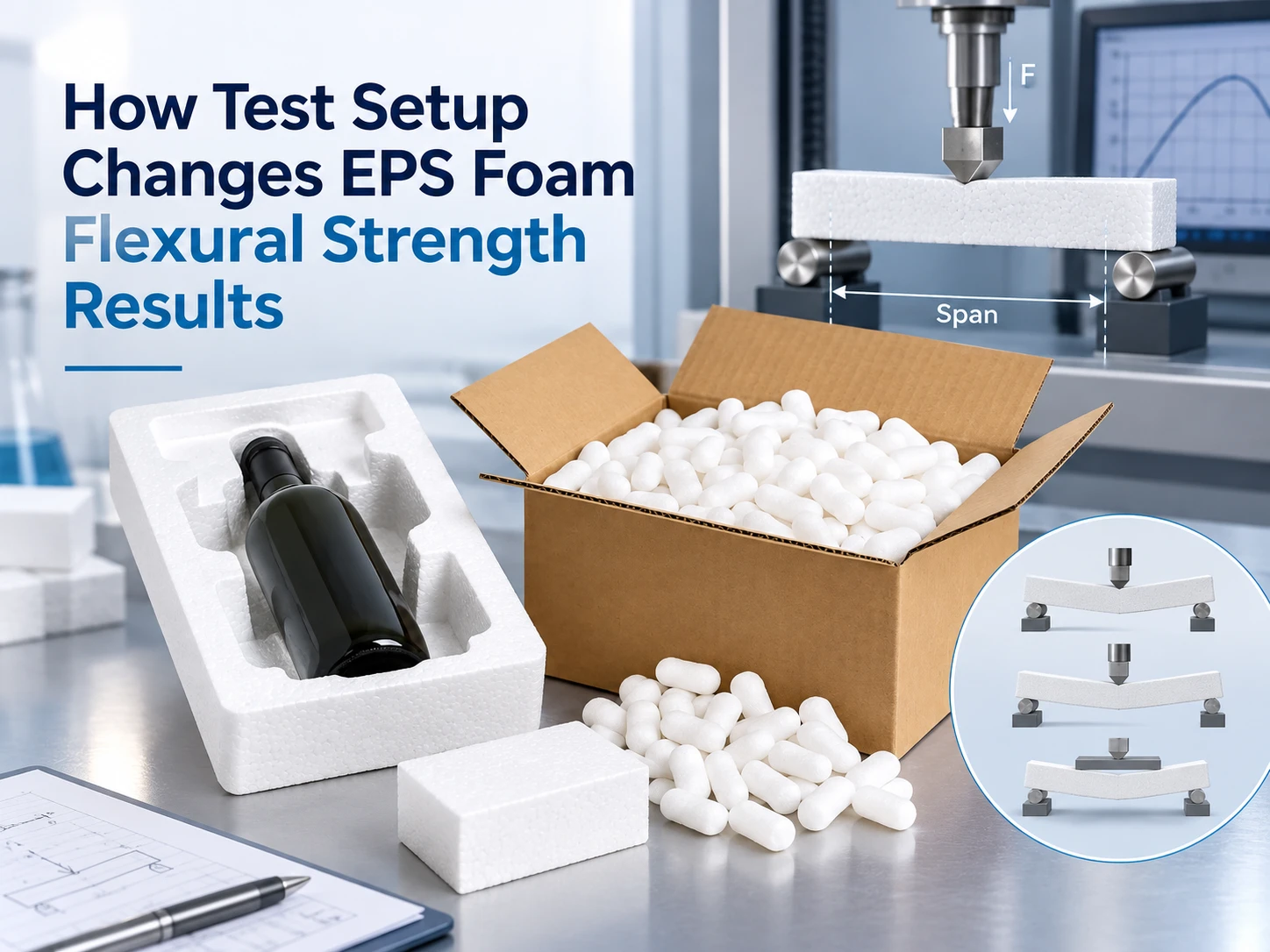
EPS foam flexural strength is a measure of how the material resists bending under a defined load and support setup. It is not a general statement that EPS is “strong” or “weak.” The value belongs to a material grade, specimen thickness, span, support condition, and test method.
That distinction matters when EPS is used in boards, panels, trays, or packaging supports. A product can carry a compressive load well and still bend too much across an open span. Buyers should compare the right property and the right test condition before approving a design.
What Flexural Strength Measures
This property describes resistance to bending under a defined test setup. A specimen is supported across a span, load is applied in a controlled way, and the resulting stress and deflection are observed. The reported value may describe failure, a specified deflection, or another defined point in the test.
The result is not the same as the maximum load a product can carry in service. A board may have a high flexural value but still deflect too much for its intended span. A packaging insert may need stiffness in one direction and flexibility in another. The design requirement should therefore state what bending behavior is needed, not only the minimum test value.
A useful data sheet identifies the standard or method, specimen size, span, support, loading rate, conditioning, and direction of test. Without those details, two flexural values may look comparable when they were produced under different conditions.
Which Material and Test Conditions Change It
Flexural behavior depends on density, cell structure, thickness, span, support, loading rate, and the direction in which the specimen is tested. These variables are part of the result, not background details. A value that fits one product form may not describe another.
Two questions matter before using the data. First, does the material represent the intended EPS grade and production method? Second, does the test geometry represent the intended product or a conservative substitute? If either answer is unclear, the comparison needs more evidence.
Density and Cell Structure
Density and cell structure influence bending resistance. Higher density can increase stiffness, but density alone does not describe the cell walls, fusion quality, or distribution of the material through the thickness. The EPS density-control process is one part of the manufacturing context because it affects the material structure that the test is measuring.
A molded or cut specimen may behave differently because its surface and internal structure are different. The same nominal density can also produce different bending behavior when cell uniformity or fusion changes. The report should identify the product form and manufacturing route.
For a board or panel, the direction of the cell structure may matter as much as the density value. A specimen cut along one direction can respond differently from one cut across the board. Confirm that the test direction represents how the finished product will carry load.
Span, Support, and Specimen Thickness
Span and support change the bending result. A longer unsupported span creates more deflection for the same load, while a shorter span increases the influence of shear and local support conditions. The span should be recorded with the result, not assumed from the specimen name.
Thickness has a similar effect. A thin specimen may bend or fail differently from a thick board, even when both are made from the same material. Use a representative thickness, or explain how the result relates to the final product.
Support conditions and loading rate also belong in the record. A simple support, fixed support, or a product held inside a frame creates different behavior. Compare data only when these conditions are known and the intended service condition is understood.
Why Flexural Strength Is Not Compression Strength
Compression strength measures resistance while a load presses the material together. It measures resistance while the material bends across a span. The two properties use different stress paths and different test setups, so one cannot replace the other.
A material selected for stacking or compression may not be the best choice for a panel that spans between supports. A material selected for bending stiffness may not have the compression or recovery behavior needed for a stacking application. The requirement should name the load direction and failure mode.
The distinction also affects how a supplier should report data. A physical property sheet that lists compression and flexural values separately is more useful than a general strength claim. The correct value can then be compared with the intended design condition.
How It Affects Boards and Panels
Boards and panels often fail through a combination of bending, support, handling, and environmental effects. Flexural data helps describe the bending part of that system, but it does not replace a full panel review. Support spacing, edge conditions, attachments, and loads all change the behavior.
The role of EPS in foam-board production helps connect the material to the board-making route. Review how boards are handled, stacked, fixed, and exposed. A board can pass a flat flexural test and still fail when it is lifted or supported only at its edges.
Ask for the intended span and support condition before comparing grades. A higher flexural value may allow a different support spacing, but only when the full design and safety requirement support that change. Keep the value attached to the product geometry.
The failure modes seen in EPS insulation boards provide a useful reminder that bending is one part of a larger performance question. Moisture, thermal movement, installation damage, and support defects can change the result, so it is worth reviewing EPS insulation boards against the grade and the application before the order.
How It Affects Packaging Supports

Packaging supports use flexural behavior differently from construction boards. A tray, rib, corner block, or long insert may need to resist bending during lifting, vibration, or handling. The support span may be short, but the load can be concentrated at a product edge.
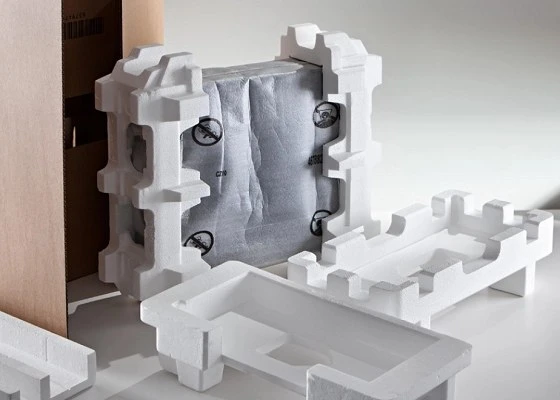
The molded support geometry shows why the molded form and process matter. A flat material value may not represent a thin rib or a curved support. Match the test to the load path, thickness, and geometry of the packaging feature.
A packaging engineer should also consider deflection. A support can remain unbroken and still let the product move too far. The acceptance criterion may therefore combine a flexural result with fit, retention, or maximum deflection measured on the actual insert.
How to Compare Supplier Data
Compare supplier flexural data only when the material, method, specimen, span, support, thickness, conditioning, load direction, and reported failure criterion are comparable. If one supplier reports a different method, request the missing details before placing the values in one table.
Ask whether the result represents a single sample, a batch, or a production range. A single best value does not show how the material varies. Multiple samples and a stated test condition provide a stronger basis for comparison.
Finally, connect the data to the intended product. A flexural value is useful only when it addresses the load direction, support condition, and failure mode that matter in the board or packaging application.
The documented production line runs with precision testing that supports density uniformity, compressive strength, and thermal insulation control. The company also documents customized EPS development for specific customer requirements, so the flexural-review criteria should match the intended product form and production route.
Conclusion
EPS foam flexural strength is a bending property tied to density, cell structure, thickness, span, support, and test method. It should not be compared with compression strength or used as a general durability score. Match the test condition to the finished board or packaging support, then compare the reported values with the same geometry and load direction.
Before ordering, ask for the material, test method, specimen details, and intended use behind the flexural value. Contact HUASHENG to discuss the EPS product form and the property evidence needed for the application.
FAQs
Q1: What is EPS foam flexural strength?
A1: It is the material’s resistance to bending under a defined span, support condition, load, and test method. The reported value applies to that material and test setup, not to every EPS product.
Q2: Is flexural strength the same as compression strength?
A2: No. Compression strength measures resistance under a pressing load. It measures resistance while the material bends across a span. They answer different design questions.
Q3: How should buyers compare EPS flexural-strength data?
A3: Compare the material grade, density, product form, test method, specimen thickness, span, support, loading direction, conditioning, and failure criterion. If those conditions differ, ask for a comparable test or keep the values separate.
 English
  German
  Spanish
  French
  Arabic