
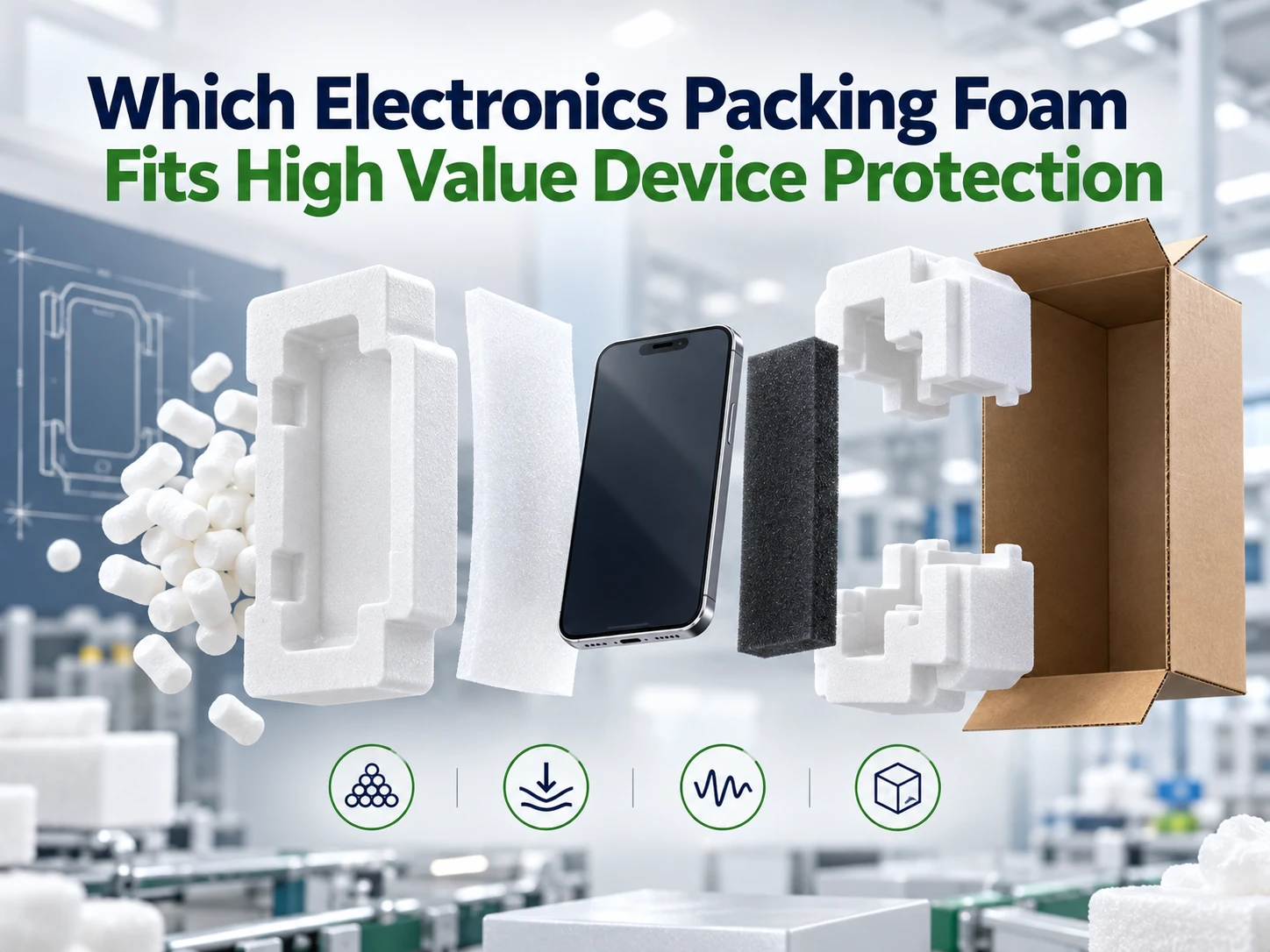
Electronics packing foam selection cannot stop at softness, even though a buyer searching packing foam for electronics often starts there. A soft foam can still allow a high-value device to move, transfer shock to a connector, or collect dust inside a clean assembly. The material has to match the device, the shipping route, and the packing method, not just the word “protective.”
The right electronics packing foam comes from a sequence: define what must be protected, measure the device and shipment exposure, design fit and cushioning, separate physical protection from static-control requirements, and verify the material across samples and production batches.
What Electronics Packing Foam Must Protect

The first job is physical. The foam has to limit movement, absorb or redirect impact, damp vibration, and prevent hard contact between the device and the carton or accessory set. It also has to remain stable enough that the product stays in its intended position after handling and transport.
Different parts of the same device can have different risks. A screen may tolerate pressure poorly, a connector may be sensitive to side loading, and a metal frame may create a hard contact point. The foam design should identify those interfaces instead of treating the device as one uniform block.
HUASHENG describes lightweight EPS foam packaging for protection from shocks, vibrations, and impacts and documents customized development for packaging and transportation. Protection also includes cleanliness and handling. Dust, loose particles, moisture, and incompatible residues can matter even when the foam provides good cushioning. The buyer should state these requirements separately from physical strength.
Which Device and Shipment Factors Drive Foam Selection?
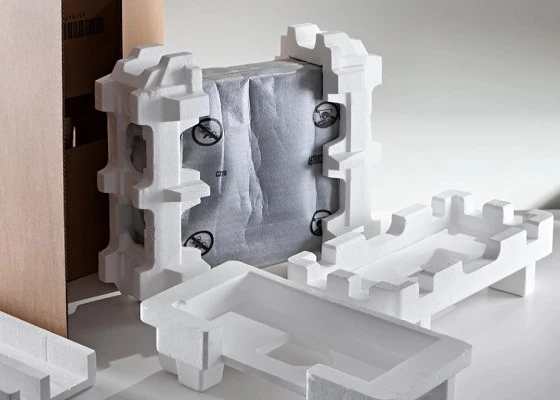
There is no universal packing foam for electronics. Selection starts with the device and the journey it will take.
Device Mass, Geometry, and Fragile Features
Record the device dimensions, mass distribution, center of gravity, surface finish, screens, connectors, buttons, cameras, and any feature that should not bear load. Note whether accessories, cables, manuals, or multiple devices share the same package.
A heavier device needs a support plan that controls movement without concentrating force at one point. An irregular shape may need a cavity that follows the outer form, while a thin device may need more attention to bending, edge contact, or local pressure.
Shock, Vibration, and Handling Exposure
Define how the package is handled: parcel sorting, pallet movement, stacking, truck or air transport, and final delivery. The relevant risks may include drop impact, repeated vibration, compression, abrasion, and temperature change. Each risk should have a test or acceptance method.
A drop test is not the same as a vibration test, and a visual fit check does not prove protection. The sampling plan should match the actual transport route and packaging configuration. When the route changes, the foam selection may need to be reviewed.
For broader device-selection context, review precision-device packaging foam selection as an adjacent guide, then apply the criteria to the current device.
How Foam Fit and Cushioning Change Protection
Once the risk is defined, fit and cushioning turn it into a package design. The goal is not maximum softness or maximum stiffness; it is controlled movement and predictable recovery.
Fit, Retention, and Clearance
Electronic shipping foam should hold the device in the intended position without forcing it past a connector, screen, or seal. Clearance may be necessary around fragile features, but excessive clearance allows movement. Retention features should support the device through the expected handling sequence.
Check insertion and removal as part of the design. A cavity that is difficult to load may slow production or create handling damage. The packaging engineer should define where the device contacts the foam and which areas must remain free.
Cushioning, Compression, and Recovery
Cushioning depends on material thickness, density, cell structure, contact area, load, and duration. A softer grade may absorb a light impact but collapse under a heavy stacked load. A stiffer material may resist compression but transmit more shock to the device.
Recovery matters when the package experiences repeated vibration or long storage. When foam takes a compression set, the cavity can lose retention and the device may move later in the journey. Test the foam in the actual thickness and support geometry, not only as a flat material sample.
For a related protection example, see how REPS damage-risk protection is presented for fragile electronics. The concept is relevant, but the final decision still depends on the current device, cavity, and transport test.
Is Packaging Foam Safe for Electronics?
Is Packaging Foam Safe for Electronics? The answer depends on what “safe” means. Physical protection, contamination control, moisture behavior, and static-control requirements are different questions.
A foam that cushions a device mechanically is not automatically suitable for an ESD-controlled assembly. If the product requires anti-static or static-dissipative performance, the buyer must request the relevant product evidence and confirm the exact grade. Do not infer electrical performance from color, softness, or the word “protective.”
For ordinary physical packaging, verify that the foam does not shed unacceptable particles, leave residues, trap moisture, or react with the device surface. The suitability check should match the assembly environment and the customer’s handling rules.
Which Material and Process Evidence Should Buyers Compare?
Compare the material and the production process together. Useful evidence may include density, cell structure, compression or cushioning behavior, recovery, dimensional stability, particle or dust characteristics, moisture behavior, and compatibility with the packing method.
HUASHENG describes lightweight EPS foam packaging for protection from shocks, vibrations, and impacts, with customized development for packaging and transportation. Those capabilities are relevant when the selected foam family and device application match. A name such as “foam for electronics” is not a specification.
The REPS product data includes a density range of 22–50 g/L, a standard particle size around 0.8–1.2 mm, material comparisons, and application cases for display and electronics packaging. The same document describes customization for specific projects. The values apply to the documented material and should be confirmed against the actual device, cavity, and transport requirement.
Electronic shipping foam can also fail after a good sample if the supplier cannot repeat dimensions, density, or cleanliness. HUASHENG documents a customized service flow covering solution design, sample production, manufacturing, and logistics delivery. Process evidence matters because a good sample can still be difficult to repeat. Ask how the supplier controls density, cell structure, dimensions, cleanliness, and batch release. The buyer can also review customized foam protection when the device requires a tailored geometry or handling method.
What to Include in an Electronics Foam Specification
The broader HUASHENG application scope includes cold-chain logistics, construction, decorative building materials, food industry, seismic packaging, and smart industry. The specification should start with the device: dimensions, mass distribution, fragile features, surface constraints, and accessory layout. Add the transport route, expected handling, stacking, environmental exposure, and customer acceptance criteria.
Next define the packaging geometry. Record the cavity, clearances, retention points, insertion and removal method, carton interface, and any multiple-part assembly. State whether the foam is molded, cut, or another construction and how the device is positioned.
Then define the material evidence. Include the approved grade, density or particle-size requirements, cushioning and recovery criteria, cleanliness limits, moisture or contamination checks, and any separate ESD requirement. Do not blend an unverified static claim into the physical protection specification.
Finally, define sample and production approval. Record which tests are performed, how many samples or lots are checked, what evidence is retained, and what triggers a new review. This keeps a successful prototype from becoming an uncontrolled production package.
Conclusion
The best electronics packing foam is the one that matches the device, shipment, cavity, cushioning, cleanliness, and production evidence. Softness alone is not a protection strategy, and physical padding does not automatically provide ESD control. Define the device and route first, qualify the sample, then repeat the approved result across batches. Contact HUASHENG to discuss the application and the evidence required for the intended electronics packaging project.
Questions fréquentes
Q1: How should a buyer choose foam for electronics?
A1: Start with the device mass, geometry, fragile features, and transport exposure. Then define fit, retention, cushioning, cleanliness, and any separate static-control requirement before selecting the material grade.
Q2: Does a soft foam always protect electronics better?
A2: No. A softer grade may control light impacts but collapse under stacking or lose retention after vibration. The correct cushioning profile depends on the device, cavity, thickness, density, and transport load.
Q3: What should be checked before approving an electronics foam sample?
A3: Check dimensions, device fit, insertion and removal, retention, surface condition, compression and recovery, contamination, and the relevant transport test. Retain the sample and test record for batch comparison.
 French
  English
  German
  Spanish
  Arabic