
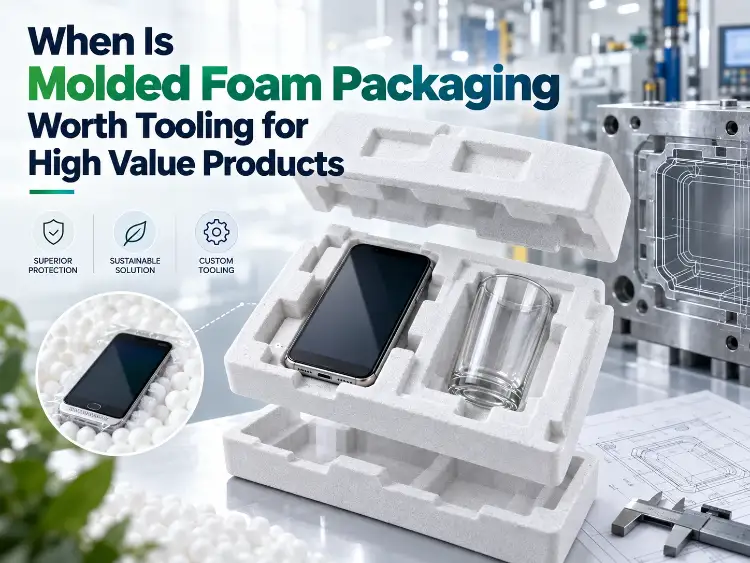
Molded foam packaging is designed around a fixed product shape. That can improve fit, reduce assembly steps, and make protection repeatable, but it also adds tooling, sample approval, and production change risk. The decision is not simply “premium product, therefore molded foam.”
A buyer who asks what is molded foam is really asking when a shaped cavity earns its cost. Tooling earns its place when the product geometry is stable, the protection requirement is understood, the order pattern can support the mold, and the material and sample can be repeated in production.
What Makes Molded Foam Packaging Different from a Generic Foam Insert
A generic insert protects a general class of items. A known product, cavity, and packing method define this format. The cavity can hold the item in a controlled position, create clearance around fragile areas, or combine several parts into one protective structure.
That geometry is useful when assembly consistency matters. A hand-cut insert may work for an early sample, but two operators can produce two different fits. A molded cavity promises a repeatable shape only after the product, material, tool, and process are controlled together.
HUASHENG describes lightweight EPS foam packaging for protection from shocks, vibrations, and impacts and documents customization across packaging and transportation, building insulation, cold-chain logistics, prefabricated buildings, and seismic packaging. Molded packaging foam should be selected after the product fit and protection requirement are understood, not before. Molded packaging foam also needs a defined material, not just a color or a density description. The grade, cell structure, stiffness, and surface behavior influence how the cavity protects the product and how the molded part releases from the tooling.
When Does a High-Value Product Justify Tooling?
The value of the product is a risk signal, not an automatic approval. A high-value item can justify more engineering attention, but the mold still has to solve a real packaging problem at a supportable order volume.
Product Geometry and Protection Requirements
Start with the product and its failure modes. Record dimensions and tolerances, mass distribution, fragile corners, connectors, screens, coatings, and features that cannot touch the cavity. Then define the transport exposure: handling, drop, vibration, stacking, temperature, and the customer’s unpacking process.
The cavity should support the product without creating new stress points. A tight fit may reduce movement but make insertion or removal difficult. A soft fit may be easier to load but allow movement inside the box. The right geometry keeps the product stable while preserving clearance where the product needs it.
This is also where a standard insert and a molded design separate. If several products can share one cut-foam layout, tooling may add cost without adding useful control. If one high-value product needs a repeatable cavity, controlled orientation, and a defined packing method, the case for molded foam becomes stronger.
Order Volume, Repeatability, and Tooling Risk
Tooling makes more sense when the same product and packaging configuration will repeat. A stable SKU, predictable order pattern, and controlled revision process allow the mold cost to be absorbed over more units. Frequent changes to the product, cavity, or packing method increase the chance that the tool becomes obsolete.
Volume alone is not enough. Ask whether the product design is frozen, whether the material is approved, and whether future orders will use the same carton and loading method. If those inputs are still moving, a prototype route may teach more at lower risk than a permanent mold.
For related logistics and waste questions, the guide to custom REPS waste and logistics shows how material choice and handling affect the wider packaging system.
How Molded Foam Compares with Cut Foam and Expanding Foam
When a buyer asks what is molded foam, the useful answer connects a shaped cavity to a specific product and process. It is one format among several. The correct comparison is not “which foam looks most professional,” but which route can deliver the required fit and protection at the current stage of the project.
Molded Foam vs Cut Foam
Cut foam is useful when the product is still changing, volumes are low, or a simple block-and-cavity layout is sufficient. It allows quick changes without a new mold. The tradeoff is repeatability: cutting and assembly depend more on operator technique and the accuracy of the cutting route.
The molded foam vs cut foam decision changes when the product needs a complex cavity or a repeatable packing sequence. The molded design can integrate ribs, clearances, and locating features into one part. A cut insert can imitate some of that geometry, but assembly time and variation may increase.
When Expanding Foam Is a Better Prototype
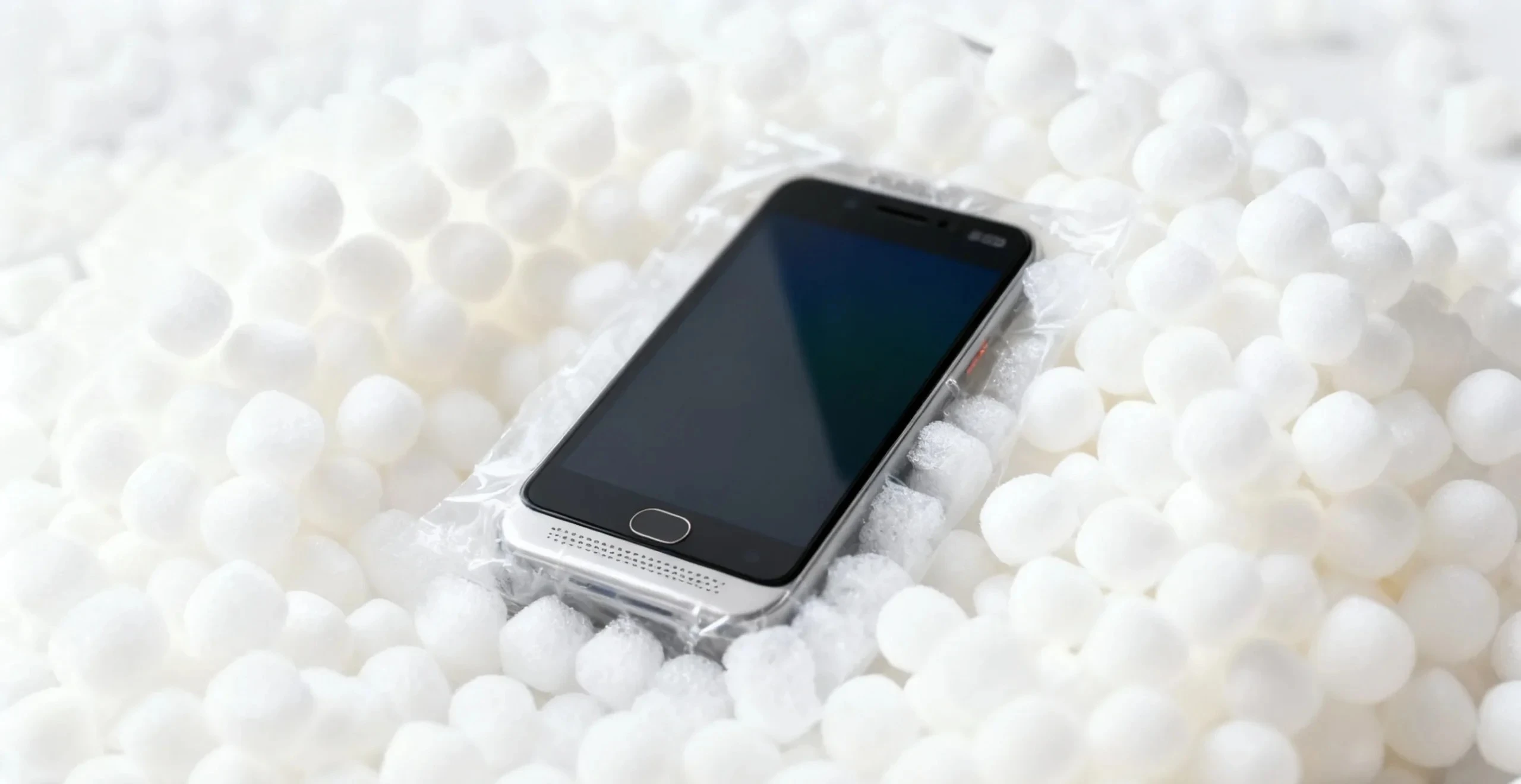
Expanding foam can be useful when the product shape is irregular or the designer needs a quick physical representation of the cavity. It can help teams study fit and handling before committing to a tool. Its limits should be clear: expanding foam is a prototype method, not automatically a production specification.
A successful custom molded foam packaging program compares the prototype with the intended production format before tooling approval. A reliable next step is to compare the prototype with the intended production format. Record the dimensions, insertion force, removal method, product support, and packing time. If those results depend heavily on the operator or the mixing process, the prototype has not yet answered whether custom molded foam packaging is ready for production.
Which Material and Process Decisions Come Before Tooling?
The material decision should follow the protection requirement. For a molded packaging part, the team may need to define density, bead or particle size, compressive behavior, thermal limits, surface quality, and compatibility with the molding process. A high-density material is not automatically better; it may add weight and stiffness without improving the relevant failure mode.
HUASHENG’s REPS grade is offered in a documented density range of 22–50 g/L, with a standard particle size around 0.8–1.2 mm and customization available for specific projects. Those values belong to the documented material and application; they are not a universal recipe for every molded package. The buyer should confirm the grade with the product load, cavity design, and process conditions.
The REPS material is documented with a density range of 22–50 g/L and a standard particle size around 0.8–1.2 mm. These values apply to the documented material and should be confirmed against the product, cavity, and process. Material data for a different foam can still be useful when the reader needs to understand density or specification language. Review high-density foam specification as an adjacent reference, then return to the grade that matches the actual packaging project.
Tooling decisions also need process input: shrinkage, cooling, mold release, fill, surface finish, and the ability to reproduce the cavity over a production run. These are not details that can be added after the mold is cut.
How to Qualify the First Molded Sample
The first sample is not approved because it looks correct. It has to prove the product fit, cavity function, and protection plan under realistic handling conditions. Start with dimensional checks and a product fit trial. Inspect the surfaces, parting lines, ribs, and areas that contact the product.
Next, test the packing sequence. Measure insertion and removal effort, verify that the product stays in position, and check whether the cavity can be loaded consistently by production staff. When the product needs accessories, cables, manuals, or multiple parts, include them in the sample trial.
Protection testing should match the product and transport risk. A drop or vibration test is not interchangeable with a visual fit check. The acceptance criteria should be written before the test so a good result is not defined after the fact. Retain the sample, drawing, material batch, and test record for comparison.
The customized development route covers solution design, sample production, manufacturing, and logistics delivery. A second sample matters when the first one requires a change. It shows whether the tooling adjustment solved the problem without creating a new fit or surface issue. The buyer can also review custom molded packaging requirements as an adjacent planning reference, then apply the criteria to the current product.
What a Tooling Approval Checklist Should Include
HUASHENG documents a customized service flow covering solution design, sample production, manufacturing, and logistics delivery, which gives a staged process for validating a tooling project. A practical approval checklist begins with product data: dimensions, mass, tolerances, fragile features, and accessory layout. Add the transport conditions and the protection criteria that the package must satisfy.
Then record the packaging design: cavity layout, product orientation, clearance, insertion and removal method, carton interface, and any multi-part assembly. Include the material grade, density or particle-size requirements, and the process assumptions behind the molded design.
Custom molded foam packaging approval should also define sample approval. Record who measured the sample, which tests were performed, what evidence was retained, and which changes require another review. When the product or material changes, the approval should identify whether the mold can remain in use.
Finally, include production controls. Define the packing method, inspection points, batch traceability, reorder process, and change-notification rule. A mold is a production asset; the packaging specification must travel with it. Teams comparing several material routes can also review precision-device packaging material selection before fixing the final cavity.
Conclusion
Tooling is worth the investment when a stable high-value product needs repeatable fit, controlled protection, and a production process that can keep reproducing the same cavity. Product geometry, order repeatability, material grade, sample evidence, and change control must support that decision together. If the product is still moving or the protection requirement is unclear, prototype first. Once the requirements are stable, contact HUASHENG to discuss the molded packaging application and the evidence needed before tooling.
Questions fréquentes
Q1: When is molded foam packaging better than a cut insert?
A1: Molded foam is stronger when the product needs a repeatable cavity, complex locating features, or a consistent packing sequence. The cut route is often more practical when the product is still changing or the required geometry is simple.
Q2: What should be tested before approving a molded foam sample?
A2: Check dimensions, product fit, insertion and removal, cavity retention, surface condition, and the actual transport protection requirement. Retain the sample and test record so later production parts can be compared against the approved condition.
Q3: Which product details should a buyer send before requesting a mold quote?
A3: Send the product dimensions and mass distribution, fragile features, intended packing method, carton and transport conditions, expected order pattern, material preferences, and any existing sample or failure evidence.
 French
  English
  German
  Spanish
  Arabic