
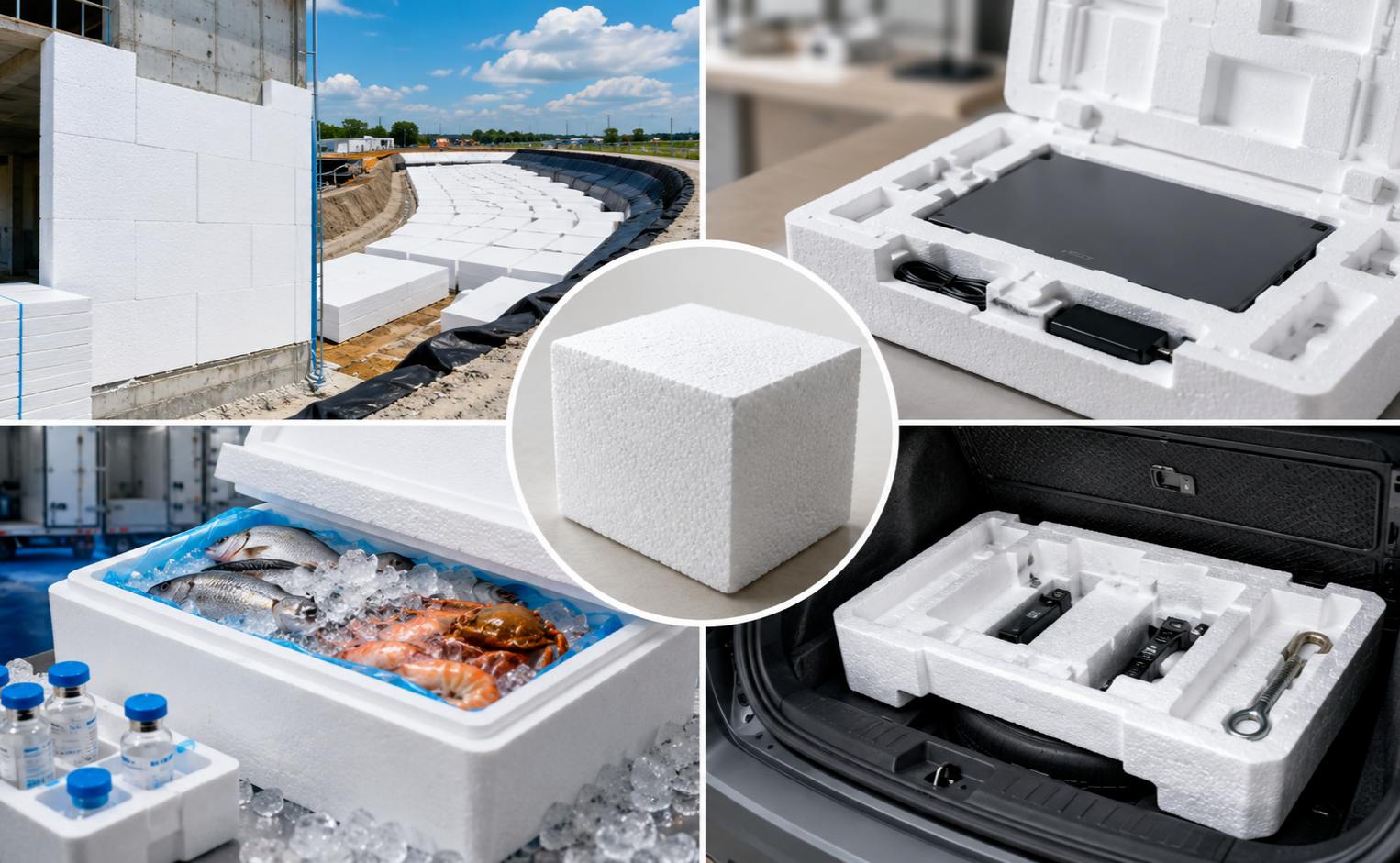
Mousse EPS La demande en 2026 continue de croître dans de nombreux secteurs industriels. Les projets privilégient désormais les matériaux légers qui améliorent l'efficacité énergétique et contribuent à la maîtrise des coûts. Ces évolutions modifient les priorités d'approvisionnement et renforcent le besoin de solutions EPS fiables et évolutives dans les chaînes d'approvisionnement de la construction et de l'industrie.
Tendances émergentes des applications EPS en 2026
Le marché mondial des mousses EPS connaît d'importantes mutations. Les industries recherchent des matériaux légers, économes en énergie et durables. Les progrès technologiques et les méthodes de fabrication plus respectueuses de l'environnement favorisent cette évolution et confèrent au EPS un nouveau rôle dans de nombreux secteurs.
Le rôle croissant de la mousse EPS dans les industries modernes
Les mousses EPS conservent leur flexibilité et continuent d'inspirer l'innovation dans des secteurs tels que l'emballage, la construction, l'automobile et même les infrastructures. Ce matériau léger offre d'excellentes propriétés d'isolation et d'amortissement. Pour les acheteurs, ses principaux atouts résident non seulement dans son coût, mais aussi dans sa facilité de manipulation, son poids réduit pour le transport et la stabilité de ses performances lors de commandes répétées.
Les forces du marché qui façonnent l'utilisation du BPA
La demande croissante en matière de développement durable s'est traduite par un renforcement des lois environnementales et des objectifs de durabilité des entreprises. HUASHENG L'entreprise reconnaît l'importance du développement durable et est consciente de ses responsabilités environnementales et sociales. Son usine intelligente a atteint des taux de recyclage des déchets supérieurs à 95 %.
L'amélioration des chaînes d'approvisionnement mondiales peut contribuer à rendre les matériaux EPS haute performance plus compétitifs en termes de coûts. En 2026, les principaux producteurs prévoient d'intégrer des systèmes de qualité basés sur l'IA.
Mousse EPS dans les projets de construction et d'infrastructure
Le secteur de la construction demeure l'un des plus gros utilisateurs de mousse EPS en raison de ses propriétés d'isolation thermique et de sa résistance structurelle.
Isolation structurelle et efficacité énergétique
Les panneaux isolants en polystyrène expansé (EPS) contribuent à réduire la consommation d'énergie dans les habitations et les bâtiments commerciaux. Les produits en mousse EPS de HUASHENG offrent une excellente isolation thermique, permettant de réduire la consommation d'énergie des bâtiments. Ceci contribue à maîtriser les besoins en chauffage et en climatisation tout en maintenant une température intérieure confortable en toutes saisons.
Des projets tels que Ville écologique GreenBuild Les résultats sont probants. L'utilisation de particules de polystyrène expansé (EPS) ignifugées B1, d'une densité de 22 kg/m³, a permis un gain de 14 % en efficacité énergétique globale. Cette amélioration des performances thermiques contribue également à l'obtention de la certification LEED Or pour la conception de bâtiments durables.
Applications de la géomousse en génie civil
La géomousse EPS est un excellent matériau de remblai léger pour les talus, les murs de soutènement et les fondations. Elle limite le tassement des sols meubles et répartit les charges de manière plus uniforme sous les infrastructures lourdes. Sa facilité de manipulation permet également aux entreprises de travaux publics d'accélérer la réalisation des projets. Certains chantiers de génie civil font état d'un gain de temps de plus de deux semaines par rapport aux matériaux de remblai traditionnels.
De plus, des versions hydrophobes telles que Modules de contrôle des inondations AquaGuard Ces modules offrent de nouvelles solutions de protection contre les inondations. Leur taux d'absorption d'eau reste inférieur à 0,5 % et ils peuvent être déployés rapidement en cas de besoin.
Solutions d'emballage innovantes utilisant de la mousse EPS
La croissance du commerce électronique a accru le besoin d'emballages de protection plus performants.
Emballage de protection pour l'électronique et les appareils électroménagers
Le polystyrène expansé (PSE) assure un amortissement optimal pendant le transport et permet de réaliser d'importantes économies de matériaux grâce à sa fabrication de précision. Dans le secteur de l'emballage et du transport, la mousse de PSE constitue une solution idéale grâce à sa durabilité et sa légèreté.
Emballage alimentaire et logistique de la chaîne froide
La logistique du froid exige des matériaux capables de maintenir des températures stables. Les solutions EPS durables de HUASHENG répondent aux exigences strictes des dispositifs médicaux (classes II et III), des produits biopharmaceutiques, notamment les vaccins à ARNm, et des chaînes d'approvisionnement de denrées périssables conformes aux normes HACCP. Grâce à leur conductivité thermique ultra-faible, ces conteneurs maintiennent une température stable jusqu'à 96 heures, ce qui les rend parfaitement adaptés au transport de produits biopharmaceutiques et à la livraison de produits surgelés.
De nouveaux revêtements biodégradables améliorent les performances environnementales sans affecter l'hygiène ni la résistance à l'humidité nécessaires aux applications alimentaires.
Applications du polystyrène expansé (EPS) dans la conception des transports et de l'automobile

Les constructeurs automobiles utilisent de plus en plus de pièces légères en polystyrène expansé pour atteindre les objectifs d'émissions et améliorer les performances des véhicules. Les pièces moulées en EPS réduisent le poids et améliorent également l'isolation acoustique dans l'habitacle. Le nouveau programme de pièces pour véhicules à énergies renouvelables de SwiftAuto, les composants moulés à haute résistance aux chocs ont permis de réduire le poids des supports de 37 % et de diminuer les coûts d'exploitation annuels de 230 000 $ par flotte de véhicules.
Les développements en matière de sécurité utilisent également le polystyrène expansé (EPS) pour absorber l'énergie d'impact. Cela le rend adapté aux pare-chocs, aux casques et aux intérieurs des transports en commun où la protection des passagers est primordiale.
Stratégie d'approvisionnement pour les applications de mousse EPS en 2026
Les équipes d'approvisionnement chargées des grands projets doivent faire correspondre les spécifications des matériaux aux exigences de performance et vérifier que les fournisseurs respectent les normes internationales.
Choisir la qualité EPS adaptée aux exigences d'application spécifiques à l'industrie
Les acheteurs doivent choisir des qualités qui correspondent aux besoins spécifiques du secteur. Par exemple, F-Matériau ignifuge de type REPS convient parfaitement à l'isolation des bâtiments, tandis que la qualité P‑Ultra-Light est adaptée à la production de grands panneaux, où une faible densité est importante.
Évaluation des besoins en matière de performance : isolation, résistance et étanchéité à l’humidité
La vérification de la résistance à la compression (≥5 MPa), de l'indice d'oxygène (>30) ou de l'absorption d'eau (<0,5%) permet de confirmer que les matériaux répondent aux besoins fonctionnels et aux règles de sécurité locales dans les applications de construction ou de chaîne du froid.
Comparer les capacités des fournisseurs dans le cadre de projets à grande échelle et multisectoriels
Avec son usine intelligente de phase II d'une capacité de 300 000 tonnes désormais opérationnelle, HUASHENG est en passe de devenir le plus grand centre mondial de production et de R&D de systèmes REPS. Cette capacité garantit des livraisons régulières en vrac, indispensables aux grands projets d'infrastructure et aux chaînes d'approvisionnement des équipementiers multinationaux.
Vérification de la certification, des normes de sécurité incendie et de la conformité environnementale
Les équipes d'approvisionnement doivent examiner les rapports d'empreinte carbone ISO 14067:2018 (719,14 kg CO₂e par tonne de R-EPS) et les résultats des tests SGS RoHS/REACH qui confirment l'utilisation de retardateurs de flamme non HBCD conformément aux règles de l'UE.
Confirmer la stabilité en vrac, le cycle de livraison et la prise en charge de la personnalisation
Des partenaires fiables offrent un accompagnement complet en matière de personnalisation, de la conception par simulation à la planification logistique. Cela permet aux projets de respecter les délais tout en maintenant la qualité et en répondant aux exigences environnementales.
FAQ (questions fréquentes)
Q1 : Quels facteurs dois-je prendre en compte lors du choix d'une qualité appropriée de mousse EPS ?
A1 : Commencez par définir l’application. Les projets de construction nécessitent des matériaux ignifuges comme le F-301 ou des options renforcées au graphite, telles que les panneaux S-Material Graphite Grade. Pour les applications d’emballage, les matériaux ultralégers de la série P, offrant des coefficients d’expansion plus élevés (jusqu’à 100×), sont souvent les plus adaptés.
Q2 : Comment la mousse EPS contribue-t-elle aux objectifs d'approvisionnement durable ?
A2 : De nos jours, les entreprises qui fournissent des biens de consommation utilisent des systèmes permettant de recycler plus de 95 % des déchets, ce qui contribue à réduire de plus de 80 % les polluants atmosphériques. Privilégiez les fabricants certifiés comme HUASHENG, qui respectent la norme ISO 14067 relative à la vérification de l’empreinte carbone.
Q3 : La mousse EPS peut-elle être personnalisée en fonction des exigences spécifiques du projet ?
A3 : Oui. Le laboratoire de jumeaux numériques de HUASHENG prend en charge une personnalisation précise Nous garantissons une uniformité de densité et une distribution granulométrique optimales pour des secteurs tels que la logistique du froid et les composants automobiles. Notre service après-vente assure une assistance technique dans les 24 heures suivant la livraison.
 French
  English
  German
  Spanish
  Arabic