
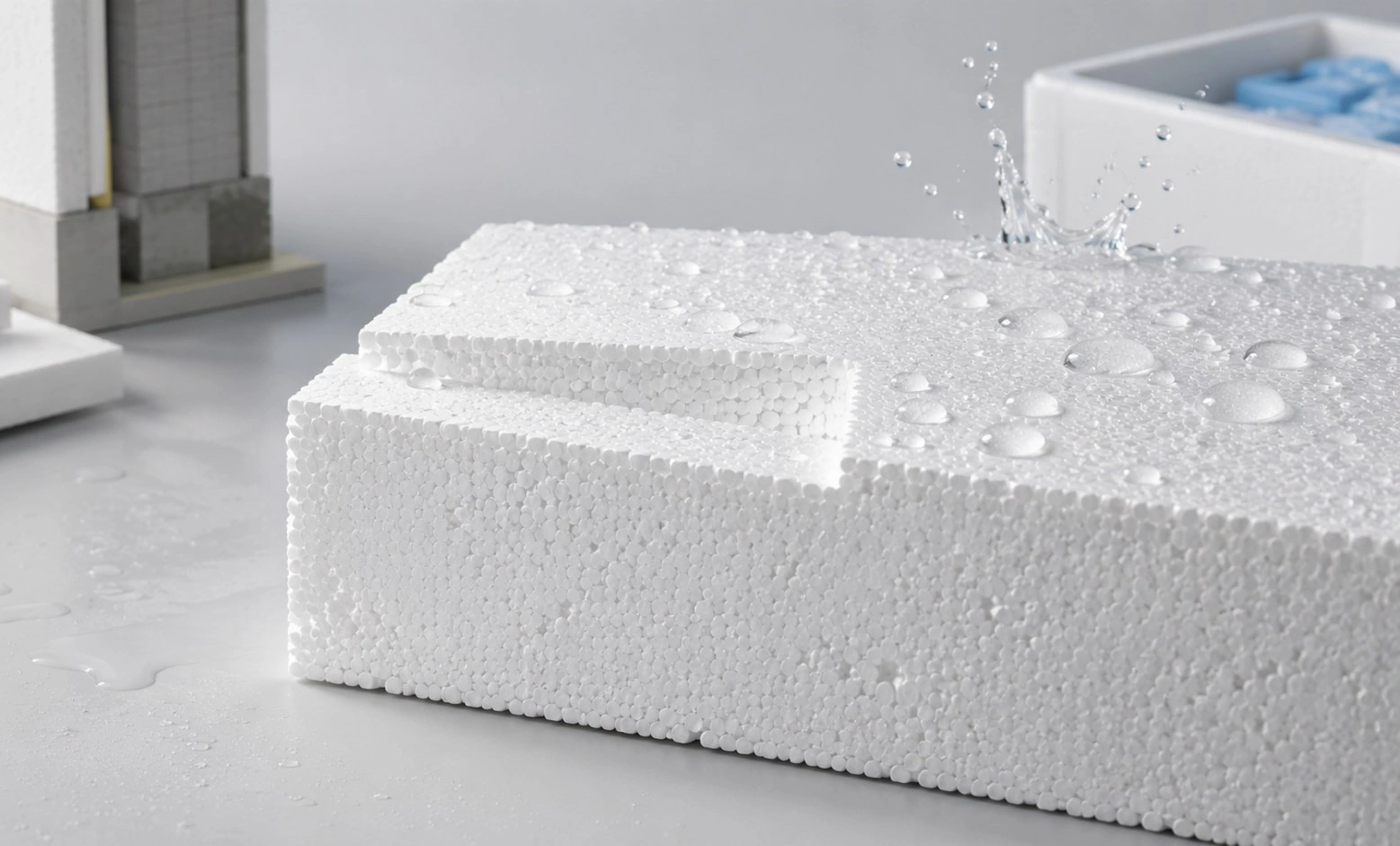
Polystyrene foam should not be treated as a waterproofing system. EPS and XPS are closed-cell insulation products with different product-level moisture behavior, but neither eliminates water entry through joints, penetrations, cracks or poorly detailed construction. A buyer needs to distinguish water absorption by the foam from the watertightness of the complete wall, roof, foundation or panel assembly.
The practical answer to “is polystyrene waterproof?” is therefore conditional: a particular foam may resist or absorb water according to its product design and test results, while the assembly still needs the membranes, drainage, flashing and detailing required by the project. HUASHENG supplies expandable EPS materials, not a blanket waterproofing guarantee for every finished EPS component or building system.
Planning an EPS material trial? Send HUASHENG your application and specification to discuss grade information, sample requirements and quotation scope.
Separate water resistance from waterproofing
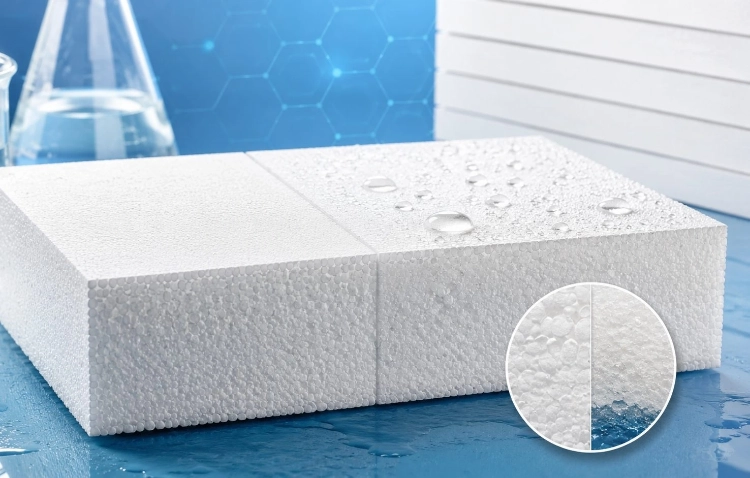
Water resistance describes how a material behaves under a defined exposure and test method. Waterproofing describes the control of water through a building element or system. Those ideas are related, but they are not interchangeable. A foam sample can have a measured water-absorption result and still be part of an assembly where water travels through joints or around fasteners.
Exposure and assembly details
Ask what the project means by waterproof. Does the requirement concern temporary rain exposure during construction, ground contact, a wet interior, freeze-thaw exposure, or water pressure? Does it concern liquid water, water vapor, or both? The answer determines which product evidence and assembly details matter. A generic product description cannot resolve all of these cases.
EPS and XPS are both polystyrene insulation families, but their structures and manufacturing routes differ. Their measured moisture properties should be compared using results for the exact products and relevant methods. Avoid claiming that all EPS is waterproof or that XPS is always appropriate simply because of a general material comparison. The project designer should specify the necessary performance level.
Check the test behind a water-absorption claim
When a supplier states a water-related value, request the product designation, test method, specimen condition, exposure duration and result units. Confirm whether the data applies to raw material, a finished board or a complete assembly. Values from different methods or product formats may not be directly comparable. If the project specification names a method, use that method or obtain written approval for an alternative.
Assembly water-control details
Water may enter a finished wall through details that have little to do with the foam itself. Joints between boards, window openings, penetrations, parapets, base transitions and fasteners all need a designed water path. A membrane or coating may carry the primary water-control function. If it is damaged or poorly joined, the insulation’s own moisture behavior will not make the wall watertight.
For below-grade or continuously wet applications, ask the designer to specify the complete assembly. The decision can involve drainage, a waterproofing membrane, protection layers, soil conditions and the structural loads on the insulation. Do not use a resin or board data sheet as a substitute for the design of a below-grade waterproofing system.
Plan for construction exposure and storage
Even when the final assembly is protected, boards can be exposed to rain, standing water or site debris before installation. Set expectations for packaging, storage, drainage and temporary covering. Store products in the way recommended by the manufacturer and keep them identifiable by grade and lot. If material gets wet, the responsible project team should decide whether it needs inspection, drying or replacement before enclosure.
Construction exposure is often a process-control issue. Make sure the installation sequence does not trap water behind a membrane or close a wet cavity without evaluation. Inspect cut edges, joints and interfaces before applying the next layer. Record any deviations from the drawings and resolve them with the designer, rather than relying on an assumption that the foam will tolerate every condition.
Where EPS resin is being purchased for conversion into boards, the resin supplier and board manufacturer have different roles. The resin supplier can provide information for the exact grade. The processor converts it into the finished panel and controls its manufacturing quality. The project designer defines how that panel is used in the moisture-managed assembly.
Evaluate EPS and XPS for the actual application
The correct comparison starts with the application and required evidence. For each candidate, document the product identity, thickness, test information, thermal requirement, mechanical load, moisture exposure and installation method. Consider service temperature, contact materials and the surrounding wall or roof details where the designer regards them as relevant. Ask the supplier to identify gaps in the available data.
Do not compare products by a single headline number or by material family alone. Two boards within the same family may have different specifications, while a board with a favorable material property may still be wrong for the assembly. Match the data to the exact thickness and configuration. If a property must hold for an installed system, seek evidence that represents the system or obtain the designer’s validation plan.
For a product substitution, use a controlled comparison. Keep the wall details and installation method stable, label each sample, and record the result against agreed criteria. If the new product requires a different membrane, adhesive or fixing, the change is a system change and should be reviewed by the responsible designer. Approval of a foam board should not silently approve every associated component.
Ask for clear, bounded supplier answers
Buyers can get a more useful response by asking direct questions: Is this EPS resin or a finished board? What exact product is being offered? Which water-related test data is available? Does it concern absorption, permeability or a completed assembly? What conditions and limitations are stated? Which documents accompany the lot? These questions make it easier to compare offers without treating a marketing adjective as a technical result.
HUASHENG’s website describes EPS products and construction applications, while its customization process invites discussion of application requirements and performance targets. A project inquiry should include the intended exposure, target product form, drawings and requested evidence. The company can clarify available material information; the contractor and design team still need to confirm that the completed construction addresses water entry.
Conclusion
The search question “is polystyrene foam waterproof?” needs two answers: what the exact foam product does under a defined test, and how the complete assembly manages water. Specify the exposure, request product-specific evidence and verify the joints, membranes and drainage details with the project designer. Contactez HUASHENG with the intended EPS product form and application to request available grade information.
Questions fréquentes
Q1: Is EPS foam waterproof?
A1: Do not make a blanket claim. Check the water-absorption data for the exact finished EPS product and remember that joints and assembly details control water entry through the construction.
Q2: Does XPS remove the need for a waterproofing membrane?
A2: No. Insulation material does not replace a membrane or the assembly details required by the design. The responsible designer should define the water-control layers.
Q3: Can wet EPS boards be installed immediately?
A3: Follow the product guidance and project quality plan. The contractor or designer should inspect the exposure and decide whether the boards can be used, need to dry or should be replaced.
 French
 English
 German
 Spanish
 Arabic