
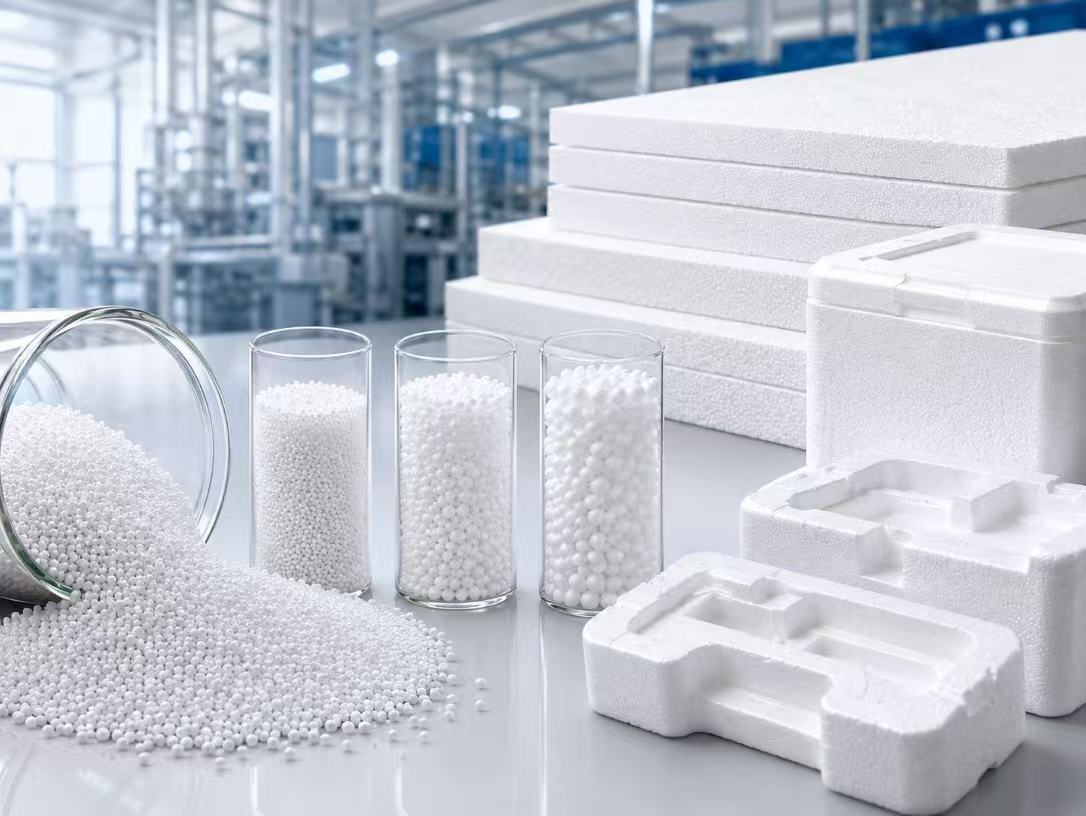
There are different stages in the manufacturing process of Mousse EPS where the stability of the density of the material has a direct impact on the performance of the product. The pre-expansion stage is vital for the bulk purchasers since this is the stage that determines the way the beads perform in molding and how the resultant foam will perform. Before exploring the expansion ratio, it is important to understand its meaning and significance.
What Is EPS Pre-Expansion Ratio and Why Does It Matter?
EPS pre-expansion ratio refers to how much expandable polystyrene beads increase in volume after the initial steaming process. During pre-expansion, EPS beads are heated with steam, causing the blowing agent inside the beads to expand and create a lightweight cellular structure.
The expansion ratio is usually expressed as the relationship between the original bead volume and the expanded bead volume. A higher ratio means the beads expand more and create a lighter material, while a lower ratio usually results in higher density foam.
The Relationship Between Expansion Ratio and Final Foam Density
In EPS production, density is closely connected with expansion ratio. When beads expand more, the amount of polymer material per unit volume decreases, creating lighter foam. When expansion is controlled at a lower level, the final product can maintain higher density and stronger physical performance.
This does not mean a higher expansion ratio is always better. A packaging insert may benefit from lightweight foam, while a construction insulation product may require better compression strength and dimensional stability. The right expansion ratio depends on the final product requirements.
For bulk buyers, this is why comparing EPS materials only by price per kilogram can be misleading. Two materials may have similar prices but produce very different foam density, output volume, and production efficiency.
Why Expansion Ratio Control Matters in Manufacturing
Small variations in densities during mass production may cause trouble. Inconsistent expansion can result in the following inconsistencies in product weight, foam strength, surface appearance, and molding consistency
Consistency in the pre-expansion process will allow producers to have better control over the process and make their results more consistent. For people who buy thousands of packaging items or insulation materials, consistency is more important than low density.
How Does Pre-Expansion Ratio Improve EPS Foam Density Control?
A controlled pre-expansion ratio gives manufacturers more flexibility when balancing lightweight performance and product strength.
Achieving More Consistent Density in Molded Foam Products
EPS molding depends on how beads fill the mold and how well they fuse together. If bead expansion is inconsistent, some areas may become lighter while others become denser.
This can affect molded packaging performance. For example, an electronic product insert requires accurate dimensions because the product must fit tightly inside the packaging. Uneven density may cause gaps, weak areas, or poor protection during transportation.
A reliable EPS supplier should control not only expansion ratio but also particle size, bead quality, and molding conditions.
Balancing Lightweight Performance and Mechanical Strength
EPS continues to be preferred for applications in packaging and insulation since it can help achieve protection without any additional weight. Reducing the density could, however, have an impact on the mechanical properties.
In the case of packaging, there is always the need to consider issues like low weight during transportation, protection from impacts, position of goods, and cost.
In the case of insulation, there will be a greater consideration of thermal insulating capabilities.
Reducing Quality Variation in Bulk Production Orders
Inconsistent packaging materials may pose challenges to distributors and brands between different production runs. A supplier who is able to produce consistent expansion of beads will help buyers avoid having to make changes to their packaging, production stoppages, and
customer complaints, which become critical when the packaging has been shipped out of the country.
What Advantages Can Proper EPS Pre-Expansion Ratio Bring?
A suitable expansion ratio improves not only foam density control but also the overall production process.
Better Material Efficiency and Production Cost Control
When expansion is properly controlled, manufacturers can achieve the required foam volume with appropriate material consumption. This helps manage raw material costs while maintaining product performance.
For lightweight packaging, higher expansion grades can reduce transportation weight. For insulation products, controlled density can help maintain the required thermal and mechanical properties.
Improved Molding Stability and Product Consistency
With good control of expansion, there will be good flow of beads into the mold. It increases filling efficiency, surface quality, dimensions, and repeatability.
HUASHENG provides various types of EPS materials for varying processing needs. An example of an EPS material type for molded packaging purposes, including electric appliances, ceramics, and fishing boxes, is B Rapid Prototyping Grade.
More Reliable Performance Across Different Applications
Different industries require different foam characteristics. A material suitable for fragile packaging may not be suitable for building insulation.
HUASHENG’s EPS product range includes common grades, flame-retardant grades, graphite grades, carbon black grades, environmental protection grades, and customized REPS solutions, allowing buyers to select materials according to project requirements rather than using one grade for every application.
How Do Different EPS Expansion Ratios Fit Different Applications?
Expansion ratio selection should always follow the final application. Different industries have different expectations for density, strength, and processing performance.
High Expansion Ratio EPS for Lightweight Packaging and Low-Density Products
High expansion EPS is used where lightweight and effective use of material are required. This includes lightweight packaging, protective inserts, big foam parts, and low-density products.
One of the examples of a lightweight material is HUASHENG P-grade EPS. It is designed for use in areas that require high foaming efficiency and lightweight foam solutions.
Medium Expansion Ratio EPS for General Packaging and Standard Foam Products
Medium expansion ratio EPS provides a balance between weight and strength. It is commonly considered for general packaging applications where buyers need stable molding performance without requiring extremely low density.
This type of material is suitable for companies producing different packaging products because it provides more flexibility across applications.
Controlled Expansion Ratio EPS for Insulation and High-Performance Applications
For insulation products, density control becomes more important. Materials need to maintain thermal performance while supporting project requirements such as strength and dimensional stability.

Graphite EPS and EPS ignifuge are often selected for higher-performance applications. Graphite-modified EPS products, such as S-series materials, are designed to improve thermal insulation performance for energy-saving buildings.
What Should Buyers Check Before Ordering EPS Materials?
Expansion ratio is an important parameter, but it should not be reviewed separately.
Confirm Target Density, Application, and Processing Requirements
Buyers are advised to provide the final product application, density, molding equipment strength, and production quantity before ordering.
Such data will assist suppliers in recommending an appropriate EPS grade rather than just supplying the cheapest grade.
Compare Expansion Ratio With Particle Size and Foam Performance Data
The quotation provided by the professional needs to consist of more than just the expansion ratio. Other criteria that need to be considered include particle size, density range, moldability, compressive strength, and dimensional stability.
Evaluate Supplier Capability for Stable Batch Production
For long-term cooperation, supplier capability matters as much as material specifications. Buyers should check sample approval processes, production capacity, technical support, and after-sales communication before confirming large orders.
A reliable supplier should help match EPS material characteristics with the customer’s equipment and application rather than only providing standard grades.
Questions fréquentes
Q1: Does a higher EPS pre-expansion ratio always mean better foam quality?
A1: No. A higher expansion ratio usually creates lighter foam, but the best ratio depends on the application. Packaging, insulation boards, and industrial products have different requirements for density and strength.
Q2: How does expansion ratio affect EPS density and strength?
A2: Expansion ratio directly influences the amount of polymer material within a certain foam volume. Higher expansion generally reduces density, while lower expansion can support stronger and denser foam structures.
Q3: What information should buyers provide when sourcing EPS materials in bulk?
A3: Buyers should provide the application, target density, product dimensions, molding equipment, expected quantity, and required performance data. These details help suppliers recommend suitable EPS grades and support stable production.
 French
  English
  German
  Spanish
  Arabic