
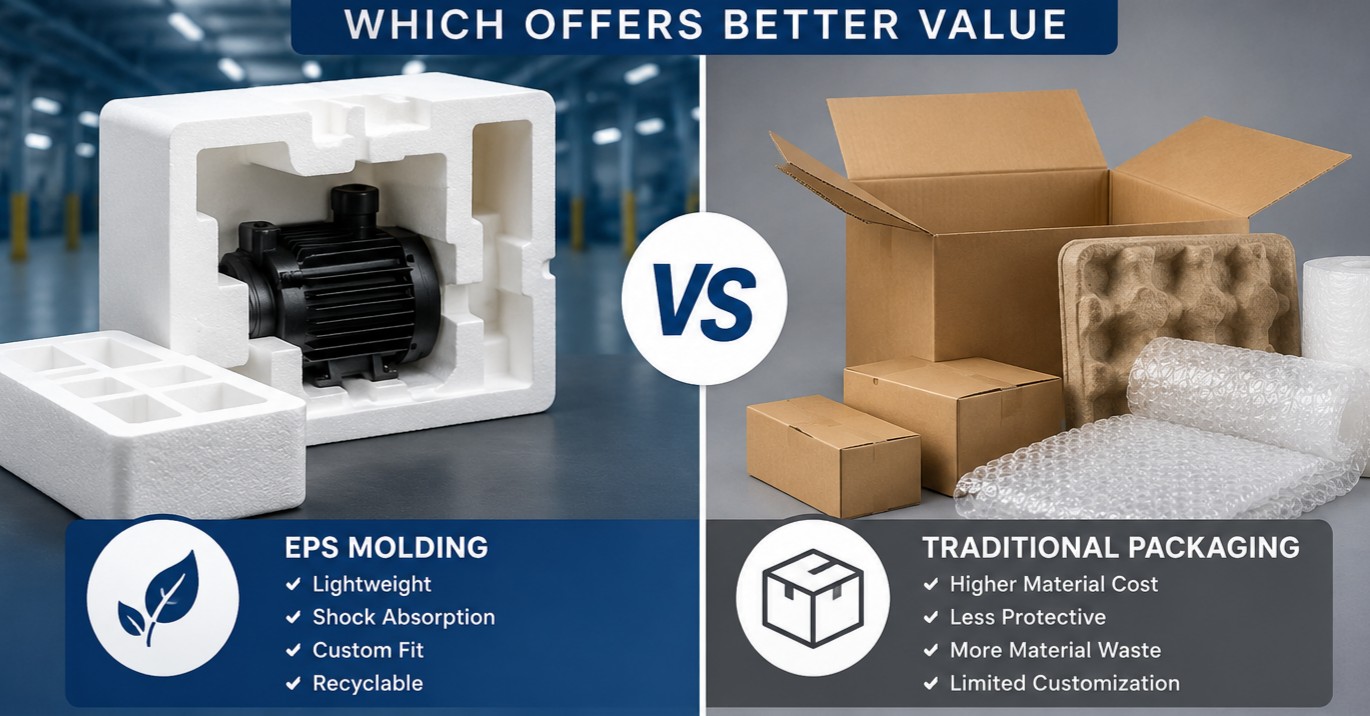
La plupart des acheteurs savent désormais qu'un simple emballage ne suffit pas. Un bon emballage doit réduire les risques de dommages, contrôler le poids, épouser la forme du produit et permettre un transport en vrac sécurisé. En comparant EPS En comparant les moules en carton, les plateaux en plastique et les matériaux de rembourrage courants, les acheteurs peuvent mieux évaluer quelle option offre une meilleure valeur à long terme.
Moulage EPS vs. Principes de base de l'emballage traditionnel
L'emballage évolue constamment, les marchandises étant conditionnées et distribuées avec pour principal objectif un produit rentable offrant les niveaux de performance requis tout en étant respectueux de l'environnement.
Aperçu de la technologie de moulage EPS
Le polystyrène expansé (PSE) est une mousse légère, rigide et à cellules fermées, obtenue par compactage puis expansion de billes de polystyrène pré-expansées. Matériau d'emballage protecteur extrêmement polyvalent, il offre des propriétés isolantes et peut être moulé en une grande variété de formes pour protéger tous types de produits lors du transport.
Caractéristiques des matériaux d'emballage traditionnels
Les matériaux d'emballage classiques sont généralement composés de carton, de carton ondulé, de bois et de plastique. Le carton est recyclable mais sensible à l'humidité. Le bois est solide mais lourd. Le plastique est durable mais a un impact négatif sur l'environnement. Il est souvent utilisé pour protéger les produits pendant le transport. Cependant, en termes d'efficacité et d'économie d'énergie et de poids, il ne constitue pas la solution optimale.
Évaluation des performances : moulage EPS vs emballage traditionnel
Lors de l'achat, entre le moulage EPS et d'autres types de matériaux généralement utilisés, deux caractéristiques clés doivent être prises en compte : la durabilité et l'efficacité de la manutention.
Durabilité et capacités de protection
Le moulage EPS offre une excellente absorption des chocs grâce à sa structure cellulaire. Dans le domaine de l'emballage et du transport, les solutions EPS de Moulage EPS Légers et robustes, les emballages en polystyrène expansé moulé (PSE) offrent une protection optimale aux articles transportés, les prévenant des dommages causés par les chocs, les vibrations et les impacts. Contrairement aux caisses en bois ou en carton ondulé, qui peuvent se déformer sous une pression excessive ou à cause de l'humidité, le PSE moulé conserve sa forme en toutes circonstances et constitue ainsi un excellent amortisseur de chocs pour les articles fragiles, tels que les équipements électriques ou la céramique, lors de transports longue distance exposés à des vibrations importantes.
Poids et efficacité de manutention
Le moulage en EPS est léger et donc peu dense. Cette faible densité réduit les coûts de transport. Ce matériau peut être mis en forme par une machine de formage automatique. De plus, lors du transport, sa légèreté permet de réaliser des économies de carburant. C'est un facteur essentiel pour les grands distributeurs qui expédient des marchandises à l'international.
Considérations environnementales dans les choix d'emballage
Durabilité L'impact environnemental est devenu un facteur déterminant dans les décisions d'achat de nombreux secteurs. Le procédé de moulage EPS et l'emballage traditionnel présentent tous deux des inconvénients environnementaux.
Défis et solutions en matière de durabilité pour le moulage EPS
Longtemps critiqué pour sa faible recyclabilité, le PSE a connu d'importantes améliorations technologiques. HUASHENG L'entreprise comprend parfaitement l'importance du développement durable et prend ses responsabilités environnementales et sociales très au sérieux. Son système de production en circuit fermé atteint des taux de recyclage supérieurs à 95 %, réduisant ainsi considérablement la production de déchets.
Le caractère écologique des options d'emballage traditionnelles
De nombreux produits à base de papier sont biodégradables, mais nécessitent une consommation excessive d'eau et d'énergie. L'utilisation du bois pour la fabrication d'emballages est également renouvelable, mais peut entraîner la déforestation en cas d'approvisionnement inapproprié. Actuellement, de nombreux matériaux naturellement biodégradables, comme ceux fabriqués à partir de papier, ne résistent pas à une utilisation durable et, par conséquent, ne peuvent rivaliser avec la durabilité du polystyrène expansé recyclé lors des tests cliniques.
Analyse de l'efficience des coûts et de l'impact économique
Les professionnels des achats doivent comparer les coûts initiaux des emballages traditionnels avec les alternatives d'emballage moulé correspondantes et vérifier leurs coûts totaux sur l'ensemble du cycle de vie.
Coûts de production et disponibilité des matériaux
Le moulage de PSE peut tirer parti des filières d'approvisionnement locales en matières premières et réduire la dépendance aux importations. De plus, l'automatisation permet d'accroître considérablement l'efficacité de la production. Les procédés de moulage, par exemple, consomment environ 20 % de l'énergie requise par d'autres procédés et sont même plus de 50 % plus efficaces.
En revanche, les caisses en carton ou en bois nécessitent l'assemblage de plusieurs pièces détachées, ce qui augmente considérablement le temps de travail nécessaire.
Avantages économiques à long terme pour les entreprises
Réduire les dommages subis par les produits pendant le transport permet de réaliser des économies sur les retours et les remplacements. Les pièces moulées recyclables peuvent être réutilisées avant de se dégrader. Par exemple, l'emballage EcoPack, moulé à partir de matériaux recyclables, a permis de réduire les coûts d'emballage de 28 % et d'améliorer de 22 points le score ESG des clients, selon un projet mené par Huasheng New Materials.
Les avancées technologiques qui façonneront l'avenir de l'emballage en 2026
L'innovation transforme sans cesse la manière dont les matériaux sont fabriqués et utilisés afin de créer des produits et services neutres en carbone dans tous les secteurs d'activité.
Innovations dans les procédés de moulage EPS
L'automatisation intègre aujourd'hui de plus en plus le jumeau numérique dans le système de production. Basée sur des structures à pores nano-fermés, la technologie HUASHENG augmente la résistance à la compression de 40 % et surpasse ainsi nettement les performances internationales. Parallèlement, des formulations hybrides avec des additifs biodégradables permettent d'atteindre une résistance mécanique élevée et facilitent le recyclage en fin de vie.
Tendances émergentes dans l'évolution des emballages traditionnels
Les matériaux de base évolueront également. L'étiquetage intelligent, comme la RFID, et les revêtements à base d'eau pour une meilleure recyclabilité sont des facteurs clés de cette évolution. La numérisation, en particulier, permettra aux producteurs de proposer des séries plus petites, conçues dans le respect de l'identité de marque, tout en maîtrisant au mieux les stocks excédentaires. Ils se rapprocheront ainsi des solutions de pièces moulées proposées par les acteurs innovants.
Perspectives du marché : Choisir entre le moulage EPS et l’emballage traditionnel en 2026
Le marché mondial des logiciels d'analyse d'images est très segmenté et principalement déterminé par des exigences d'application spécifiques, plutôt que par l'adoption généralisée d'une solution unique.
Tendances d'adoption par l'industrie dans tous les secteurs
Parmi les industries à forte valeur ajoutée, fabrication électronique L'entreprise a récemment opté pour des solutions moulées, car celles-ci permettent un ajustement précis et offrent ainsi une protection optimale dans leur emballage. Les cycles de moulage rapides permettent de produire efficacement des emballages pouvant être empilés sur des lignes de production automatisées, comme la boîte d'emballage pour instruments de précision fabriquée en matériau B de qualité Quick.
Considérations stratégiques pour les entreprises qui vont de l'avant
En 2026, des réglementations environnementales plus strictes influenceront le choix des fournisseurs à l'échelle mondiale. Les entreprises qui mettront en œuvre des stratégies d'approvisionnement conformes à des objectifs de neutralité carbone bénéficieront d'un avantage concurrentiel. L'innovation de nouveaux produits doit donc être évaluée au regard de leur faisabilité. Les décideurs en matière d'achats doivent s'assurer d'un approvisionnement fiable auprès de fournisseurs certifiés tels que Huasheng New Materials Co., Ltd.
FAQ (questions fréquentes)
Q1 : Quels sont les avantages du moulage EPS par rapport aux emballages traditionnels ?
A1 : Le moulage EPS offre une meilleure protection contre les chocs ; il est plus léger que les emballages comparables ; il est plus flexible et peut être pré-moussé pour créer des moules sur mesure ; et il est durable grâce à des taux de recyclage élevés, supérieurs à 95 %.
Q2 : Les produits moulés en EPS peuvent-ils être personnalisés pour répondre aux besoins du projet ?
A2 : Oui. HUASHENG peut offrir une personnalisation complète des produits moulés EPS en utilisant son système de banque de gènes de matériaux pour concevoir et fabriquer des produits de densité ou de taille de particules souhaitée pour répondre aux besoins spécifiques des clients en matière d'isolation de bâtiments ou d'applications d'équipements de précision.
Q3 : En cas d'achat à grande échelle, comment HUASHENG garantit-il la qualité ?
A3 : Les lignes de production intelligentes de Lanzhou Huasheng New Materials utilisent des équipements de test de précision pour garantir l’uniformité de la densité et la résistance à la compression. Par ailleurs, nous sommes certifiés ISO, ce qui atteste de notre conformité aux normes environnementales internationales les plus exigeantes. Pour toute question, n’hésitez pas à nous contacter. nous contacter.
 French
  English
  German
  Spanish
  Arabic