
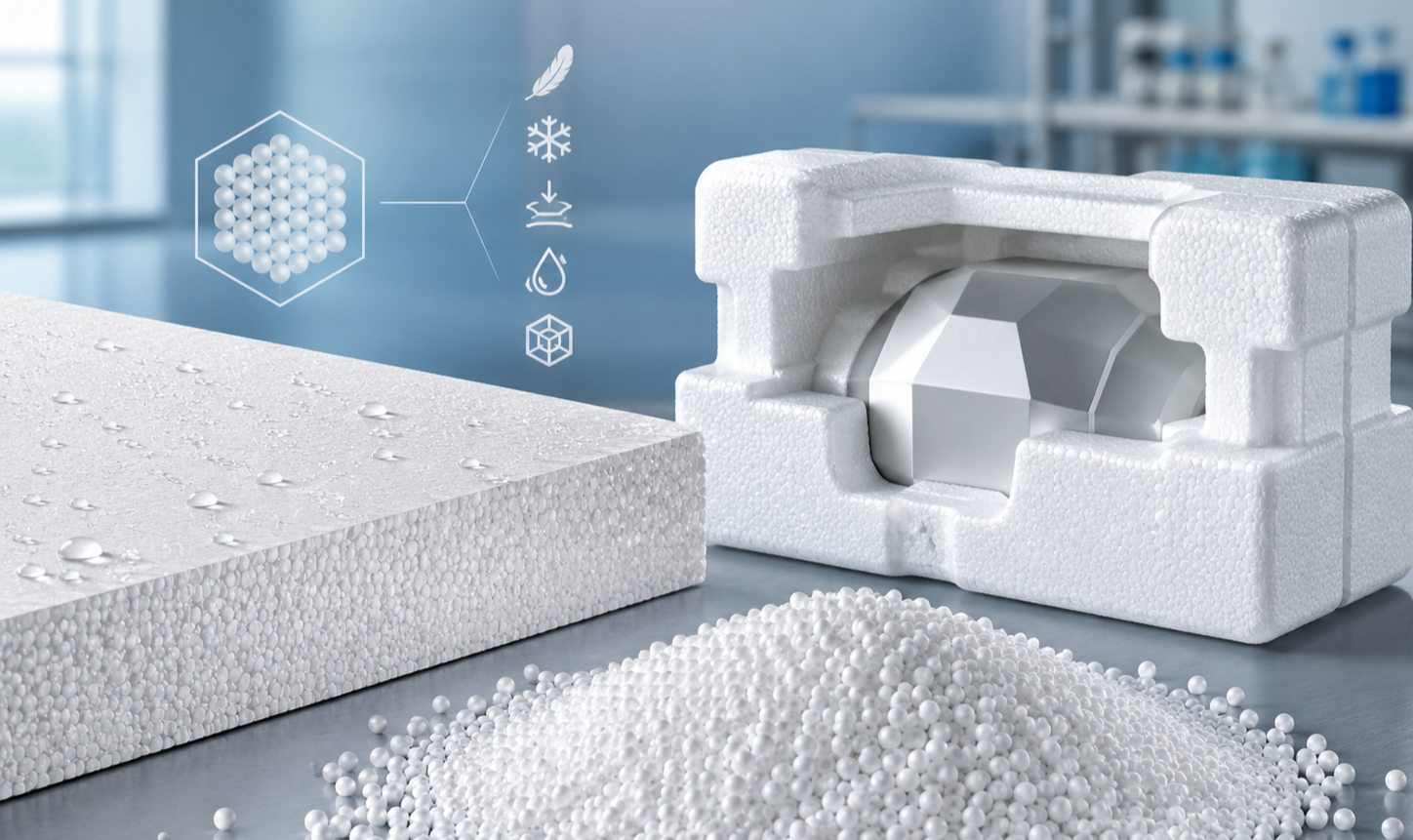
Antes de confirmar un pedido de espuma de poliestireno expandido (EPS) a granel, los compradores necesitan más que un precio unitario o un simple nombre del producto. Las propiedades de la espuma de EPS influyen en su comportamiento durante el moldeo, el envío, el almacenamiento, la instalación y el uso final.
¿Por qué son importantes las propiedades de la espuma EPS antes de realizar pedidos al por mayor?
El EPS se compra como materia prima, pero los compradores suelen pagar por el producto final: una esquina moldeada que protege un electrodoméstico, una caja para mariscos que conserva su forma o un tablero que cumple con los requisitos de aislamiento y resistencia al fuego. Una pequeña variación en la densidad o el tamaño de las perlas puede afectar el llenado del molde, el tiempo de enfriamiento, el acabado superficial y la resistencia final.
El riesgo aumenta cuando el pedido cruza fronteras. Si un contenedor llega con la calidad incorrecta, la producción puede detenerse, puede ser necesario rediseñar las cajas y los clientes posteriores pueden presentar quejas antes de que se aclare la causa.
Comience con la densidad, el tamaño de las perlas y la relación de expansión.
La densidad y el índice de expansión controlan el costo, el peso y la resistencia.
La densidad suele ser el primer dato que preguntan los compradores, y con razón. Una menor densidad reduce el peso del material y puede ayudar a reducir costos, pero también puede disminuir la resistencia a la compresión, la protección de los bordes y la estabilidad dimensional. Una mayor densidad proporciona un soporte más firme, pero puede añadir peso innecesario para un embalaje de un solo uso.
La relación de expansión explica cómo la perla alcanza esa densidad. El EPS ultraligero tipo P de HUASHENG es un buen ejemplo: sus tamaños de partícula indicados van desde 1,30-1,60 mm hasta 0,30-0,55 mm, con rangos de primera expansión de 80-100 a 30-40 y rangos de expansión múltiples de hasta 180-200 en grados de perla más grandes.
El tamaño de las perlas afecta al flujo, al detalle y a la apariencia moldeada.
Para los compradores que comparan grados generales de embalaje, perlas de EPS de grado común Son un punto de referencia práctico. Los grados B de moldeo rápido incluyen tamaños de partícula desde 1,30-1,60 mm hasta 0,30-0,55 mm, con rangos de primera expansión de 70-90 a 35-50. Los cordones más gruesos pueden ser adecuados para piezas de mayor tamaño, mientras que los más finos pueden ayudar en esquinas, pequeñas cavidades y superficies moldeadas más lisas.
Compruebe conjuntamente el rendimiento térmico, de resistencia, de resistencia al agua y de resistencia a la llama.
La conductividad térmica debe coincidir con la ruta o el objetivo del edificio.

La conductividad térmica es importante para los paneles aislantes, las cajas de la cadena de frío, los contenedores de mariscos y los embalajes de transporte sensibles a la temperatura. Materiales EPS de grafito Demostrar por qué importa el número. El S-33 puede indicar una conductividad térmica de 0,033 W/m·K o inferior, mientras que el S-32 puede alcanzar 0,032 W/m·K o inferior; el EPS común, en las mismas notas del producto, se muestra en 0,039 W/m·K. Para proyectos de aislamiento, esa diferencia puede afectar el espesor del panel y la presión para su aprobación.
La resistencia a la compresión debe probarse bajo la carga prevista.
La compresión afecta a las cajas apiladas, las tapas de los electrodomésticos, la manipulación de tableros y los insertos moldeados. Los compradores deben solicitar información sobre la dirección de la prueba, la densidad, el punto de deformación y el formato de la muestra. Para proyectos de construcción y aislamiento, puede valer la pena pagar por grados más resistentes; el EPS ignífugo FSH, que cumple con la norma europea, está diseñado para el aislamiento en edificios e industria, con una resistencia a la compresión que se describe como más de un 20 % superior a la de otros grados.
La absorción de agua necesita la misma atención que la resistencia.
La absorción de agua afecta a las cajas de pescado, los envíos en cadena de frío, el almacenamiento al aire libre y los paneles que esperan en la obra. El EPS es de celda cerrada, pero una mala fusión de las perlas, las capas exteriores dañadas o una exposición prolongada pueden generar problemas. En proyectos que impliquen uso en ambientes húmedos, se debe incluir una comprobación de la absorción de agua.
El grado de resistencia al fuego debe coincidir con el mercado y el proceso.
El rendimiento de la llama es uno de los aspectos en los que es más fácil que se produzca un desajuste costoso. Grados de EPS ignífugos Puede que se apliquen los requisitos B2 o B1 según el grado y el proyecto. El material de grado F hace referencia a las normas GB/T 10801.1-2002 y GB 8624-2012, y también advierte que mezclar EPS común con material ignífugo puede reducir su resistencia al fuego.
Utilice las familias de grados EPS como referencias prácticas para la compra.
Los envases y las piezas moldeadas en general necesitan estabilidad en el proceso.
Los compradores de embalajes en general suelen preocuparse por el moldeo rápido, la fusión estable, la protección contra impactos y el coste por pieza terminada. El EPS de moldeo rápido B es adecuado para el embalaje de electrodomésticos, embalaje de cerámica, cajas de pescado, cajas de fruta, cajas de verduras, flotadores, artesanías y piezas moldeadas en general. Aquí es donde HUASHENG Funciona más como un ejemplo de proveedor que como un anuncio publicitario. Su gama abarca grados de EPS comunes, ignífugos, de grafito, ecológicos, de negro de humo y personalizados, de modo que un comprador puede analizar la densidad, el tamaño de partícula, el comportamiento de expansión y el uso previsto en una sola conversación técnica.
El aislamiento y los mercados regulados necesitan disciplina.
Los proyectos de construcción, exportación y proyectos regulados requieren una mayor correspondencia entre la calidad del producto y el mercado de destino. Opciones de EPS sin HBCD Los productos FHE y FGH están diseñados con retardantes de llama distintos del HBCD, y cumplen con las normativas REACH y RoHS, según se indica en las notas del producto. El FGH también combina la modificación funcional con grafito o negro de humo con propiedades ignífugas, lo que puede ser relevante para los canales de distribución europeos o de mayor exigencia.
| Situación del comprador | Especificaciones a priorizar | Por qué es importante antes de la compra a granel |
| Embalaje para electrodomésticos o para exportación | densidad, tamaño de las perlas, relación de expansión, prueba de compresión | Mantiene la repetibilidad de los insertos moldeados y reduce los daños en las cajas. |
| Cajas para pescado y paquetes de cadena de frío | densidad, conductividad térmica, absorción de agua, ajuste de la tapa | Un control deficiente puede aumentar las pérdidas por fusión, las fugas o las quejas sobre la temperatura. |
| Paneles aislantes para edificios | conductividad térmica, grado de inflamabilidad, resistencia a la compresión, envejecimiento | afecta la aprobación del proyecto, la estabilidad de la junta directiva y las reclamaciones de clasificación de resistencia al fuego. |
| Mercados de la UE o regulados | Grado no HBCD, clasificación de inflamabilidad, documentos de prueba, trazabilidad del lote | evita lagunas de cumplimiento después de que el contenedor haya sido enviado. |
Qué deben demostrar las muestras antes de pasar a la producción en masa.
Muestras de prueba en condiciones similares a las de producción.
Una prueba de muestra debe reproducir el pedido real con la mayor fidelidad posible. Se deben registrar el grado del cordón, la densidad, el coeficiente de expansión, el tiempo de envejecimiento, el tipo de molde, el proceso de vaporización, el método de enfriamiento y el método de corte. Para un inserto moldeado, las pruebas de caída y compresión deben realizarse con el producto real o con un maniquí de peso. Para un tablero, se deben evaluar el valor térmico, la resistencia a la compresión, la absorción de agua y el comportamiento ante el fuego con la densidad y el espesor indicados.
La muestra aprobada debe convertirse en un elemento de control. Conserve una muestra sellada, un dibujo, un rango de densidad objetivo y un registro de prueba. Cuando llegue el primer lote a granel, compare la fusión de las perlas, el acabado superficial, las dimensiones, el peso y la respuesta a la compresión con respecto a la muestra de referencia.
Si el proyecto necesita una densidad, color, tamaño de partícula o grado modificado especial, registre el Requisitos de muestra y personalizados Antes de la fabricación o el envío. Una frase vaga como «igual que la muestra» es débil. Un rango de densidad claro, el grado de las perlas, el método de prueba, la regla de empaque y el límite de aceptación son mucho más fáciles de aplicar.
Asesoramiento en materia de adquisiciones según el mercado objetivo y la demanda del proyecto.
Diferente Áreas de aplicación de EPS Se requieren diferentes prioridades. El embalaje de electrodomésticos debe comenzar con la densidad, el tamaño de las perlas, la compresión, el ajuste al molde y las pruebas de caída. Las cajas para la cadena de frío deben incluir la conductividad térmica, la absorción de agua, el ajuste de la tapa y la manipulación en húmedo. El aislamiento de edificios debe priorizar el valor térmico, la resistencia al fuego, la resistencia a la compresión, el envejecimiento y los estándares del mercado en el proceso de compra.
Los grados estándar resuelven muchos pedidos, pero no todos los proyectos se ajustan perfectamente a una línea de catálogo. Una pequeña bandeja para componentes electrónicos puede requerir un borde más fino y una superficie más lisa. Una placa de baja densidad puede requerir un equilibrio entre la expansión y la resistencia al fuego. Un proyecto de exportación puede requerir posicionamiento no HBCD, documentación trazable y un embalaje más cuidadoso.
La ruta de compra más segura es sencilla: primero, definir el mercado; luego, el rendimiento; y finalmente, la calidad. Solicitar muestras fabricadas bajo las condiciones de producción propuestas, realizar pruebas específicas para cada ruta y comparar el lote a granel antes de la producción en masa.
Preguntas frecuentes
P1: ¿Qué propiedad de la espuma EPS deberían comprobar primero los compradores antes de realizar pedidos al por mayor?
A1: La densidad suele ser el primer factor a considerar, ya que afecta al peso, el coste, la resistencia, el aislamiento y la amortiguación. Debe comprobarse junto con el tamaño de las perlas y el índice de expansión, no como un valor independiente.
P2: ¿Un tamaño de perla de EPS más pequeño siempre significa una mejor espuma?
A2: No. Las cuentas más pequeñas pueden ayudar a mejorar el detalle y el acabado superficial, pero las cuentas más grandes son más adecuadas para planchas más gruesas o piezas moldeadas de mayor tamaño. El tamaño adecuado depende del molde, el grosor de la pieza, la densidad deseada y el uso final.
P3: ¿Cuándo deberían los compradores elegir grados de EPS ignífugos o de grafito?
A3: Los grados ignífugos son importantes para los materiales de construcción y los mercados con requisitos de resistencia al fuego. El EPS de grafito es más relevante cuando se necesita una conductividad térmica baja, especialmente en proyectos de aislamiento o ahorro energético.
 Spanish
  English
  German
  French
  Arabic