
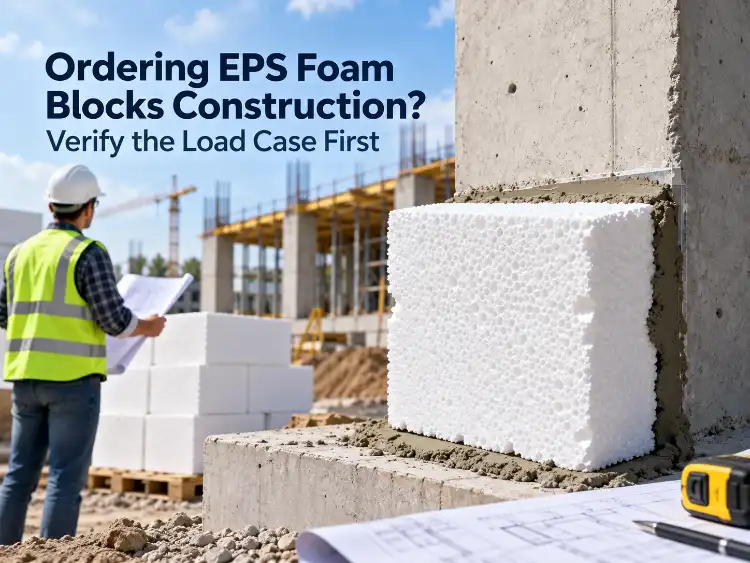
EPS foam blocks construction orders usually open with a density number and a price, and the decision that actually matters sits behind both: what the block is being asked to carry. A block that performs well as insulation in a wall is not automatically the right block under a floor slab or a section of road fill.
The verification is short once it is framed correctly. Confirm the loading case, treat density and compressive strength as two separate requirements, agree the block format the site can place, and settle what a sample has to prove before the bulk order is released.
What the Block Is Being Asked to Carry

Construction use of EPS blocks splits into loading cases that have very little in common. In a wall or a foundation detail the block is usually asked to insulate, and the mechanical demand is modest. Under a slab, or as lightweight fill in ground and road works, the block is being asked to carry load, and that changes which property decides the purchase.
The distinction matters because buyers often carry a proven grade from one project to the next. That habit works inside the same loading case and fails across them. A block that met a wall requirement has no automatic claim on a ground-fill requirement, even when the dimensions and the density figure look similar.
Service life belongs in the same conversation, because a block that is expected to sit in the ground for decades is chosen differently from one that is closed into a wall. Where EPS products are used across construction shows how far the loading cases differ, and the service question belongs in the specification rather than in the supplier’s assumptions.
Reading Density and Compressive Strength Together

Buyers ask for density because it is the number everyone quotes. Suppliers answer with density for the same reason. The problem is that density describes how much material is packed into the block, while load performance is described by compressive strength, and the two are related without being interchangeable.
Density Alone Does Not Set the Grade
A density figure tells the buyer how heavy and how thermally effective a block is expected to be. It does not, on its own, state what happens when the block is compressed. Rigid cellular polystyrene products are specified by type, physical properties and dimensions rather than by a single density value, which is exactly why an order that names only a density leaves the load requirement unstated.
For a buyer this has a practical consequence. When the density is the only agreed number, a delivered block can be legitimate and still unsuitable, and neither side has a basis to resolve the disagreement.
Compressive Strength at the Stated Density
The property that has to appear in the order for a load-bearing block is compressive strength, stated at the density the project expects. In ground and road works this is the governing requirement, because the fill has to resist the load above it rather than insulate it.
Reading the two together is what makes the specification usable. Density tells the buyer what material was ordered; compressive strength tells them what the material has to do. How a high-density foam specification is written is the same discipline applied to a neighbouring product, and a supplier who can quote both properties and explain how the density was controlled is answering the question the load case actually asked.
Block Dimensions and Delivery Format
Format is the second half of the decision and the half that most often stops a delivery. Block thickness and length have to match what the site can place, and the delivery format — how the blocks are presented, protected and handled — determines whether the site can start work when the truck arrives.
For EPS foam blocks in home construction, the constraint is usually the space available on site and the sequence of the build. Narrow plots, restricted access and staged programmes all turn the block format into a real requirement rather than a preference, and the buyer who confirms it in advance avoids a delivery that has to be rehandled before it is used.
Dimensional behaviour is a product and process outcome rather than something the site can correct. The checks that separate a consistent EPS supply from a variable one are worth running before agreeing a dimension that the process cannot hold.
What to Verify in a Sample Before Bulk
A sample proves the process that produced it. Two suppliers can send visually similar blocks with different density control and different compressive behaviour, so the sample conversation should settle three things.
First, which properties the sample is being accepted on, and how they were measured. Second, the dimensions and the format that the sample represents, because a sample cut to a convenient size says nothing about the block the site will receive. Third, the conditions the sample represents, since density control in production is a process result that should be repeated rather than a value that happened once.
The supplier’s documented production line includes precision testing, and sample production is handled inside the same coordinated supply process rather than as a separate exercise. That is the arrangement a sample-first verification step is meant to use: the same process that produced the approved block is the process that runs the order.
Write the outcome of the sample review down. A sample that is approved without a recorded basis is an opinion, and opinions do not settle a delivery.
What to Put in the Order
Four statements turn the verification into an enforceable order.
The order should begin with the loading case, in the buyer’s own words, so the supplier is choosing a grade against a purpose rather than a habit. Density and the compressive requirement belong in it as two separate properties at the expected density. The block dimensions and the delivery format follow, including how the blocks must be presented and protected on arrival, and the sample basis closes the list by naming which properties were accepted and how they were measured.
Nothing in that list is unusual, and none of it requires new information from the site. What it removes is the ambiguity that lets a delivery be argued about after the fact, and it gives the buyer a defensible basis for accepting or rejecting what arrives.
Conclusión
Match the block grade to the load case, state density and compressive strength as separate requirements, agree the block format the site can place, and record what the approved sample proved. Those four verifications are what make an EPS block order complete before the material leaves the plant.
Send the application, the expected load and the block dimensions to the HUASHENG technical team, so the grade and the sample can be confirmed together before the bulk order is placed.
Preguntas frecuentes
Q1: Is a higher density EPS block always the right choice?
A1: No. Density describes how much material is in the block and how it is expected to perform thermally; it does not by itself state what the block does under load. With a load-bearing block, the compressive requirement has to be stated at the expected density as well.
Q2: Which value should the order state for a load-bearing application?
A2: State both. Give the density the project expects and the compressive requirement the load case needs, and name them as separate requirements. An order carrying only a density figure leaves the property that governs the loading case unstated.
Q3: What should a sample prove before a bulk block order?
A3: The sample should prove the properties it is accepted on and how they were measured, the dimensions and format it represents, and the production conditions behind it. Approved without that record, a sample is an impression rather than a basis for accepting the bulk delivery.
 Spanish
  English
  German
  French
  Arabic