
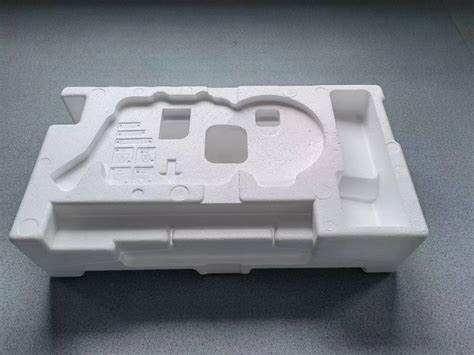
Steam chest molding produces a repeatable EPS part only when filling, heating, fusion, cooling and ejection work together. A density result leaves local support and dimensional questions unanswered. For a failed feature, keep its position, material identity and process history available before deciding which setting to change.
Suppose a tray looks sound across the center but a narrow corner opens during loading. More steam across the mold could change the rest of the surface without fixing that corner’s filling or venting. Compare the corner on good and affected parts first. The goal is to reproduce the acceptable part in routine production, rather than select the best sample from a trial.
What Should Steam Chest Molding Consistency Mean?
A panel and a closely fitted tray won’t have the same critical features. Name what the part must do before discussing the machine. The specification needs to pick out the dimensions, contact areas and surfaces that control that use.
Measure the features that control the application
For a tray, the seating areas and movement restraints deserve measurement; for a panel, flatness and thickness may take priority. Put the datum and method beside each critical dimension. Otherwise the factory and buyer can both report a measurement while referring to different features.
In an EPS molding consistency review, a smooth skin doesn’t establish sound fusion inside a thick section. Nor does a rough patch by itself explain failed protection. Record appearance, dimensions and performance separately, then investigate which observation supports the suspected cause.
Set the measurement timing as well. A sample measured immediately after production should not be compared casually with one measured after storage. Agree on conditioning and the relevant elapsed time, then use the same procedure on good and affected parts.
Explore HUASHENG’s material range before the investigation, so that the sample description includes a named material family rather than just “white foam.”
How Do Grades Affect Steam Chest Molding?
Pre-expansion, bead condition and mold filling create the starting conditions for bead fusion. Process settings should therefore be reviewed with the exact grade and batch. A material change can make an old production setting an unsuitable reference.
HUASHENG lists B as a quick grade for electrical packaging, panels and precision instrument packaging. Traditional and automatic vacuum molding machines are included in its stated scope. Fast molding, high strength, surface smoothness and good overall performance are the listed characteristics. For a tray inquiry, those details identify a family to discuss; the repeatability of its fitted features still has to be demonstrated.
Within B, 301 corresponds to 1.0–1.8 mm particles and a single-time expandable ratio of 50–70. The remaining entries are 302 at 0.8–1.3 mm and 45–65, 303 at 0.6–1.0 mm and 40–60, and 401 at 0.3–0.8 mm and 30–50. Retain all three fields for the chosen entry. They describe different grade specifications, not interchangeable settings for one trial.
P is HUASHENG’s ultra-light family for large panels, electrical packaging and ceramic lamp packaging made on automatic vacuum forming machines. Its listed features include high foaming efficiency, storage stability, smoothness, toughness and multiple pre-foaming capability. P 301 has a stated single-time expandable ratio of 80–100; B 301 lists 50–70. The shared particle-size range doesn’t remove that difference in expansion characteristics or application scope.
A grade comparison won’t supply a universal steam pressure or aging time for EPS molding consistency. Request guidance for the exact material and equipment. Review customized REPS possibilities with the proposed feature geometry if the material discussion needs to be more specific.
P specification 303 lists 0.6–1.0 mm particles with a single-time expandable ratio of 60–80. P specification 401 lists 0.3–0.8 mm particles and a ratio of 55–75. Both belong to the same ultra-light family, whose listed features include multiple pre-foaming capability.
Where Should a Local Fusion Problem Be Investigated?
Mark where the weak section occurs and whether it returns in the same place. A narrow passage, deep pocket or abrupt thickness change can have different local filling, heating and cooling conditions. That map gives the process review somewhere to begin before a whole-mold setting changes.
Compare the same locations on acceptable parts
Keep good and affected samples from an identified production period. Mark their orientation and cavity identity if relevant. Inspect comparable sections using an agreed procedure rather than breaking samples in different places and judging the fragments informally.
Bring the mapped defect to the molder for a review of filling route, vents, steam distribution and condensate management at that location. Each proposed correction needs a plausible cause behind it. After the trial, inspect the rest of the part for side effects instead of checking only whether the original corner looks better.
A two-cavity comparison illustrates why location matters. If only one cavity repeatedly produces the defect, compare the cavities before rejecting the entire material lot. If both change after material preparation changes, that is a different pattern to investigate. Neither pattern alone establishes the final cause.
Read HUASHENG’s REPS material information alongside the sample identification. Bead fusion should be evaluated in the finished geometry using a defined method, rather than inferred from a promotional description.
How Should Cooling and Dimensional Checks Prevent Recurrence?
Review the actual cooling and ejection record as well as filling and heating. Early removal may leave a part unable to hold its shape, while uneven thermal history can complicate a dimensional comparison. Those are possibilities to examine against the record, without assigning either cause in advance.
Define the production release check
Before another trial, choose the measurement points, conditioning and pass limits. Include the intended product or an appropriate controlled gauge for a fit check. A ruler across an easy outer edge may miss the pocket that prevents the product from loading.
For a revised vent intended to improve one corner, state that purpose in the corrective-action record. Inspect the corner after the trial, then look elsewhere for new distortion or incomplete filling. Recording the change and its intended result makes the next check more useful than a general statement that the sample improved.
Keep a physical approval reference for molded part inspection, identified by drawing and material. Receiving staff can use it to learn which differences matter. Depth, fit and local stiffness may be difficult to judge from a photograph alone.
HUASHENG discusses application scenarios and project features before developing a customized material solution. Requirement analysis, design, samples, manufacturing and logistics delivery fall within its service scope. Identify the critical feature during that early discussion, when it can still guide the sample brief.
With a request for help, include the marked defect, sample identity and measurement method. If it appears only during packing or installation, show that sequence too. Molded part inspection needs to reproduce the troublesome condition for the comparison to explain it.
Keep the affected corner marked through every inspection stage. Otherwise, different reviewers may compare different locations and mistakenly report that the correction worked.
Conclusión
Steam chest molding consistency is a chain of connected conditions, from prepared beads to the conditioned part. Investigate defects by location and lot, match the review to a named grade, and compare filling, bead fusion, cooling and dimensional results systematically. The strongest correction improves the critical feature and remains repeatable in production. Discuss your part and process requirements with HUASHENG using good and affected samples, a marked drawing and clear acceptance criteria.
Preguntas frecuentes
Q1: Does higher density prove good steam chest molding?
A1: No. Density is one characteristic. Fusion, local geometry, dimensions and application performance need their own checks.
Q2: What information helps an EPS molding consistency investigation?
A2: Provide the material grade, lot, cavity, defect location, photographs, measurements, conditioning method and good reference samples.
Q3: Can more steam correct every bead fusion defect?
A3: No. The bead preparation, filling route, vents and local heating all deserve review. Raising steam broadly can affect other features while the original weak area remains unresolved.
 Spanish
 English
 German
 French
 Arabic