
Foam selection looks simple until a prototype reaches the warehouse. A pack that survives one drop may crack after repeated handling, while a resilient insert may add cost that a one-way shipment cannot recover. The useful question is which material fits the load, distribution cycle, tooling plan, and end-of-life route.
What EPS and EPP Mean in Foam Packaging and Project Use
EPS: lightweight protection with flexible density options
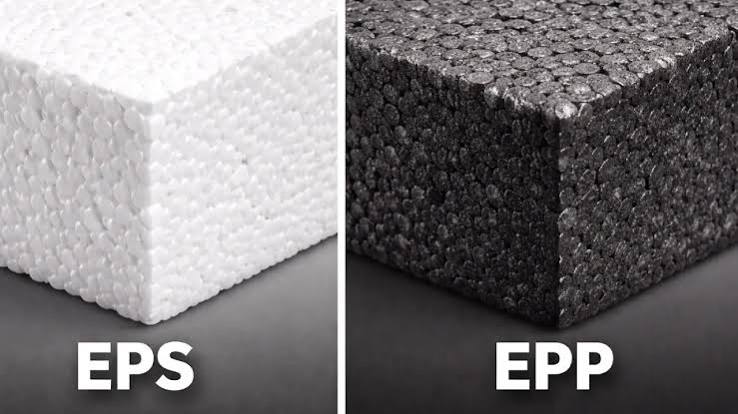
EPS means expanded polystyrene. Steam expands polystyrene beads, then a mold fuses them into a rigid, closed-cell shape. The result is light, dimensionally stable, insulating, and easy to mold around products. An EPS end cap can hold an appliance or display away from the carton wall without a heavy structure. It normally absorbs a major impact through cell deformation, so visibly damaged packaging should not be reused without inspection.
EPP: resilient foam for repeated impact and return cycles
EPP means expanded polypropylene. It is also bead-molded, but its structure provides greater flexibility and elastic recovery after compression. That suits returnable dunnage, automotive components, reusable transit boxes, and parts exposed to repeated knocks. Material, processing, and tooling can bring a higher entry cost, so the planned reuse frequency must be realistic.
EPS vs EPP: The Differences That Affect a Real Project
EPS provides firm positioning and compressive support at low weight. EPP recovers better when the same component is loaded or struck many times. Thermal work often favors EPS, which is widely used in insulation boards, cold-chain boxes, and temperature-sensitive packaging. EPP can insulate too, but its extra cost may be difficult to justify for one-way delivery. The table is a starting point; density, grade, molding quality, geometry, and test method still affect the result.
| Project factor | EPS | EPP |
| Structural behavior | Rigid, supportive, dimensionally stable | Flexible, resilient, good shape recovery |
| Impact pattern | Strong fit for one major impact or limited handling cycles | Better suited to repeated impacts and compression cycles |
| Thermal insulation | Common choice for boxes, panels, and cold-chain packaging | Useful, though less often selected on insulation cost alone |
| Tooling and unit economics | Often attractive for high-volume, cost-sensitive molded parts | Higher entry cost may make sense across many reuse cycles |
| Surface and design | Visible bead texture; precise molded cavities are possible | Fine molded texture; living features and durable surfaces are possible |
| Typical project | Appliance packaging, seafood boxes, insulation, display protection | Returnable dunnage, automotive parts, reusable cases, sports protection |
The load, thermal, fire, and processing questions used in foam material selection should be applied to both materials. Density alone cannot predict whether a corner will split or an insert will survive its planned cycle count.
Where EPS Usually Makes More Commercial Sense
Protective packaging and display components
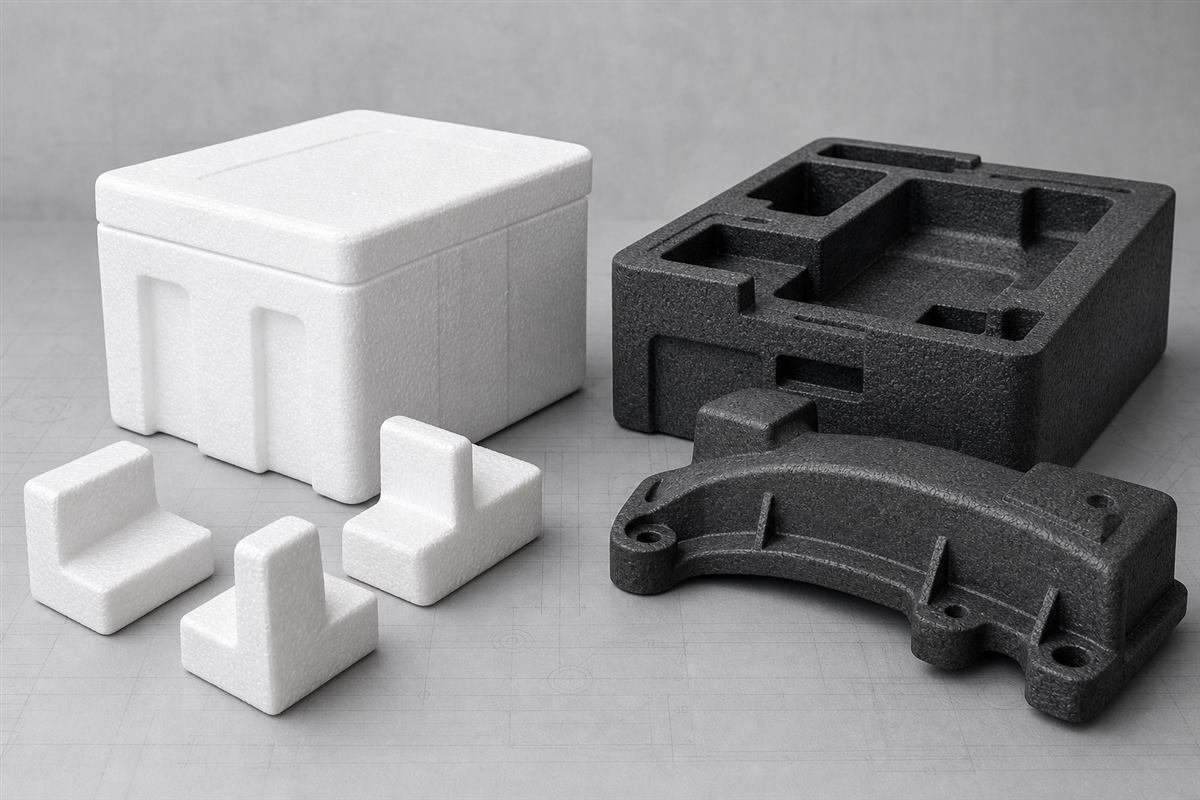
EPS often fits one-way shipments that need low weight and rigid location. Molded end caps support appliances, maintain clearance from the carton, and spread loads across a larger area. A well-designed part may use less material than a soft wrap that relies on thickness.
Material grade still changes the outcome. HUASHENG supplies common-grade EPS beads in fast-molding B, standard E, and extra-light P options. They show why an order for “EPS” still needs a density target, particle size, molding equipment, and final application.
HUASHENG also develops REPS-Materialien for firmer packaging that needs more toughness. Published test data covers densities from 25 to 50 g/L at different expansion ratios. REPS is not a universal substitute for EPP, but it offers another route for display modules, electronics trays, and similar components.
Cold-chain boxes and temperature-sensitive shipping
Fish boxes, produce containers, and temperature-controlled packs need low weight, stable walls, and predictable insulation. When a box is handled only a few times, paying for repeated elastic recovery brings little return. Fit, wall thickness, lid seal, coolant arrangement, and route validation matter more.
Building insulation and lightweight construction
EPS boards reduce heat transfer without adding much dead load. Flame-retardant or graphite-modified grades can address specific system requirements. Buyers should verify thermal value, density, fire classification, aging conditions, and the complete assembly rather than judging a board by color or weight.
When EPP Is Worth the Higher Material and Processing Cost
EPP earns its place when the part is expected to return. Automotive dunnage may face hundreds of handling cycles. A cracked insert can scratch a painted part or interrupt an assembly line, so recovery after repeated compression has measurable value.
It also works where foam remains in the product. Bumper absorbers, tool cases, HVAC parts, seating structures, and sports equipment may require toughness or repeated impact resistance. The higher cost makes sense when service life and failure cost are documented.
“Reusable” must match the route. If distributors do not return empty packaging, reverse freight is costly, or inserts are regularly lost, the case for EPP weakens. EPS may deliver the required protection with a simpler one-way supply plan.
Matching Foam Choice to Product Risk and Distribution Conditions
Start with the expected damage and load pattern
Start with the damage mechanism. A heavy appliance needs bottom support; a display module needs even pressure; returnable machined parts need a surface that survives repeated trips. Tests should reproduce stacking, vibration, temperature changes, drops, and the weakest carton orientation.
Compare cost per shipment or reuse cycle
Calculate cost per successful trip, not just cost per part. One-way packaging depends on tooling, material weight, carton size, reject rate, and warehouse space. Reusable packaging adds return freight, cleaning, tracking, repair, loss rate, and achieved cycle count. Without a reliable return loop, EPP’s lifecycle case may disappear.
HUASHENG‘s EPS application areas show how packaging, cold-chain, construction, food, and industrial requirements lead to different grades. The discussion should begin with the product and route, then move to material.
What Buyers Should Verify Before Placing a Bulk Order
Ask for samples molded at the proposed density on equipment comparable to the production line. Hand-cut samples do not reveal bead fusion, cooling marks, shrinkage, or cavity fit. Tie the approved sample to a drawing, weight tolerance, density range, and test condition.
Check batch repeatability. Poor EPS fusion or insufficient aging can cause cracking and movement; EPP processing changes can alter stiffness, recovery, and surface quality. Ask how beads, molding windows, inspections, and out-of-tolerance lots are controlled.
Put tooling ownership and change control in writing. Confirm mold ownership, cavity count, maintenance, and the effect of drawing revisions. Finished inserts also need suitable packing so crushed corners, contamination, moisture, or mixed labels do not reach the assembly line.
Run a pilot lot through the real route and compare damage, pack time, cube use, and operator feedback. HUASHENG can discuss customized foam requirements such as particle size, color, density, or tougher EPS-based formulations. Keep every specification testable: “high strength” is not an acceptance criterion, but a load, deformation, temperature, and method are.
FAQ (häufig gestellte Fragen)
Q1: Is EPS always cheaper than EPP?
A1: EPS commonly costs less for one-way packaging and insulation. EPP may cost less per trip when a controlled return loop achieves enough cycles.
Q2: Can EPS be used for a project that needs better toughness?
A2: Yes. Density, bead fusion, geometry, and modified materials such as REPS can change the protection profile. Test the sample under the intended impacts and temperatures.
Q3: What information should be sent for a custom foam quotation?
A3: Send drawings or samples, packaging weight, fragile areas, carton size limitations, shipping route, unloading requirements, temperature range, annual shipment volume, reuse objectives, and any special requirements such as fire resistance, food contact, anti-static properties, or recyclability.
 German
  English
  Spanish
  French
  Arabic