
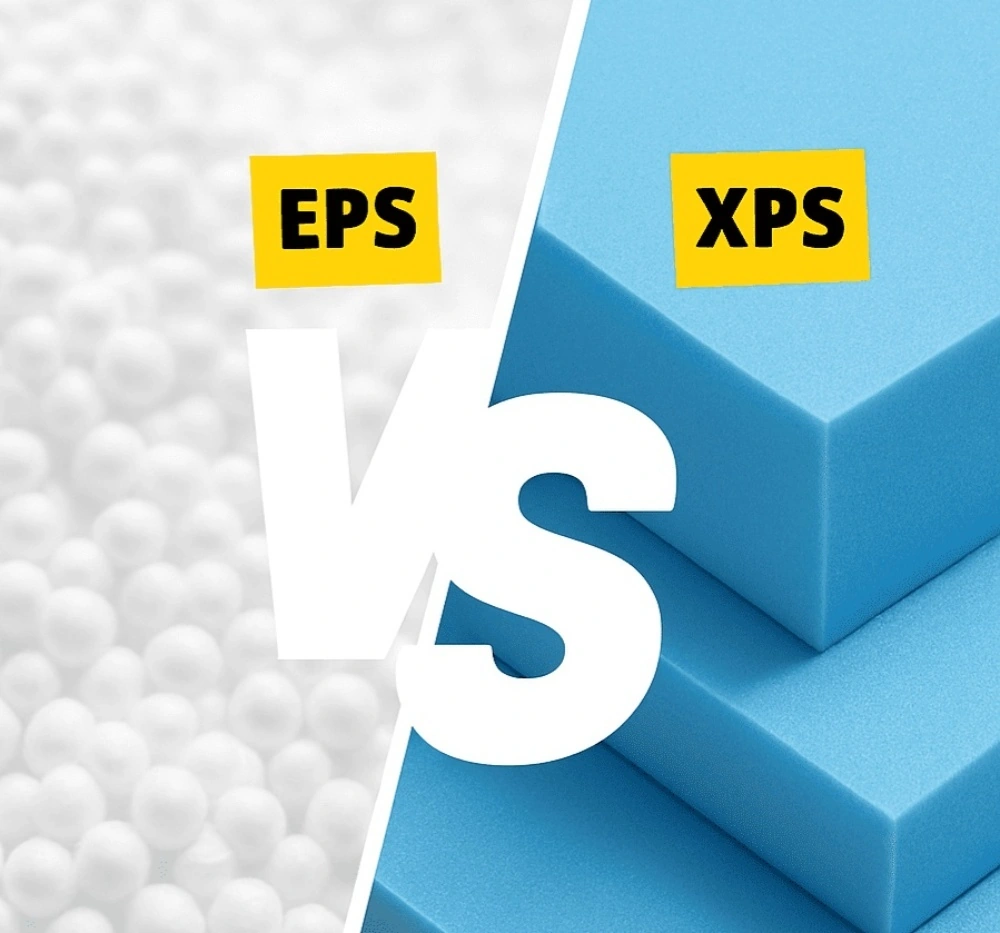
EPS and XPS are both polystyrene insulation materials, but they are produced differently and should not be treated as interchangeable labels. EPS is made by expanding beads; XPS is formed through an extrusion process. The better choice depends on the project’s thermal, moisture, mechanical, fire and installation requirements, plus the product evidence available for the intended assembly.
Buyers searching “XPS insulation vs EPS” often need a clear comparison before requesting a quote. Start by identifying whether you need raw EPS resin, finished EPS boards, finished XPS boards or a complete insulation system. HUASHENG supplies expandable EPS materials and lists construction applications; its product pages do not make every EPS grade equivalent to a finished board or to an XPS product.
Planning an EPS material trial? Send HUASHENG your application and specification to discuss grade information, sample requirements and quotation scope.
Compare the exact product, not only the material names
Product names describe broad families. Within each family, finished products can differ in thickness, edge profile, facing, declared properties and intended use. Request the exact product designation and technical information for every candidate. Check whether the evidence concerns raw material, an individual board or an assembled system. Record the market and specification against which the product is being offered.
Product scope and interfaces
EPS is generally made from expanded beads that are fused into a shaped product. XPS is produced by extrusion into a continuous foam structure. The manufacturing route can influence the finished product’s measured properties and processing options, but buyers should rely on product-specific data rather than infer performance from the manufacturing description alone. Ask for the test methods and conditions behind any comparison.
The same caution applies to broad brand or trade terms. A search may use “Styrofoam” informally for rigid foam insulation, but procurement documents should use the actual product name and supplier designation. This reduces the chance that a quote covers a different foam family or a different supply stage than the design calls for.
Use the application to set comparison criteria
Make a project table that records where the insulation will be installed, what it touches, what loads it carries and how it will be protected. A protected cavity, a below-grade wall, a roof, a floor and a temporary site application present different conditions. The designer should define the required criteria and evidence for the relevant market.
Project criteria and evidence
For thermal performance, compare declared or tested values for the exact product and thickness. Confirm the method and whether the value represents a material specimen or the installed assembly. A whole-wall result can be affected by joints, framing, fixings, moisture and workmanship, so a single board value should not be represented as the performance of every wall design.
For moisture, identify whether the concern is liquid-water absorption, vapor movement, rain exposure or water pressure. Ask for results measured with relevant methods and confirm that the product scope matches the intended application. Drainage, membranes, flashings and joint details remain part of the water-control strategy regardless of which insulation family is selected.
For mechanical loading, state the load case and acceptance criteria. Do not use density alone as a proxy for compressive performance or suitability. If the insulation is below a slab or supports another component, the engineer should specify the load, deflection and long-term design considerations that govern the selection.
Review fire and installation requirements early
Fire performance depends on the exact product and the full wall or roof assembly. EPS or XPS should not be called fireproof based on a product family or a flammhemmend grade name. Request the applicable evidence and confirm whether it represents the proposed thickness, facings, joints, fixings and protective layers. The designer should check that the evidence is acceptable under local code and project requirements.
Installation can also change the practical comparison. Consider how boards are cut, fitted around penetrations, joined, fixed and protected during construction. Confirm which adhesives or coatings are compatible with the exact foam product, because solvents or other chemicals may affect polystyrene. Use written product guidance rather than generic assumptions about all insulation materials.
Plan for storage and exposure before enclosure. Define how materials will be kept dry, protected from damage and separated by type or lot. If a project uses a new board or supplier, install an agreed mock-up or sample area where the designer believes it will help confirm fit and detailing. Document any changes from the approved installation method.
Compare total project fit, not a single headline number
A fair EPS-versus-XPS comparison holds the project scope constant. Match the required thickness, assembly role, test evidence, delivery format and accessories. Compare the total installed solution where the buyer is choosing a system, and compare product supply alone where the material is the only scope. A quote for expandable EPS resin should never be compared directly with a quote for finished XPS boards without accounting for conversion and supply differences.
Ask suppliers to identify assumptions and gaps. If a quotation uses a preliminary thermal value, a generic test result or a different product thickness, require clarification before treating it as a compliant offer. Confirm which documents accompany delivery and how a substitution will be controlled. If test data is not available, mark it as unresolved and ask the design team whether another evaluation route is acceptable.
For EPS projects, HUASHENG’s listed grades and customized REPS process provide a starting point for a material inquiry. Share the intended application, target product form, drawing, market and required documentation. The supplier can respond about available EPS material options; the processor and designer must complete their respective review of the finished board and assembly.
Make the selection traceable
Keep the approved product schedule with the drawings and purchase order. Record the product designation, supplier, grade or lot where available, thickness, test documents and the intended assembly. If the project accepts more than one option, list the conditions for each option rather than saying that EPS and XPS are equivalent in general.
When changing products mid-project, review any related components and details. A different board may change joint dimensions, cutting behavior, adhesive selection or evidence needed for compliance. Require written approval from the responsible designer before substituting. Traceable decisions help procurement, site teams and inspectors understand why a specific product was selected.
Schlussfolgerung
EPS vs XPS is a project decision rather than a contest between two generic material names. Set the required criteria from the installation, compare product-specific evidence and keep the raw material, finished board and assembly scopes distinct. Send HUASHENG the EPS application and specification to discuss available material information and quotation requirements.
Häufig gestellte Fragen
Q1: Is EPS always cheaper than XPS?
A1: Not as a universal rule. Price depends on the exact products, thickness, region, supply scope and installation requirements. Compare equivalent project offers.
Q2: Which is better for wet locations, EPS or XPS?
A2: There is no universal answer from the material name alone. Compare water-related test data for the exact products and confirm the assembly’s membranes, drainage and exposure conditions with the designer.
Q3: Can I substitute EPS for XPS without changing the design?
A3: Do not assume so. A substitution needs a review of required properties, product evidence, dimensions, interfaces and local approval. Obtain the responsible designer’s written acceptance.
 German
 English
 Spanish
 French
 Arabic