

The importance of materials used for lining helmets goes beyond the expectations of many customers. Certification rules, cost considerations, and consistency of production have put the industry of helmet producers under certain pressures as early as 2026. The choice of material to be used for inner liners is critical for B2B purchase managers.
Among available foam materials, EPS Schaumstoff is still widely used in helmet padding systems. It is found in industrial helmets, construction safety helmets, cycling helmets, and various protective gear categories.
The Growing Importance of EPS Foam in Helmet Padding Systems
Helmet padding must deal with impact energy, long-term wear comfort, and stable production performance. In real production environments, material selection affects not only safety results but also manufacturing efficiency and product consistency.
Impact Absorption Behavior Under Real Safety Conditions
EPS foam absorbs energy through controlled deformation of its bead structure. When impact occurs, the internal foam cells collapse layer by layer, reducing the force transmitted to the head.
This behavior is important because helmet safety standards are based on controlled energy absorption rather than rigid resistance.
In practical helmet production, HUASHENG’s EPS foam material systems are designed with controlled density and uniform bead expansion. This helps maintain consistent impact performance across different production batches, which is critical for OEM helmet suppliers working with strict certification requirements.
Lightweight Structure for Long-Term Wear Comfort
Helmet users often wear protective equipment for long periods. In construction sites, logistics operations, or cycling environments, weight becomes a real factor affecting user fatigue. EPS foam has a low-density structure that reduces overall helmet weight while still maintaining protective capability. This makes it suitable for large-scale helmet production where comfort and compliance need to be balanced.
Compared with heavier composite materials, EPS offers a practical solution that meets both user comfort and industrial cost expectations.
Stable Moldability for Helmet Inner Liner Production
Helmet padding must match outer shell geometry precisely. EPS beads can be pre-expanded and molded into consistent liner shapes with controlled density distribution. This stability reduces fitting issues during assembly. In mass production, this is not a small detail. Even slight deformation differences can affect assembly speed and product rejection rate.
Cost Efficiency in Mass Helmet Manufacturing
Helmet manufacturing is a volume-driven industry. Even small material cost differences can become significant when production reaches tens or hundreds of thousands of units. EPS foam remains cost-efficient compared to alternatives such as EPP. For many OEM helmet factories, EPS is still the preferred option because it allows stable pricing, easier sourcing, and predictable production cycles.
EPS vs. EPP vs. EPE in Helmet Padding Materials
When buyers evaluate helmet padding materials, EPS, EPP, and EPE are usually the main comparison points. Each material behaves differently in structure and application.
EPS vs. EPP: Energy Absorption vs. Recovery Ability
EPP foam has elastic recovery and can return to shape after multiple impacts. This makes it suitable for reusable protection systems. EPS foam, however, is designed for single-impact energy absorption. It permanently deforms after impact, which aligns with most helmet safety standards where helmets are replaced after a major impact event.
From a procurement perspective, EPS is easier to scale in production and more stable in cost structure. EPP is generally used in premium helmets or specialized applications where rebound performance is required.
EPS vs. EPE: Structural Role Difference
EPE foam is softer and more flexible. It is commonly used in packaging and cushioning applications rather than structural protection systems. In helmet padding, structural rigidity and controlled collapse behavior are necessary. EPS provides this through its bead-based internal structure, while EPE does not maintain sufficient rigidity under impact conditions.
Because of this, EPE is rarely used as a primary helmet liner material in certified safety products.
Why EPS Maintains Market Position in Helmet Manufacturing
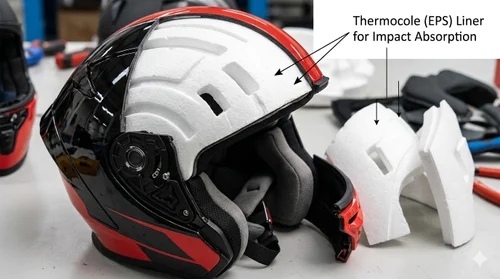
Despite new materials entering the market, EPS remains widely used due to several practical factors:
- stable industrial production process
- consistent molding behaviorin mass manufacturing
- well-established certification pathways
- predictable cost structure
- mature global supply chain
For helmet manufacturers working with OEM/ODM models, production reliability is often more important than theoretical material advantages.
Procurement Considerations for EPS Helmet Padding Materials
For buyers, selecting EPS foam is not just a material decision. It is also a supplier capability and production stability decision.
Confirm Density, Impact Performance, and Certification Requirements
EPS density directly affects impact absorption and weight balance. Different helmet categories require different density levels depending on the use environment.
Industrial helmets usually require stronger impact resistance, while sports helmets may prioritize comfort and ventilation balance. Procurement teams should always request test reports and certification documents based on target market requirements such as CE, ANSI, or regional safety standards.
Evaluate Molding Accuracy and Batch Consistency
The biggest challenge that comes with manufacturing helmets is consistency from one batch to another. Any slight variation in bead expansion and molding process may influence the quality of fit of the liners. This affects efficiency during assembly and may result in rejection when manufactured in bulk. Suppliers like HUASHENG, referenced in EPS material systems on its product platform, focus on controlled material processing and stable batch output, which helps maintain consistent molding behavior across large-scale orders.
Compare Supplier Mass Production Capability
Helmet buyers should also evaluate supplier capability beyond material specifications. Key factors include:
- stable production capacity
- mold development support
- sampling speed and adjustment cycle
- long-term supply reliability
- OEM/ODM customization support
In helmet supply chains, production interruption or inconsistency usually creates higher costs than small material price differences.
FAQ (häufig gestellte Fragen)
Q1: What EPS foam density is commonly used in helmet padding?
A1: EPS helmet padding usually uses medium-density material. The exact level depends on helmet type and certification requirements. Industrial helmets and sports helmets often use balanced density to achieve both safety performance and weight control.
Q2: Can EPS foam meet helmet safety certification requirements?
A2: Yes. EPS foam is widely used in certified helmet systems globally. When properly designed within helmet structures, it can meet standards such as CE, ANSI, and other regional safety regulations.
Q3: Why is EPS still preferred over EPP or EPE in helmet production?
A3: EPS remains preferred because of its cost efficiency, stable molding behavior, and mature production systems. EPP is used in higher-end applications due to cost, while EPE is not suitable for structural impact absorption in helmets.
Q4: What role does HUASHENG play in EPS helmet padding material supply?
A4: EPS foam products with regulated density and stable bead formation by HUASHENG are used for various industrial purposes. In the process of helmet padding manufacturing, it is important to ensure consistency between batches, minimum molding deviation, and large-scale manufacturing for OEM. For more information, do not hesitate to Kontaktieren Sie uns.
 German
  English
  Spanish
  French
  Arabic