
Expanded Polystyrene (EPS) foam is a featherweight, closed-cell material that’s a total champ in all sorts of industries. You’ll see it popping up in everything from building insulation to protective packaging and cold chain setups. It’s great at locking in heat, soaking up impacts, and keeping water at bay—perfect for tough jobs that need to save energy.
What’s cool about EPS? You can tweak it into different grades to fit exactly what you need. Want something crazy strong or fire-resistant? There’s an EPS type built for that, no problem.
If you’re seeking a trusted partner in this space, HUASHENG stands out as a leading manufacturer of EPS materials. With decades of experience and a strong commitment to innovation, HUASHENG delivers reliable solutions across industries. Their extensive product lines cover everything from standard grades to customized high-performance foams, all backed by rigorous quality control systems.
Fundamental Properties of EPS Foam
Before jumping into the various types of EPS foam, let’s get a handle on what makes it tick. EPS is mostly air—98% to be exact—with just a smidge of polystyrene, so it’s crazy light but still holds up strong. Its closed-cell setup traps heat like a champ, perfect for places where temperature control is a big deal.
EPS foam stays rock-solid in shape and keeps moisture out like a pro. It holds up great, no matter how much the weather flips around, keeping its form and doing its job for the long haul.
Advantages of EPS in Industrial Applications
The widespread use of EPS foam stems from its high performance-to-cost ratio. It offers significant energy savings during processing due to its low steam consumption and fast molding cycles. The curing time and molding cycle are short; the product has good fusion; the surface is smooth; stable size, high strength, strong applicability. These features make EPS suitable for mass production in automated systems.
Moreover, its recyclability adds value in sustainability-conscious markets. Many industries opt for EPS not only because of its technical capabilities but also due to its ease of integration into existing manufacturing workflows.
HUASHENG’s Position in the EPS Market
As a pioneer in the field, HUASHENG has built a reputation on consistency and innovation. Their R&D capabilities allow them to develop specialized grades that meet evolving industrial demands—from flame-retardant variants to precision packaging foams like their Rapid Prototyping Grade – B – Precision Instrument Packaging Box.
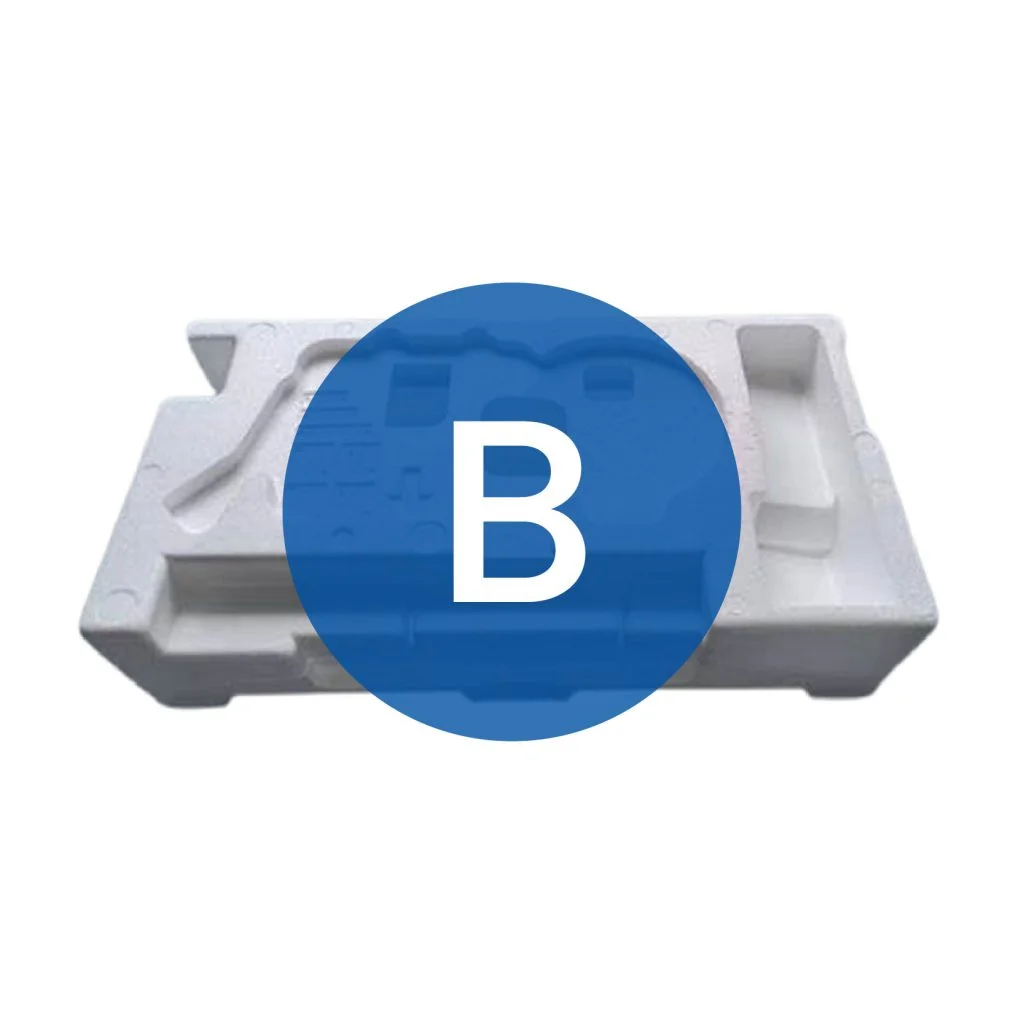
Their E-standard series exemplifies this commitment: E-standard material is a widely used ordinary EPS, suitable for automatic vacuum forming machines, electric drive forming machines, and traditional lifting hydraulic presses.
Classification of EPS Foam Types
EPS foam isn’t one-size-fits-all—it comes in multiple variants engineered for specific functions. Each type offers distinct advantages depending on your operational requirements.
Standard White EPS
This is the most commonly used type across general-purpose applications. It is widely used in electrical packaging, thermal insulation materials, fishing floats, handicrafts, decoration, lost foam castings. Standard white EPS offers balanced performance with fast foaming speed and low energy consumption.
Grades like E-101 or E-201 are ideal if you need moderate density with high expansion ratios—perfect for fruit boxes or ceramic packaging needs.
Graphite-Enhanced EPS (Grey EPS)
For projects requiring superior thermal insulation without increasing thickness or weight, grey EPS infused with graphite particles becomes your go-to solution. The graphite improves infrared reflectivity within the material structure, significantly lowering thermal conductivity compared to standard white types.
This makes grey EPS highly suitable for energy-efficient building envelopes where space constraints exist but insulation performance cannot be compromised.
High-Density Structural EPS
When structural integrity takes precedence—such as load-bearing walls or flooring systems—high-density variants deliver enhanced compressive strength and rigidity.
These foams are engineered with smaller cell sizes and denser packing structures that resist deformation under stress. This ensures long-term durability even under dynamic loads or sustained pressure conditions. HUASHENG provides specialized high-density grades tailored for construction applications where dimensional stability and mechanical endurance are critical. These solutions are often paired with advanced molding technologies for custom geometries suited to architectural designs.
Flame-Retardant EPS Grades
Safety regulations increasingly demand fire-resistant materials across residential and commercial projects. Flame-retardant grades incorporate additives that inhibit ignition and slow down flame propagation.
Developed through stringent testing protocols, HUASHENG’s flame-retardant series meets international safety standards while retaining essential physical properties like shape retention and impact resistance—making them ideal for insulated panels or HVAC ducting systems.
Applications Across Key Industrial Sectors
Each industry sector leverages specific eps foam types based on functional needs ranging from protection to insulation.
Building and Construction Industry
EPS serves as both an insulator and structural filler in walls, roofs, foundations, and facades. Its light weight simplifies installation while reducing overall load on buildings—especially critical in seismic zones.
High-density structural types are favored here due to their load-bearing capacity combined with excellent thermal efficiency over decades of use.
Packaging and Logistics Sector
In packaging applications where shock absorption matters more than structural rigidity—such as electronics or ceramics—the E-standard grade shines. E standard grade E-101 has a specification of 1.30-1.60mm, suitable for general packaging such as electrical ceramic packaging.
For more sensitive instruments requiring precision-fit cushioning during transit or prototyping phases, consider Rapid Prototyping Grade – B – Precision Instrument Packaging Box.
Cold Chain and Refrigeration Logistics
Due to its excellent insulating properties even at low densities, grey graphite-enhanced foams dominate cold chain logistics—from vaccine containers to seafood boxes—ensuring temperature stability throughout transport cycles.
Automotive and Machinery Components
EPS finds utility in automotive crash pads or machinery housings where impact resistance is key but weight must be minimized. Custom-molded components using advanced techniques ensure tight tolerances without compromising safety standards.
Performance Comparison Across EPS Types
Choosing between eps foam types involves evaluating key performance metrics relevant to your application scenario.
Thermal Conductivity and Insulation Ratings
Graphite-enhanced variants outperform others when it comes to minimizing heat transfer—a crucial factor in energy conservation strategies within buildings or refrigerated units.
Standard white foams offer sufficient insulation for less demanding environments at lower cost points.
Mechanical Properties
High-density types lead here with superior compressive strength essential for load-bearing roles. Meanwhile, standard grades provide adequate impact resistance suitable for general-purpose packaging tasks without excessive material costs.
Environmental Resistance
All closed-cell foams resist moisture ingress effectively but grey variants offer better aging characteristics due to enhanced formulation stability over time—even when exposed to UV radiation intermittently during storage or installation phases.
Material Selection Guidelines Based on Application Needs
Selecting the right type hinges on matching functional priorities with material capabilities:
- For lightweight protective packaging? Go with E-standard.
- Need superior thermal performance? Choose grey graphite-enhanced.
- Concerned about fire safety? Opt fora certified flame-retardant.
- Structural support required? High-density is non-negotiable.
Balancing cost-efficiency against performance ensures you’re not over-engineering while still meeting all operational benchmarks reliably over time.
Innovations in EPS Technology by HUASHENG
HUASHENG leverages precision molding methods enabling intricate geometries without sacrificing strength or uniformity—a major advantage when designing custom parts like those found in Rapid Prototyping Grade – B – Precision Instrument Packaging Box.
Sustainability remains central across all operations—from raw material optimization to recycling protocols—allowing you to meet green compliance goals without compromising technical excellence.
FAQ
Q: What makes graphite-enhanced (grey) EPS different from standard white types?
A: Grey EPS includes graphite particles that reflect radiant heat more effectively than standard white foam, significantly improving thermal insulation performance without increasing thickness or weight.
Q: Can I use standard white EPS for load-bearing construction elements?
A: Standard white types are not recommended where structural integrity is critical; high-density variants should be used instead due to their superior compressive strength and dimensional stability under load conditions.
Q: Is there an eco-friendly option among eps foam types?
A: Yes! Many manufacturers now implement sustainable practices throughout production—including recycling offcuts—which makes standard white or customized grades more environmentally responsible choices depending on application needs.






 English
  German
  Spanish
  French
  Arabic