
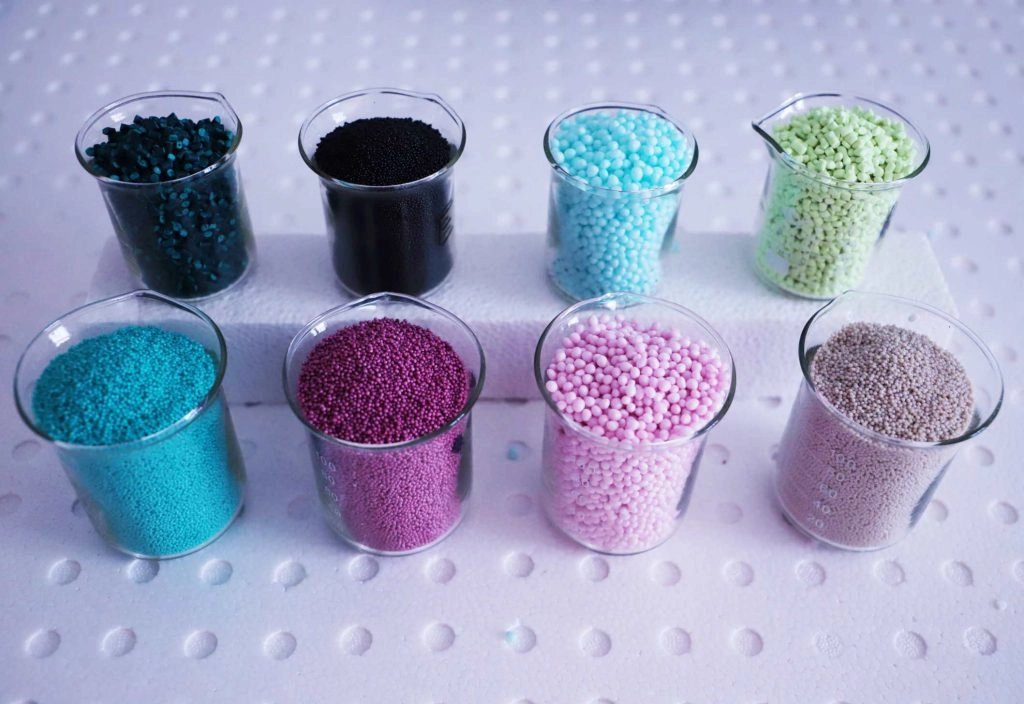
 Expanded polystyrene (EPS) foam is often treated as a low-complexity packaging or insulation material. In practice, its behavior is governed by polymer chemistry, gas diffusion kinetics, bead fusion mechanics, and long-term structural relaxation. These variables define whether a molded part remains dimensionally stable, whether a panel reaches its target thermal resistance, and whether flame-retardant grades perform consistently after aging.
If you work with EPS in packaging systems, building envelopes, or industrial components, you are not selecting a generic foam. You are selecting a micro-engineered cellular solid whose properties depend on how molecular chains are formed, how beads expand, and how cell walls bond during molding.
To evaluate EPS scientifically, it is necessary to examine its internal composition and structure before judging surface appearance or density labels.
What is EPS foam made of at the molecular level?
Polymer backbone
EPS is based on polystyrene chains created through suspension or extrusion polymerization. Molecular weight distribution affects melt viscosity, bead expansion control, and final compressive response. Higher molecular weight improves mechanical stability but narrows the processing window during foaming.
Blowing agent system
Physical blowing agents embedded in raw beads vaporize during pre-expansion, generating closed cells. Gas type and diffusion rate influence cell size, internal pressure balance, and early-stage shrinkage after molding.
Additives and modifiers
Industrial EPS rarely uses pure polystyrene. Flame-retardant compounds, graphite, carbon black, antistatic agents, and color masterbatches are introduced to modify combustion behavior, thermal radiation transfer, surface resistivity, and visual consistency.
Once the chemical composition is clear, the next question is how this formulation becomes a load-bearing cellular structure.
How does the cellular structure form during foaming?
Pre-expansion
Raw beads absorb steam, soften, and expand up to 40–100 times their original volume. Expansion ratio determines initial density and influences later fusion behavior.
Cell nucleation
Gas pressure creates thousands of microcells inside each bead. Uniform nucleation leads to predictable compressive paths and thermal insulation behavior, while irregular nucleation produces weak zones that degrade impact resistance.
Fusion bonding
During molding, softened beads weld together through polymer chain diffusion. Poor fusion creates inter-bead voids that weaken structural continuity and increase thermal bridges.
Materials optimized for rapid fusion and short curing cycles, such as B-rapid prototyping grade material, are engineered around uniform bead size, high bead fluidity, fast demolding behavior, and stable expansion ratios. These parameters directly reflect how microstructure evolves under automated molding conditions.

Why do microstructural differences lead to large performance gaps?
Compression
Load transfer occurs through cell walls and bead interfaces. Smaller, evenly distributed cells form more parallel stress paths, increasing compressive strength without raising density.
Heat transfer
Thermal conductivity is governed by gas conduction inside cells, polymer conduction through walls, and infrared radiation across cavities. Structural irregularities increase radiative loss and degrade insulation stability.
Dimensional stability
Residual internal gas pressure relaxes over weeks. Beads with poor curing balance or uneven fusion exhibit post-molding shrinkage, which is often wrongly attributed to density rather than structure.
Once you recognize how structure defines performance, supplier-level process control becomes decisive.
Who develops EPS materials with scientific process control?
Among large-scale EPS manufacturers, HUASHENG positions its development model around material engineering rather than short-term output volume. Our company specializes in expandable polystyrene systems spanning common grades, flame-retardant grades, graphite grades, carbon black grades, environmental protection grades, and fully customized material systems.
Our production system focuses on bead size control, expansion ratio predictability, compressive strength consistency, and thermal performance verification across batches. Intelligent production lines and precision testing platforms are used to regulate foaming behavior and fusion quality in high-cycle industrial molding environments.
Beyond conventional EPS, the company invests heavily in recycled EPS (REPS) engineering, closed-loop manufacturing systems, and nano-scale pore structure research. Digital twin laboratories, material gene databases, and process simulation platforms guide formulation design and parameter selection. These facilities contribute to developing new materials better used in those applications, such as construction, cold-chain logistics, decorative building materials, food industry, and seismic packaging, while reducing lifecycle energy consumption and material loss.
This combination of structural engineering and sustainable manufacturing allows material behavior to remain predictable under real operating conditions rather than laboratory assumptions.
Flame-retardant chemistry provides a clear example of how formulation reshapes structure and processing.
How do flame-retardant systems change EPS behavior?
Combustion mechanism
Flame-retardant additives alter the thermal degradation pathway of polystyrene. Instead of rapid chain scission and melt dripping, modified systems promote char formation and suppress flammable gas release.
Aging stability
Freshly molded flame-retardant EPS often contains residual blowing agent. Controlled aging allows internal pressure to stabilize, which is essential for achieving consistent B1 or B2 combustion ratings and dimensional stability.
Construction-oriented materials, taking FSH-European standard flame-retardant grade material as an example, are designed to reach B1 performance faster, deliver compressive strength more than 20% higher than conventional grades, and maintain stable fusion quality in plate-forming equipment. This illustrates how flame-retardant chemistry reshapes both microstructure and molding dynamics.

What are the most common misconceptions about EPS’s basic properties?
Density equals quality?
Density only describes mass per volume. Two foams at 20 kg/m³ can differ by more than 30% in compressive strength due to bead fusion quality and cell geometry.
Do all EPS behave the same?
Grades vary widely in molecular weight, blowing agent system, bead size, flame-retardant chemistry, and aging profile. Treating EPS as a uniform material leads to unstable performance in critical applications.
Soft foam means weak foam?
Elastic recovery and energy absorption depend on cell wall architecture, not surface hardness. Properly fused low-density foam can outperform dense material with poor bonding.
Once these assumptions are removed, selection becomes a technical process.
How should you evaluate EPS material for technical applications?
Structural indicators
Review bead diameter distribution, fusion continuity, closed-cell ratio, and post-molding shrinkage behavior.
Processing indicators
Assess curing time, demolding stability, steam penetration efficiency, and tolerance to molding pressure fluctuations.
Performance indicators
Verify compressive strength retention after aging, thermal conductivity drift over time, and flame-retardant durability under humidity and temperature cycling.
These parameters determine whether EPS functions as a structural engineering material or remains a short-term filler.
Conclusion
Composition shapes structure, and structure governs performance.
EPS foam is not defined by its white appearance or low density. It is defined by polymer chain design, gas-solid interactions during foaming, bead fusion physics, and long-term structural relaxation. When you evaluate EPS through this lens, material selection shifts from habit to engineering logic. Thermal efficiency, mechanical reliability, fire safety, and sustainability become predictable outcomes rather than variables discovered after installation or shipment.
FAQs
Q1: Does bead size measurably affect EPS strength?
A: Yes. Uniform bead diameter improves fusion continuity and stress distribution, which directly increases compressive stability and reduces long-term deformation.
Q2: Why does curing time influence flame-retardant performance?
A: Residual blowing agents alter internal pressure and combustion behavior. Proper aging stabilizes cell structure and allows flame-retardant systems to perform consistently.
Q3: Can recycled EPS reach the same structural reliability as virgin material?
A: With controlled particle grading and modern process regulation, REPS systems can achieve comparable fusion quality and mechanical stability while lowering environmental impact.
 English
  German
  Spanish
  French
  Arabic